Novi Sad Travel Guide for EXIT Festival (2026 Update)

Last reviewed: 21 October 2026. The most important thing to know before planning an EXIT Festival trip to Novi Sad is that there is no traditional EXIT edition at Petrovaradin Fortress in 2026. EXIT’s organisers announced a Global Tour instead. The fortress is still open as a historic attraction, but a trip to Novi Sad this year is a city break, not a ticketed EXIT weekend. See the EXIT Global Tour’s official programme before booking travel around a future music event.
This Novi Sad travel guide for EXIT Festival fans helps you enjoy the festival’s historic home without relying on outdated stage maps, ticket offers, accommodation assumptions or rail instructions. It covers Petrovaradin Fortress, the practical route from Belgrade, the best areas to stay, the city’s cultural highlights, realistic spending, and a two- or three-day itinerary. It also explains how to evaluate any future EXIT announcement without implying that a new Novi Sad edition is confirmed.
Novi Sad is a worthwhile destination in its own right. The pedestrianised centre, Danube waterfront, fortress viewpoints, independent galleries and nearby Fruška Gora vineyards offer a completely different pace from Belgrade. Most central sightseeing is walkable, but train-station changes in October 2026 make your arrival plan just as important as your list of attractions.
Table of Contents
Quick Answer: EXIT Festival and Novi Sad in 2026
| Planning question | Practical answer in October 2026 |
|---|---|
| Is EXIT taking place at Petrovaradin Fortress in 2026? | No. The organisers have announced the EXIT 2026 Global Tour instead of the usual Novi Sad festival. |
| Can you still explore the fortress? | Yes. The upper fortress, clock-tower viewpoints and Lower Town are sightseeing attractions outside festival events; specific indoor spaces have separate access rules. |
| Best base for a first visit | The historic centre around Liberty Square and Dunavska Street. |
| How long should you stay? | One full day for the centre and fortress; two nights for a relaxed first visit; three nights if adding a day trip. |
| Best travel route from Belgrade | Check a Srbija Voz train to the correct Novi Sad-area station, or take a long-distance bus. The historic main station is not the normal passenger arrival point. |
| Do you need a car? | Not for Novi Sad’s core sights. A car or organised tour may help with dispersed Fruška Gora stops. |
| What if EXIT returns in a later year? | Wait for the organiser to confirm the city, venue, dates, tickets and visitor rules before booking non-refundable arrangements. |
Important distinction: The EXIT Global Tour has included several destinations outside Novi Sad. That does not mean the historic fortress festival has relocated permanently to one of those destinations, nor does it establish a return date. The organiser’s October 2025 announcement is the primary source for this change. For background on other local events, see our overview of Novi Sad festivals, but verify each event’s dates with its organiser, particularly older EXIT descriptions.
Why EXIT Fans Should Still Visit Novi Sad
EXIT began as a student-led initiative in 2000 and developed into a major festival known internationally for its performances inside Petrovaradin Fortress. The setting mattered: instead of a flat outdoor field, visitors moved between stages in courtyards, passageways and defensive structures above the Danube. The event’s history is closely linked to the city, even in a year when its flagship gathering is not staged there.
Visiting Petrovaradin without a festival crowd reveals details that are difficult to appreciate during a late-night concert. You can study the stone ramparts, look back across the Danube to Novi Sad, visit the artists’ colony, and see how the historic Lower Town connects with the upper fortification. The Novi Sad Tourism Organisation’s fortress overview describes the complex’s military architecture and its modern use as a cultural district.
There is a second benefit: the city offers an experience beyond its music identity. A café morning on Zmaj Jovina Street, a gentle walk through Dunavski Park, a late lunch featuring Vojvodina food and an evening across the bridge create a satisfying trip without expensive tickets. Treat Novi Sad as a destination rather than a venue you pass through between concerts.
How Many Days Do You Need in Novi Sad?
One day works for the central pedestrian streets and a visit to the fortress, particularly when staying in Belgrade. However, you will need to check your return rail stop before setting off and resist adding a countryside excursion.
Two days with one or two nights is the more comfortable choice for first-timers. Give one day to the old centre and river, then take a slower half-day around Petrovaradin. With that pacing you can fit a museum or gallery without rushing every café stop.
Three days lets you add Sremski Karlovci or the Fruška Gora area. These trips are not the same: Sremski Karlovci is a relatively compact town with heritage buildings and wine cellars; Fruška Gora covers a much wider area of forest, trails, monasteries and rural stops. Choose according to your interests and mobility.
| Time available | What genuinely fits | What to leave out |
|---|---|---|
| 5–7 sightseeing hours | Liberty Square, Dunavska Street, Danube views, Petrovaradin viewpoint | Underground galleries and rural excursions unless prearranged |
| 2 days | Centre, museum or gallery, fortress, Lower Town, relaxed evenings | A packed winery-and-hiking circuit |
| 3 days | Two city days plus Sremski Karlovci or selected Fruška Gora stops | An attempt to visit every monastery and winery |
| Longer stay | Additional museums, markets, river activities and rural Vojvodina | Treating unconfirmed festival dates as fixed |
How to Get to Novi Sad in October 2026
The train-station situation is the biggest practical update to older Novi Sad guides. The city’s original main railway-station building is not the routine arrival point for Belgrade trains. An alternative stop called TPS Novi Sad, on Rumenački put, began receiving passengers in October 2026, with a revised service pattern effective 12 October. Srbija Voz subsequently announced additional stops at Petrovaradin from 19 October for relevant services.
This matters because TPS Novi Sad and Petrovaradin are different places, on opposite sides of the Danube, and neither is identical to the old central station. Read the precise station on your reservation. The official operator’s 12 October service-change notice and 19 October additional-stop announcement should take precedence over a dated travel-blog screenshot.
Belgrade to Novi Sad by train
Start with the official Srbija Voz website or ticket app and search for Beograd Centar as your departure station. Then compare available arrival stops and departures on your actual travel date. Soko/InterCity services can be quick, but a fast rail journey is not the same as arriving at Liberty Square: you still need to connect from the station to the old centre.
At TPS Novi Sad, the city’s October information identifies the stop near Rumenački put, with connections including bus lines 4, 5, 14, 41, 42 and 43 in the surrounding area. The appropriate stop and direction depend on your accommodation, so check the operator’s current route planner or ask locally. At Petrovaradin, a different city-bus or taxi journey may be needed. Do not count on a free shuttle mentioned in guides written before the October changes.
The train’s final booking screen controls the fare, ticket conditions and departure time. If you want a detailed walkthrough of the newest station arrangements, use our Belgrade to Novi Sad train guide and then confirm any post-publication changes with Srbija Voz.
Belgrade to Novi Sad by bus
A direct intercity bus can be a sensible alternative if its departure station is more convenient, your train choice has an awkward arrival stop, or you have bulky luggage. Expect a longer journey than the fastest train and allow for road traffic. Verify the exact Belgrade departure terminal: assumptions about the historic bus station can be wrong after infrastructure changes.
You will generally arrive at Novi Sad’s intercity bus area rather than directly at the pedestrian centre. Check whether your ticket specifies the main bus station, a roadside stop or another operator’s pickup point. From there, use a licensed taxi, local bus or a walk suited to your luggage and weather.
From Belgrade Nikola Tesla Airport
Belgrade Airport is the most relevant international gateway for Novi Sad. There is no reason to fly into another country simply because an old festival package mentioned a particular transfer. The main choices are to travel into Belgrade and take the train or bus, or arrange a direct road transfer if your arrival is late or the group can share the cost.
A direct transfer can simplify a late-night arrival, but compare its total cost with an airport connection plus onward public transport. If using separate bookings, build in time for border formalities where relevant, baggage reclaim, traffic and a missed connection; none of those are included in the train’s advertised running time.
Which arrival option should you choose?
| Arrival choice | Strongest reason to use it | Important check |
|---|---|---|
| Soko or other train | Fast intercity journey from Belgrade | Exact Novi Sad-area stop and local connection |
| Intercity bus | Useful schedule or easier departure location | Bus terminal, traffic and luggage rules |
| Direct airport transfer | Luggage, late arrival or several passengers | Written total fare, pickup location and cancellation terms |
| Rental car | Continuing to wineries, monasteries or other Serbian regions | Parking, driving conditions and where you will actually use the car |
Visiting Petrovaradin Fortress Without a Festival Ticket
Petrovaradin Fortress sits above the Danube on the side opposite central Novi Sad. Built largely from 1692 to 1780, it is an extensive historic complex, not a single entrance building. Its open exterior spaces are what make the first visit rewarding, but individual museums, galleries and guided underground sections have their own arrangements. No EXIT ticket is needed merely to visit the publicly accessible sightseeing areas outside an event.
Walking to the fortress from the city centre
A pleasant approach starts in the old centre, heads toward the river and crosses Varadin Bridge into Petrovaradin before climbing toward the upper fortress. Depending on your starting point and pace, allow roughly 35–55 minutes from the central pedestrian area to the principal upper viewpoints, including the uphill section. This is a planning estimate, not a timed transport service.
Stone surfaces, steps, exposed paths and summer heat can make the ascent more demanding than it looks on a map. Bring water, wear comfortable shoes and keep the uphill walk for a cooler part of the day in July or August. A taxi toward the upper area may be better for some visitors, although vehicles cannot remove every uneven walking section.
Accessibility note: The fortress’s historic terrain is not uniformly step-free. Visitors with limited mobility should contact the museum or tourism office about accessible entrances and ground-floor exhibits rather than relying on a general claim that the entire complex is accessible.
The Clock Tower and upper fortress views
The best-known landmark is the Petrovaradin Clock Tower, often nicknamed the Drunken Clock. Its unusual design gives the larger hand to the hours and the smaller hand to the minutes. From the adjacent terrace you can see the Danube, the bridge, the old centre and the broad shape of the fortress itself.
The viewpoint is most attractive when you leave time to look around rather than immediately turning back. Late afternoon often gives pleasant light, but the ideal photography angle varies with weather and time of year. Keep a respectful distance from unprotected edges, especially after rain or when travelling with children.
The Lower Town: Gradić
Do not overlook Gradić, the Baroque Lower Town beneath the fortifications. Its historic buildings and narrow streets create a very different atmosphere from the upper ramparts. It also helps explain how soldiers and civilians lived around the fortress rather than treating the whole site as a former concert venue.
The official tourism description of Petrovaradin identifies the Lower Town as a historic district in its own right. If you have limited time, combine a walk through these streets with the Clock Tower viewpoint rather than adding a distant museum that requires a separate transfer.
City Museum and underground military galleries
The City Museum of Novi Sad has exhibition spaces at Petrovaradin. You may be able to see collections documenting the fortress and the city’s history; confirm the specific exhibits and opening day rather than assuming every gallery is open. The underground military galleries form a defensive system of around 16 kilometres in total, but only a guided visitor section of approximately one kilometre is normally accessible.
Do not attempt independent tunnel exploration. The city tourism authority says the underground visit is organised through the museum’s guiding service. Check the official gallery information, and ask about timing, language, age restrictions and footwear before making the tunnel visit the centrepiece of your day. Guided access may require advance coordination.
The artists’ colony and workshops
Petrovaradin is also associated with artist studios and cultural workspaces. Not every working studio is a public museum. If a door is open or a tour mentions a workshop, check whether visitors are welcome before entering. This is a more rewarding and respectful way to explore the fortress’s creative life than assuming every courtyard is part of a festival circuit.
How long should you allow?
| Fortress stop | Sensible planning allowance | Access note |
|---|---|---|
| Clock Tower and upper terraces | 45–75 minutes | Exterior viewpoint; weather and site controls matter |
| Lower Town and climb | 45–90 minutes | Walking terrain and photography add time |
| City Museum | 45–90 minutes | Check opening hours, tickets and current exhibitions |
| Underground galleries | Tour-dependent | Guided access only; contact museum in advance |
| Full fortress-focused visit | About 3–5 hours | Includes walking breaks and one cultural stop |
What the Traditional EXIT Festival Experience Was Like
The festival’s usual home gave EXIT a distinctive identity. Its stages historically occupied different zones of the fortress rather than a single purpose-built venue, which meant an evening involved significant walking. Stone paving, slopes, stairs and narrow passageways were practical challenges as much as atmospheric details. Music continued late into the night during past editions, so accommodation close to the river and central transport connections often mattered more than luxury facilities.
These details are historical context, not descriptions of a confirmed festival in Novi Sad in 2026. Never publish a former lineup, entrance map, re-entry policy, campsite location or ticket price as if it applies to an unannounced future edition. If EXIT returns to Petrovaradin, the organiser may change almost every operational detail.
Booking checklist for any future EXIT announcement
- Confirm the year, venue and dates on EXIT’s official website, not a third-party hotel advertisement.
- Check the official ticket seller, ticket types and refund terms before paying.
- Identify the precise entrance area and nightly transport arrangements once the organiser publishes them.
- Choose accommodation with realistic late-night walking or taxi access; a short straight-line map distance does not guarantee an easy route.
- Check age limits, ID, prohibited items, cashless payment, water and re-entry policies for that edition.
- Book refundable accommodation if key details are still pending. Do not interpret a general summer festival calendar as an EXIT confirmation.
The 2026 situation shows why this distinction matters. You can enjoy the historic setting now while keeping any future concert trip dependent on an actual announcement.
Best Areas to Stay in Novi Sad
For a first-time non-festival visit, neighbourhood choice should reduce commuting and support the way you actually spend evenings. Because there is no traditional 2026 Petrovaradin EXIT event, choose a base for sightseeing rather than paying extra purely for hypothetical gate proximity.
Old Town / Stari Grad — best overall
The historic centre near Trg slobode (Liberty Square), Zmaj Jovina Street and Dunavska Street is the most convenient all-round base. Restaurants, galleries, cafés, shopping and evening walks are accessible without a car. You can begin the fortress walk from here, although the full climb still takes time.
The main trade-offs are street noise in busy locations and less straightforward parking. Read recent property reviews for comments on noise and access. If you are on a short visit and arriving by public transport, proximity to the pedestrian streets is typically more useful than a large but remote apartment.
Liman — residential atmosphere and river access
Parts of Liman suit visitors who want a quieter, more residential stay with access to riverside walking and green spaces. However, different parts of this broad neighbourhood are not equally close to Liberty Square, so check the exact address before booking. A property advertised as “near the Danube” may still be some distance from Petrovaradin.
Liman can be particularly practical for families or travellers who want to mix sightseeing with park time. It is not necessarily the best base for someone who wants to walk home from late-night activity near the fortress without any transport.
Petrovaradin — for the historic fortress side
Staying on the Petrovaradin side offers a different character: historic streets, quieter pockets and a short route to some fortress entrances. Accommodation choices can be more limited than in central Novi Sad, and the best option depends on how often you plan to cross the Danube for dinner or museums.
Do not assume Petrovaradin is automatically cheaper or closer to every possible festival gate. A future festival could use different access controls from earlier years. Book for the trip you are taking, not for an event that has not been announced.
| Area | Best for | Watch out for |
|---|---|---|
| Historic centre / Stari Grad | First visit, cafés, museums, most sightseeing | Evening noise, limited parking |
| Liman | Parks, residential atmosphere, relaxed stays | Location within the neighbourhood varies |
| Petrovaradin | Fortress-focused visit, historical ambience | Fewer accommodation choices; river crossing for city evenings |
| Farther-out neighbourhoods | Potentially larger rooms or lower rates | Public transport and taxi costs reduce savings |
Hotel, apartment or hostel?
A hotel works well for a short visit where luggage storage and simple check-in matter. An apartment may be better for groups staying several nights, although parking and key collection should be checked carefully. A hostel suits solo travellers who want a social experience and can accept shared facilities. None is automatically the cheapest on every date.
Compare the final total, not just the headline nightly rate: cleaning charges, local taxes, cancellation restrictions, deposit policies, breakfast and transport can change the value of an offer. Any accommodation booked for an unannounced future festival should ideally have a flexible cancellation policy.
Exploring Novi Sad Beyond Petrovaradin
A good Novi Sad itinerary is not a sequence of landmarks separated by taxi rides. The most rewarding first-day walk links the centre to the river, with enough time for markets, cafés and a slower afternoon.
Liberty Square and the historic centre
Start at Trg slobode, the principal civic square. The Church of the Name of Mary, the Town Hall and surrounding façades make it a practical place to orient yourself. Continue along pedestrian Zmaj Jovina Street to see cafés, bookshops and the rhythm of daily life. The centre is manageable on foot, but allow time to go inside any museum or church rather than scheduling only photographs.
This is also where you can get a feel for Novi Sad’s Vojvodina character: its architecture and food reflect centuries of different Central European and Balkan influences. A morning stroll here provides a useful contrast with Belgrade. For a longer Serbian city route, see our first-time Belgrade itinerary.
Dunavska Street and Dunavski Park
Follow Dunavska Street toward Dunavski Park, an easy and attractive transition away from the liveliest pedestrian core. This makes a good coffee or snack break, especially on a warm day. The park is not an all-day attraction; pair it with nearby museums or the river depending on your available time.
The Danube waterfront and Štrand
The Danube helps define Novi Sad’s atmosphere as much as the fortress. A walk beside the water gives you views toward Petrovaradin and a sense of how the city relates to the river. In the warmer season, Štrand is a popular urban beach and recreation area. Swimming or other water activities should depend on local rules, conditions and lifeguard information; a pleasant-looking river should not be treated as automatically safe for swimming.
Museums and galleries worth considering
Choose one cultural visit rather than trying to fit several into an already full day. Options include the Museum of Vojvodina, Gallery of Matica Srpska and the City Museum at Petrovaradin. Collections and temporary exhibitions change, so check official opening information for the date that you will visit. If history is your priority, the fortress museum is a natural fit; if art is the priority, start with the central galleries and plan the fortress separately.
What to eat in Novi Sad
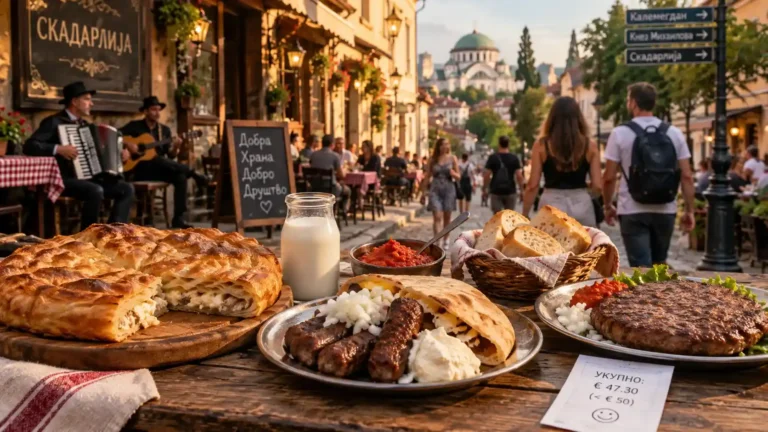
Novi Sad’s food scene is a good introduction to Vojvodina cuisine, shaped by Serbian, Hungarian and broader Central European traditions. Look for hearty soups, stews, baked dishes, pastries and regional cheeses, alongside contemporary cafés and international options. A bakery breakfast and an unhurried local lunch can fit the day better than travelling far for one restaurant.
If you are comparing restaurant prices, read the displayed menu and ask about service charges before ordering. Tipping is optional, not a compulsory fee. Cash in Serbian dinars is useful for smaller purchases even though cards are common in many central businesses.
Sremski Karlovci: An Easy Cultural Day Trip
Sremski Karlovci is a small historic town southeast of Novi Sad, known for its religious and educational heritage as well as winemaking. Its sights include the Patriarchal Palace, historic school buildings, churches, the Four Lions Fountain and the Chapel of Peace, associated with the Treaty of Karlowitz in 1699. The Novi Sad Tourism Organisation’s guide gives useful background and local visitor contacts.
For a first visit, set aside a half-day for the central streets and a relaxed meal; allow longer if arranging a winery visit. Public transport can make the trip possible without a car, but confirm current service routes and departures with the local bus operator. Some wineries require advance appointments rather than accommodating walk-ins at any hour.
If you plan a tasting, use public transport, a taxi or a guided trip so nobody needs to drive after drinking. You can also enjoy the town’s architecture, cafés and pastry shops without choosing a wine experience at all.
Fruška Gora: Nature, Monasteries and Countryside
Fruška Gora National Park is the larger nature option outside Novi Sad. It has forested hills, walking routes, picnic areas, monasteries and scattered villages and vineyards. This is a region, not a single lookout that can be added for thirty minutes at the end of a city day.
Pick one kind of outing for a first visit. A short forest walk works for travellers seeking nature; a monastery-focused route suits visitors interested in heritage; a guided winery experience works for those prioritising tasting and local food. Road travel, trail conditions and the distance between stops determine whether you need a vehicle.
The tourist board publishes suggestions for local-bus excursions and picnic routes. These are helpful starting points, but route numbers and departure patterns should be checked again before relying on them. Do not treat a bus serving a town on the park’s edge as transport to every trailhead.
Sremski Karlovci or Fruška Gora?
| Choose | If you want | Main planning challenge |
|---|---|---|
| Sremski Karlovci | Heritage streets, cafés, wine culture, a relaxed half-day | Winery booking and current bus times |
| Fruška Gora | Walks, viewpoints, monasteries, nature | Spread-out locations and onward local transport |
| Both on one day | A small taste of each, using a car or tour | Less time at individual stops and more road travel |
For a longer Serbia route including Novi Sad, western landscapes and Belgrade, the 7-day Serbia road trip itinerary shows how to allocate genuine travel days rather than adding nature stops to an already full afternoon.
A Realistic Three-Day Novi Sad Itinerary for EXIT Fans
Use this programme without assuming that a festival takes place. Travellers with only one day can combine the first two days’ highlights and leave out most museums. Days can be rearranged around opening times, weather and your actual arrival station.
Day 1: Historic Novi Sad and the Danube
| Time window | Plan | Why this order works |
|---|---|---|
| Morning | Liberty Square, Zmaj Jovina Street, café breakfast | Keeps the first stops close together |
| Late morning | Dunavska Street, Dunavski Park | Continues through the walkable centre |
| Lunch | Choose a restaurant or bakery near the centre | Avoids unnecessary cross-city transport |
| Afternoon | One museum or gallery, then Danube waterfront | Flexible according to opening hours |
| Evening | Dinner and a relaxed central walk | No long transfer after a full sightseeing day |
If you arrive only in the afternoon, skip the museum rather than racing around before closing. Novi Sad is a stronger experience when you allow time to enjoy streets and river views, not only scheduled entries.
Day 2: Petrovaradin Fortress and Lower Town
Begin with the walk over the Danube into Petrovaradin. Explore Gradić, then climb to the upper fortress for the Clock Tower and viewpoints. Allow a lunch or coffee break on the fortress side; choose a museum or guided underground tour if you have confirmed the time in advance. Return to Novi Sad for the evening.
If temperatures are high, visit the exposed upper fortress earlier in the day. If it rains, focus on a booked indoor museum and postpone the viewpoints. Avoid adding a far-off nature excursion to Day 2: walking around the fortifications can be surprisingly tiring.
Day 3: Sremski Karlovci or Fruška Gora
Take a slow breakfast before leaving the city. For a culture-led day, visit Sremski Karlovci’s compact centre and arrange an optional tasting. For an outdoors-focused day, choose one accessible part of Fruška Gora and give yourself adequate time to return. Both are excellent additions, but each deserves its own transport plan.
If leaving from Novi Sad by train in the afternoon, leave generous time to reach the actual departure station. Do not end a countryside trip immediately before a non-refundable rail or airport connection.
Practical Costs and Budget Planning
Serbia uses the Serbian dinar (RSD). Exact prices for hotels, transport, attractions and meals change frequently, so a fabricated fixed daily total would be less useful than a breakdown you can check against your own dates.
| Expense | Budget strategy | What to verify |
|---|---|---|
| Accommodation | Check central guesthouses, hostels and apartments; compare total stay cost | Taxes, cleaning, cancellation and event demand |
| Meals | Mix bakeries, casual local lunch spots and an occasional restaurant dinner | Posted menu prices and optional service charges |
| Central sightseeing | Walk most routes; choose one paid museum | Actual museum opening and entrance charge |
| Fortress | Enjoy accessible exterior views; book galleries separately if interested | Tour availability and whether advance notice is needed |
| Train or bus | Compare operator departures for the exact date | Ticket station, fare, luggage and local transfer |
| Day trip | Use local transit where it reaches your destination | Last return service and distance to trailhead or winery |
The main money-saving decision is where you stay: a cheaper outlying room may cost more overall if you use taxis every evening. The next important decision is avoiding non-refundable reservations based on an EXIT edition that has not been confirmed.
Travel insurance note: If your trip includes hiking, cycling, concerts or other activities, check what your policy covers and what it excludes. Do not assume the cheapest package automatically covers every outdoor activity or ticket disruption.
Getting Around, Internet and Everyday Essentials
For the centre, walking is normally best. You will spend more time in pedestrian streets and parks and less time parking or waiting for a short ride. Use city buses for station transfers and outer neighbourhoods, and taxis when travelling with luggage or returning from somewhere less well served. Check the fare or app estimate before starting a taxi ride.
Carry some cash in dinars for small purchases and keep your payment card secure. Most visitors can rely on mobile maps for the centre, but download a map of Novi Sad and the surrounding area before travel because mobile roaming charges depend on your home plan. Serbia is not automatically included in every EU-only roaming package. If buying an eSIM, verify country coverage and whether it supports data only or also calls.
Summer can be hot, especially on stone surfaces around Petrovaradin, while evenings and riverfront walks can become cooler or windy. Pack suitable walking shoes, water, sun protection, a light layer and medication you may need. In colder months, allow for shorter daylight and potentially slippery paths at the fortress.
For official orientation, maps and visitor help, the Novi Sad Tourism Organisation lists a tourist information office in the historic centre at Trg slobode 3. Its online listings may also show operating hours and event notices; check them close to your visit.
Common Planning Mistakes in 2026
- Assuming an EXIT ticket exists for Novi Sad in 2026. It does not; the official programme is a Global Tour.
- Buying a rail ticket to the wrong station. TPS Novi Sad, Petrovaradin and the old main station are not interchangeable.
- Using an old free-shuttle guide. Check the current local-bus connection instead of assuming historic arrangements continue.
- Treating Petrovaradin as a 15-minute stop. The climb, Lower Town and upper viewpoints deserve time.
- Assuming you can enter the underground tunnels unaccompanied. Visitors need organised guided access.
- Renting a car for central sightseeing. Parking often adds complexity without saving time.
- Adding all of Fruška Gora to a half-day city visit. Choose a single reachable activity.
- Booking festival accommodation before confirmed dates. Prioritise refundable reservations if future plans depend on EXIT returning.
- Assuming every rural winery accepts walk-ins. Check appointments and transport arrangements.
- Forgetting the departure journey. When using the train, confirm the exact station and allow an onward-transfer buffer.
Questions First-Time Visitors Ask
Is EXIT Festival happening in Novi Sad in 2026?
No traditional EXIT edition is scheduled at Petrovaradin Fortress in 2026. The organiser instead announced a Global Tour. Check the official EXIT programme for current and upcoming events, rather than relying on older Novi Sad dates.
Can I visit the fortress without a festival?
Yes. Publicly accessible exterior areas of Petrovaradin Fortress can be visited as part of a normal sightseeing trip. Museums, individual galleries and underground tunnels have separate access rules and may require a ticket or a guide.
Is it better to stay in Novi Sad or visit from Belgrade?
A day trip from Belgrade works if your main goals are the old centre and fortress viewpoint. Stay a night or two if you prefer slow evenings, museums, a proper fortress visit or a day trip to Sremski Karlovci or Fruška Gora.
Which Novi Sad train station should I use?
It depends on the specific service. October 2026 changes introduced regular use of TPS Novi Sad, while additional Petrovaradin stops resumed on selected services. Check the station printed on your actual ticket and arrange the local connection before travelling.
How much time should I allow at Petrovaradin?
Allow about half a day for the Lower Town, climb, upper viewpoints and one optional museum. A quick visit is possible, but it leaves out much of the fortress’s historic context.
Is Novi Sad suitable without a car?
Yes for most city sightseeing. The historic centre is compact and the fortress is reachable by walking or local transport. A car is only helpful when you are combining several widely spaced countryside locations.
Is Sremski Karlovci better than Fruška Gora for a short trip?
Sremski Karlovci generally fits a straightforward cultural half-day more easily. Fruška Gora is stronger for nature, monasteries and walking, but its attractions are more widely dispersed. Choose according to the actual transport you have.
Is a future EXIT edition at Petrovaradin confirmed?
Do not treat past annual patterns as confirmation. Wait for an official future announcement naming the year, dates, venue and ticketing details before making non-refundable arrangements.
Final Thoughts: Novi Sad Is More Than Its Festival
The 2026 EXIT change matters, and pretending otherwise would mislead travellers. There is no traditional Novi Sad edition at Petrovaradin Fortress this year, and rail arrivals have also changed during October. Both facts should shape your planning.
But Novi Sad remains an excellent trip for EXIT fans. You can understand the music festival’s unusual historic home, explore the Old Town and Danube, and spend another day in Sremski Karlovci or Fruška Gora. Choose a central base, check the correct arrival and departure stations, and give Petrovaradin the time its architecture deserves.
If your broader trip continues through Serbia, our Balkans itinerary by train and Serbia, Bosnia and Montenegro itinerary can help connect Novi Sad to a realistic onward route. For future festivals, keep the planning principle simple: verify the event first, then book the journey.