
7-day budget Balkans itinerary Bosnia Montenegro

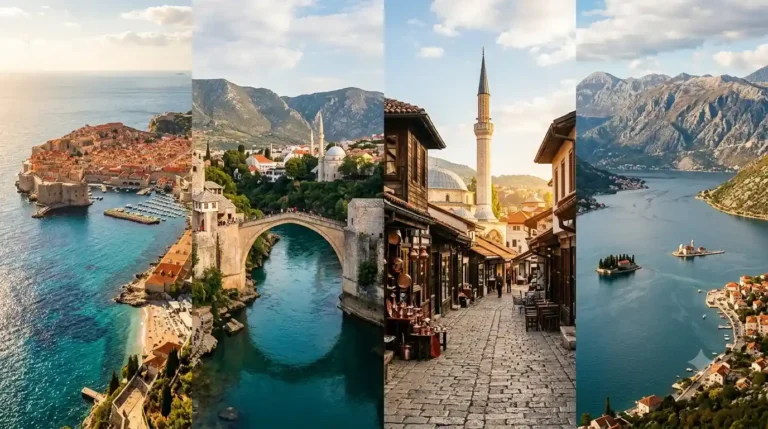
The Balkans remain one of Europe’s best-kept secrets, offering a mesmerizing blend of Ottoman history, rugged mountain peaks, and turquoise coastal waters—all without the staggering price tags of Western Europe. If you are looking for an adventure that balances culture, nature, and affordability, this 7-day budget Balkans itinerary focusing on Bosnia and Montenegro is your perfect roadmap.
From the cobblestone streets of Sarajevo to the breathtaking fjords of Kotor, this guide will show you how to navigate two of the region’s most captivating countries on a backpacker’s budget.
Table of Contents
Why Choose Bosnia and Montenegro for a Budget Trip?
When travelers think of the Balkans, Croatia often steals the spotlight. However, Bosnia & Herzegovina and Montenegro offer a more authentic, raw experience for a fraction of the cost.
- Affordability: You can easily find hearty meals for $5–$8 and comfortable hostel beds or guesthouses for $15–$25.
- Diverse Landscapes: In one week, you can transition from the “Jerusalem of Europe” (Sarajevo) to the dramatic Black Mountains of Montenegro.
- Ease of Travel: While trains are limited, an extensive (and cheap) bus network connects major hubs like Mostar and Kotor.
Understanding Your 7-Day Budget Balkans Itinerary
This itinerary is designed to maximize your time while keeping costs low. It follows a logical geographic route, starting in the historic heart of Bosnia and ending on the stunning Montenegrin coast.
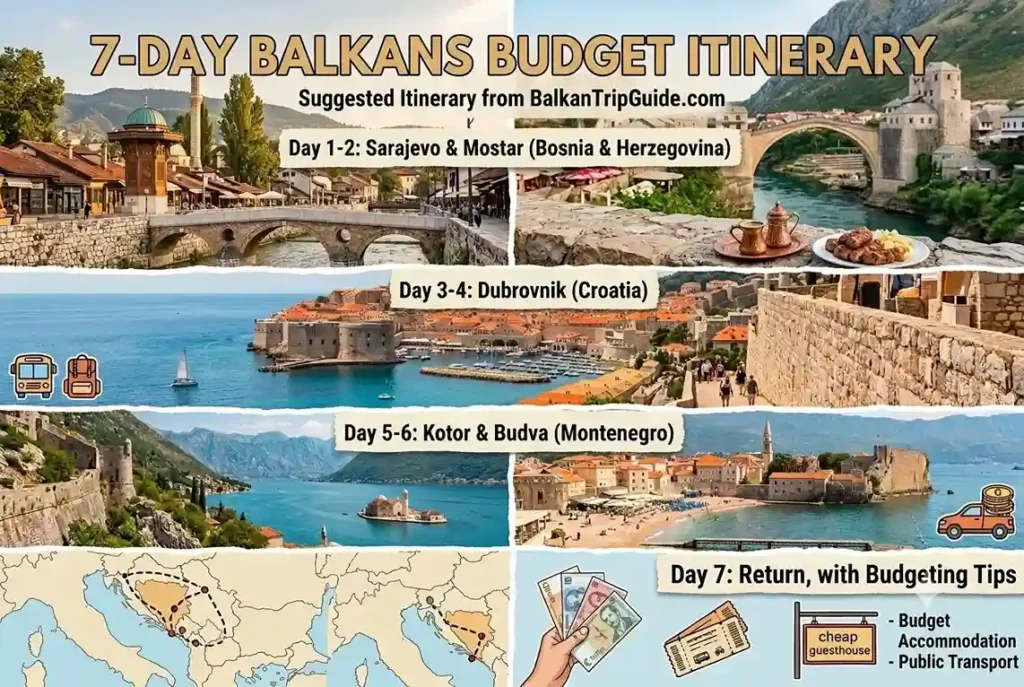
Route Overview:
- Days 1-2: Sarajevo, Bosnia & Herzegovina
- Day 3: Mostar, Bosnia & Herzegovina
- Day 4: Journey to Montenegro (Durmitor National Park or Podgorica)
- Days 5-7: Kotor and the Adriatic Coast
Day 1: Arriving in Sarajevo – The Soul of the Balkans
Sarajevo is a city that stays with you long after you leave. It is a place where East meets West, where minarets and church spires share the same skyline.
Morning: Step Back in Time in Baščaršija
Start your 7-day budget Balkans itinerary in the Old Bazaar, Baščaršija. This Ottoman-era market is the cultural heart of the city.
- The Sebilj: Take a photo at the iconic wooden fountain in the center of the square.
- Copper Alley (Kazandžiluk): Watch artisans hammer out traditional coffee sets and trinkets.
Afternoon: A Lesson in Resilience
Sarajevo’s history is marked by the tragic 1,425-day siege in the 1990s. To understand the city, you must visit:
- The Latin Bridge: The site of the assassination of Archduke Franz Ferdinand, which sparked WWI.
- The War Tunnel (Tunel Spasa): Located near the airport, this was the city’s only lifeline during the siege. It’s an essential, sobering experience.
Evening: The Best Budget Meal in Town
You cannot visit Sarajevo without eating Ćevapi. Head to Ćevabdžinica Željo or Petica Ferhatović. For less than $5, you’ll get a plate of grilled minced meat sausages served in fluffy somun bread with onions and kajmak (creamy cheese).
Day 2: Sarajevo Views and Hidden Gems
On your second day, take advantage of the city’s hilly geography for some free, world-class views.
Morning: The Yellow Bastion (Žuta Tabija)
Walk up from the Old Town to the Yellow Bastion. It’s a bit of a climb, but the panoramic view of the city’s red-tiled roofs and surrounding mountains is completely free and breathtaking.
Afternoon: Abandoned Olympic Bobsled Track
Take the Trebević Cable Car (approx. $11 for a round trip) or hike up to Mount Trebević. Here, you’ll find the graffiti-covered remains of the 1984 Winter Olympics bobsled track. It’s a surreal spot for photography and a favorite for budget travelers looking for something “off-the-beaten-path.”
Evening: Traditional Bosnian Coffee Ritual
Spend your evening at Morica Han or Miris Dunja sipping Bosnian coffee. Unlike espresso, this is a slow ritual. Learn how to dip your sugar cube and enjoy the atmosphere as the call to prayer echoes through the valley.
Budget Tip for Bosnia:
Currency: Bosnia uses the Convertible Mark (BAM). Most small shops and bakeries (Pekaras) are cash-only. Always keep small change for public toilets and bus station fees.
Day 3: Mostar – The Jewel of Herzegovina
The third day of your 7-day budget Balkans itinerary takes you south into the sun-drenched region of Herzegovina. The journey from Sarajevo to Mostar is widely considered one of the most beautiful train rides in Europe, and fortunately for budget travelers, it’s incredibly affordable.
Morning: The Scenic Train Journey
Instead of the bus, take the early morning train from Sarajevo to Mostar (approx. $7–$10). Sit on the left side of the train for the best views as the tracks hug the emerald-green Neretva River and wind through dramatic limestone tunnels.
Afternoon: The Stari Most Experience
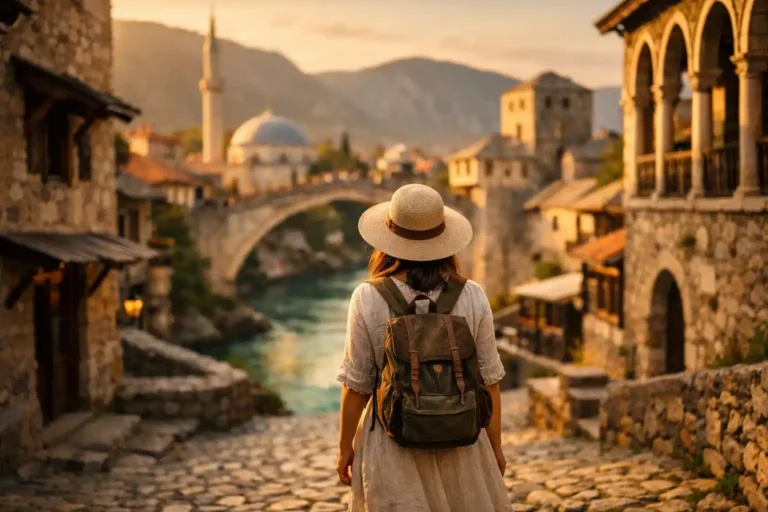
Upon arrival, head straight to the UNESCO-listed Stari Most (Old Bridge).
- The Divers: You will likely see local divers standing on the edge of the 24-meter-high bridge. They only jump once they’ve collected enough tips from tourists—feel free to contribute a Euro or two to see the spectacle.
- Koski Mehmed Pasha Mosque: For about $6, you can climb the narrow minaret for the most famous “postcard” view of the bridge and the Old Town.
Late Afternoon: Exploring the Kriva Ćuprija
Avoid the crowds of the main bridge by walking a few minutes further to the Crooked Bridge (Kriva Ćuprija). It’s a miniature version of the Stari Most, nestled in a quiet, leafy corner of the city with several affordable riverside cafés.
Dinner: The Mostar Platter
Mostar is famous for Sahan, a traditional dish consisting of stuffed onions (sogan-dolma), peppers, and vine leaves. A generous platter for two usually costs less than $15 at local eateries like Šadrvan or Tima-Irma.
Day 4: Crossing the Border – From Mostar to Montenegro
Day four is the “transition day” of your 7-day budget Balkans itinerary. Crossing from Bosnia to Montenegro can be a bit tricky due to limited direct public transport, but with a bit of planning, it’s an adventure in itself.
Option A: The Scenic Route to Durmitor (Budget Nature Lovers)
If you love hiking and raw mountain scenery, aim for Žabljak in Northern Montenegro.
- Transport: You may need to take a bus from Mostar to Trebinje, then a taxi or a connecting bus to the border.
- The Highlight: Durmitor National Park. Entry is only about $5.
- Activity: Walk the 3.5km loop around the Black Lake (Crno Jezero). The reflection of the pine trees in the glacial water is spectacular and costs nothing but your time.
Option B: The Direct Route to Kotor (The Coastal Path)
If you prefer the sea, take a direct bus from Mostar to Kotor (approx. $25–$30). This journey takes about 5-7 hours depending on border queues.
- Pro Tip: This route passes through the mountains of Herzegovina and enters Montenegro via the Bay of Kotor. Have your camera ready for the descent into the bay—the views are world-class.
Where to Stay on a Budget in Montenegro
Montenegro is slightly more expensive than Bosnia, but you can still find great value:
- Hostels: Kotor and Budva have vibrant hostel scenes ($18–$25 for a dorm). Look for “Old Town” hostels to save on local transport.
- Sobas: Look for signs saying “Sobe” (Rooms). These are private rooms in family homes, often cheaper than hotels and a great way to meet locals.
Securing the Best Budget Stays
Finding the right base is crucial for keeping your costs low in Sarajevo and Kotor. For the widest selection of hostels and local guesthouses, Booking.com and Agoda are the gold standards in the Balkans. If you prefer a more “home-like” experience or are traveling in a small group, Vrbo offers excellent private apartments. For those who prioritize loyalty rewards and consistent quality, checking Hotels.com, Expedia, or Marriott can often yield exclusive member deals, while Tripadvisor remains the best place to cross-reference real traveler photos and recent reviews before you hit the “book” button.
Budget Breakdown: Bosnia vs. Montenegro
| Category | Bosnia (Daily) | Montenegro (Daily) |
| Dorm Bed | $12 – $18 | $18 – $28 |
| Cheap Meal | $4 – $7 | $7 – $12 |
| Local Beer | $2.00 | $3.50 |
| Transport | $5 – $15 | $10 – $25 |
Day 5: Entering the Fjord of the Adriatic – Kotor
Welcome to the Bay of Kotor (Boka Kotorska). Often mistaken for a fjord, this submerged river canyon is the crown jewel of Montenegro’s coast.
Morning: Conquering the Kotor City Walls
The best way to start your day is the hike up to the San Giovanni Fortress (St. John’s Fortress).
- The Budget Hack: If you start your climb before 7:00 AM, you can often bypass the entry fee (approx. $16) and avoid the Mediterranean heat. The 1,350 stairs are grueling, but the view of the bay shaped like a “butterfly” is the highlight of any 7-day budget Balkans itinerary.
Afternoon: The Maze of the Old Town
Kotor’s Old Town is a labyrinth of marble-paved squares and narrow alleys. It is famously inhabited by hundreds of cats, which are considered the city’s unofficial mascots.
- Free Activity: Simply getting lost in the streets and visiting the “Cat Squares” is a joy.
- Saint Tryphon Cathedral: A beautiful Romanesque building that costs only a few dollars to enter.
Evening: Sunset by the Water
Walk along the waterfront towards Dobrota. There are several small stone piers (pontas) where you can sit with a $1.50 bottle of Nikšićko beer from a local supermarket and watch the sun dip below the limestone cliffs.
Day 6: Perast and the Serenity of the Bay
On the sixth day of your 7-day budget Balkans itinerary, you’ll explore the smaller, more tranquil gems of the Bay of Kotor. While Kotor is the bustling hub, Perast is the architectural heart of the region.
Morning: The Short Hop to Perast
Take the local “Blue Line” bus from the main road in Kotor (approx. $2.00). It runs every hour and takes you along the scenic coastal road.
- The View: Perast looks like a piece of Venice that floated across the Adriatic. It consists of one main street lined with 16 Baroque palaces and 19 churches.
Afternoon: Our Lady of the Rocks
From the Perast waterfront, dozens of small boats offer round-trips to the man-made island of Gospa od Škrpjela (Our Lady of the Rocks).
- Cost: A return boat trip usually costs around $6–$10.
- The Legend: According to local lore, the island was built over centuries by seamen who laid a rock in the bay after every successful voyage.
- Budget Tip: If you want to save money, skip the museum entry on the island and simply enjoy the boat ride and the exterior architecture.
Late Afternoon: Hiking the Vrmac Ridge
For a completely free and active afternoon, head back towards Kotor and hike the Vrmac Ridge. This trail separates the inner Bay of Kotor from the outer Tivat Bay.
- The Reward: You get a 360-degree view of the entire coastline. It’s a favorite for hikers on a budget Balkans itinerary because it offers the best vistas without the crowds or the fees.
Day 7: Budva or Sveti Stefan – The Grand Finale
For your final day, you have a choice: the vibrant energy of Budva or the iconic, luxurious silhouette of Sveti Stefan.
Option 1: Budva’s Old Town and Beaches
Budva is the “Miami of Montenegro.” While parts of it are flashy and expensive, the Stari Grad (Old Town) is a 2,500-year-old fortified treasure.
- Mogren Beach: Follow the seaside path from the Old Town to Mogren Beach. It’s tucked behind limestone cliffs and is one of the most beautiful spots for a final swim in the Adriatic.
- Budget Lunch: Look for Pekaras (bakeries) near the bus station. A giant slice of pizza or a meat-filled Burek will cost you less than $3.
Option 2: The Glamour of Sveti Stefan (On a Budget)
Sveti Stefan is a private island resort and one of the most photographed spots in the Balkans. While you can’t enter the island without a pricey hotel reservation, you can experience it for free.
- Transport: Take a local bus from Budva (approx. $2.50).
- The Walk: Walk the “Seven Bay Trail” from Pržno to Sveti Stefan. It takes you through a shaded pine forest with glimpses of turquoise coves.
- The Photo: The public beach to the left of the causeway offers the iconic view of the red-roofed stone houses against the blue sea.
Seamless Transport & Border Crossings
Navigating the mountainous terrain between Bosnia and Montenegro requires reliable transport. To compare bus and train schedules in real-time, Omio and 12Go are fantastic for booking regional tickets online. If you are flying into the region, Kiwi.com and WayAway are excellent for finding “hidden city” tickets and cashback deals on flights. For those who want the freedom of a road trip, Localrent.com is highly recommended for the Balkans as they work with local fleets, though Discover Cars, RentalCars.com, EconomyBookings, and AutoEurope offer competitive price-matching for international brands. Once you’re in the city, InDrive is a great budget-friendly alternative for negotiating fair ride prices.
Logistics: Departing from the Balkans
Wrapping up your 7-day budget Balkans itinerary requires a bit of forward thinking regarding your departure point.
- From Tivat Airport (TIV): Located just 15 minutes from Kotor, this is the easiest exit point for flights to Western Europe.
- From Podgorica Airport (TGD): Montenegro’s capital is about 1.5–2 hours from the coast. Buses are frequent and cheap (approx. $8).
- Returning to Sarajevo: If you booked a round-trip flight from Sarajevo, there are overnight buses from Kotor/Budva back to Bosnia, though they can be long (7-9 hours).
Final Budget Summary for 7 Days
| Expense Category | Estimated Total (USD) |
| Accommodation (Hostels/Guesthouses) | $120 – $160 |
| Food & Drink (Street food + 1 sit-down meal/day) | $140 – $180 |
| Transportation (Buses, Trains, Local taxis) | $70 – $100 |
| Activities (Museums, Parks, Tours) | $50 – $80 |
| Total Estimated Cost | $380 – $520 |
Helpful Phrases for Your Trip
| English | Bosnian/Montenegrin | Pronunciation |
| Hello | Zdravo / Ćao | Zdrah-vo / Chow |
| Thank you | Hvala | Hva-la |
| Please | Molim | Mo-leem |
| Cheers! | Živjeli! | Zhee-vye-lee |
| The bill, please | Račun, molim | Ra-choon, mo-leem |
This concludes our comprehensive 7-day budget Balkans itinerary. You now have the route, the costs, and the hidden gems at your fingertips.
Specialized Budget Tips for a 7-Day Balkans Itinerary
To truly master a 7-day budget Balkans itinerary, you need to look beyond just the destination and understand the local infrastructure. Bosnia and Montenegro offer incredible value, but there are “insider hacks” that can shave another 20% off your total trip cost.
1. Master the “Pekara” Culture
In both Bosnia and Montenegro, the Pekara (bakery) is a budget traveler’s best friend. These are open 24/7 in larger cities like Sarajevo and Budva.
- Burek: A flaky pastry filled with meat.
- Sirnica: The cheese version.
- Zeljanica: The spinach version.A massive portion that serves as a full meal costs roughly $1.50 – $2.50. It is the gold standard for cheap, delicious Balkan fuel.
2. Drinking Water: Free vs. Paid
In Sarajevo, the tap water is mountain-fresh and perfectly safe to drink. Carry a reusable bottle and fill up at the public fountains (like the Sebilj) for $0. In parts of coastal Montenegro, while generally safe, the water can be quite hard or slightly saline; many locals prefer bottled water. To save, buy 5-liter jugs at supermarkets like IDEA or Voli rather than small bottles at tourist kiosks.
3. Negotiating “Wild” Taxis
In Bosnia, taxis are metered and very cheap. However, when crossing from Mostar to Montenegro, you might find private drivers offering “transfers.”
- The Rule: Always agree on the price before putting your bags in the trunk.
- The Alternative: Use apps like Viber or WhatsApp to book local taxi companies, as this provides a digital trail and often fixed rates.
specific bus departure times 2026
Since March 2026 schedules are now active, these are the real-world timings you can use to plan your arrival and transition between Bosnia and Montenegro.
1. Sarajevo to Mostar (The Scenic Start)
For the best experience, I recommend the train for its world-class views, though buses are more frequent.
- By Train (Recommended):
- Morning: 07:15 AM (Arrives 09:13 AM) — The “Talgo” train is the best budget value.
- Afternoon: 04:46 PM (Arrives 06:48 PM)
- Cost: Approx. $8 – $10 (Buy at the station).
- By Bus (Flexible):
- Departures roughly every hour from 06:00 AM to 07:55 PM.
- Key Times: 09:00 AM, 11:30 AM, 12:30 PM.
- Cost: Approx. $10 – $19 (Operators: Autoprevoz Mostar, Globtour).
2. Mostar to Kotor (The Border Crosser)
This is the longest leg of your trip. Note that border crossing times can vary.
- Early Morning: 07:00 AM or 07:30 AM (Arrives approx. 12:00 PM – 03:00 PM).
- Late Morning: 08:30 AM or 09:30 AM (The fastest direct options, approx. 5.5 – 7 hours).
- Afternoon (Night Bus): 04:00 PM (Arrives 01:00 AM).
- Cost: Approx. $30 – $45 (Operators: Lalatović, Centrotrans, Globtour).
3. Local Montenegro Links (Coastal Hopping)
Buses on the coast are frequent and “hop-on, hop-off” style.
- Kotor to Budva:
- Buses run roughly every 30–60 minutes between 05:00 AM and 10:00 PM.
- Travel Time: 35 – 50 minutes.
- Cost: $4 – $6.
- Budva to Podgorica (For Departure):
- Buses run hourly from 06:00 AM to 09:25 PM.
- Travel Time: Approx. 1 hour 30 minutes.
- Cost: $6 – $10.
Pro-Traveler Tips for 2026:
- Station Taxes: In Montenegro (especially Kotor and Budva), you must pay a €1.00 – €2.00 station fee at the counter to get your platform ticket. This is separate from your bus fare.
- Luggage Fees: Expect to pay the driver €1.00 per large bag in cash for the hold.
- Booking: For the Mostar to Kotor leg, I highly recommend booking online via Busticket4.me or Globtour at least 2 days in advance, as these smaller buses sell out quickly.
Timing your 7-day budget Balkans itinerary is crucial for both your wallet and your sanity.
Unforgettable Tours & Activities
To truly experience the history of Sarajevo or the beauty of the Adriatic, booking a guided tour is a must. Viator and GetYourGuide offer an extensive range of walking tours, from war-themed history walks to boat trips in the Bay of Kotor. If you are looking for specific museum tickets or regional attractions, Tiqets and Klook often provide skip-the-line access and mobile-friendly entry. For those arriving by sea or planning a coastal excursion, Cruise Critic provides invaluable insights into the best port-of-call activities in Montenegro.
🔝 Top-Rated Budget Hostels in Sarajevo, Bosnia
In Sarajevo, the best budget stays are located within the Old Town (Baščaršija) or the City Center (Centar).
- The Doctor’s House
- Why it’s trending: Perched on a hill with a stunning terrace view of the city, this hostel is known for its family-like atmosphere and communal dinners that save you money.
- Perks: Large common areas, fully equipped kitchen, and legendary local tips from the staff.
- Est. Price: $15–$18 (Dorm).
- Hostel Franz Ferdinand
- Why it’s trending: The only boutique hostel in Sarajevo, themed around the assassination that sparked WWI. It’s located right in the pedestrian zone near the Cathedral.
- Perks: Free breakfast, modern beds with privacy curtains, and central access to all free walking tours.
- Est. Price: $16–$20 (Dorm).
- Hostel Balkan Han
- Why it’s trending: Famous for its “Han” (traditional traveler inn) vibe and a large green garden/bar area where travelers mingle over coffee.
- Perks: Excellent security, central location, and a social but not “party-hard” atmosphere.
- Est. Price: $14–$17 (Dorm).
🔝 Top-Rated Budget Hostels in Kotor, Montenegro
In Kotor, staying inside the Old Town (Stari Grad) walls is the ultimate budget hack to save on transport and be near the fortress hike.
- Old Town Hostel Kotor
- Why it’s trending: Consistently ranked as one of the best hostels in the world. It’s built into a medieval stone building and offers a “Balkan family” vibe.
- Perks: Organized boat tours, nightly events (bar crawls/dinners), and a private pool area (rare for a hostel).
- Est. Price: $22–$28 (Dorm).
- Hostel Centrum
- Why it’s trending: Located in the heart of the Old Town, this hostel is praised for being exceptionally clean and modern while maintaining historic charm.
- Perks: Privacy curtains, personal lockers with charging ports, and a very helpful “no-nonsense” staff.
- Est. Price: $20–$25 (Dorm).
- Hostel Pupa
- Why it’s trending: Located just outside the South Gate of the Old Town, offering a slightly quieter stay but with better access to the main bus station (saving you $5 on taxis).
- Perks: Huge kitchen, waterfront proximity, and very spacious dorm rooms.
- Est. Price: $18–$24 (Dorm).
💡 Quick Booking Tip for 2026:
- Book Direct: Many of these hostels offer a 10% discount if you book through their own website rather than major booking platforms.
- Mixed vs. Female-Only: Most Balkan hostels offer female-only dorms for a small $2–$3 premium—highly recommended for solo travelers seeking extra comfort.
- Check for Breakfast: Hostels like Franz Ferdinand include breakfast, which saves you a daily $5–$7 trip to the bakery.
The Shoulder Season (May–June & September–October)
This is the “sweet spot.”
- Weather: Pleasant for hiking in Durmitor and swimming in the Adriatic.
- Price: Accommodation rates drop by 30-50% compared to July and August.
- Crowds: You won’t have to fight for a spot on the bus or a seat at a popular Sarajevo café.
The High Season (July–August)
Bosnia remains relatively affordable, but Montenegro’s coast sees a massive price hike.
- Budget Hack: If traveling during this time, stay in Zelenika or Lastva instead of the heart of Kotor or Budva. You’re only a short bus ride away but will save significantly on your nightly stay.
Detailed Cost Breakdown: Bosnia vs. Montenegro
Understanding the slight economic shift when you cross the border will help you manage your cash flow during your 7-day budget Balkans itinerary.
| Feature | Bosnia & Herzegovina (BAM) | Montenegro (Euro) |
| National Park Entry | $2 – $5 | $5 – $10 |
| Intercity Bus (2 hrs) | $8 – $12 | $12 – $18 |
| Coffee (Café) | $1.00 – $1.50 | $2.00 – $3.50 |
| Hostel Dorm | $12 – $15 | $18 – $25 |
| Daily Budget (Low) | $35 | $50 |
Safety and Practicalities
Is the Balkans safe for budget travelers? Yes. In fact, Bosnia and Montenegro are among the safest countries in Europe regarding violent crime. However, there are a few practical things to keep in mind for your 7-day budget Balkans itinerary:
- Landmine Safety (Bosnia): While cities and marked hiking trails are 100% safe, never go wandering into unmarked, overgrown fields in rural Bosnia. Stay on the path.
- Registration (Montenegro): By law, tourists in Montenegro must pay a small “tourist tax” (approx. $1 per day). Most hostels and hotels include this and register you automatically, but if you stay in an Airbnb, ensure your host does this to avoid issues at the border when leaving.
- Smoking: Be prepared—smoking is still very common inside restaurants and bars in the Balkans. If you are sensitive to smoke, look for outdoor terrace seating.
Integrating Nature: The Vrmac Hike (A Free Gem)
As mentioned in the Day 6 section of your 7-day budget Balkans itinerary, the Vrmac Ridge is a budget traveler’s dream.
- Getting There: Start the hike from the “Fort Vrmac” side near Trojica.
- What to Bring: Enough water and a picnic from a local Pekara.
- The Experience: You will walk through abandoned Austro-Hungarian fortifications with the Bay of Kotor on one side and the open Adriatic Sea on the other. It is a world-class hiking experience that costs zero dollars.
Essential Travel Protection & Connectivity
Never travel the Balkans without ensuring you’re connected and covered. In 2026, eSIMs are the easiest way to avoid roaming fees; airalo and Saily offer great regional plans, while Yesim and Holafly (or airalo) are perfect for multi-country Balkan trips. Regarding safety, specialized providers like Insubuy, VisitorsCoverage, and EKTA offer tailored insurance plans for adventurous travelers. Lastly, if your flight to the Balkans is delayed or canceled, AirHelp can assist you in claiming the compensation you are legally owed.
Cultural Etiquette and Local Insights for Your 7-Day Budget Balkans Itinerary
To truly maximize your 7-day budget Balkans itinerary, understanding the cultural nuances of Bosnia and Montenegro is just as important as knowing the bus schedules. The Balkans are famous for their hospitality, but showing respect for local customs can often lead to “off-menu” experiences, like being invited for a homemade plum brandy (Rakija) or getting a discount at a family-run guesthouse.
1. The Coffee Culture (Ćejf)
In Bosnia, coffee is not a caffeine fix; it is a social institution.
- The Concept of Ćejf: This refers to a state of pure relaxation and enjoyment.
- Budget Tip: Never rush your coffee. Even if you only spend $1.50 on a Bosnian coffee, you are entitled to sit at that table for two hours. It is the cheapest way to people-watch and soak in the atmosphere of Sarajevo or Mostar.
2. Navigating Sensitive History
While the people of Bosnia and Montenegro are incredibly open, the 1990s conflict is still a living memory for many.
- Approach with Empathy: If a local chooses to share their story, listen without being judgmental.
- Avoid Politics: As a traveler on a 7-day budget Balkans itinerary, it’s best to avoid initiating debates about borders or ethnic tensions. Focus instead on the incredible resilience and reconstruction you see around you.
3. Religious Respect
You will visit many mosques in Bosnia and Orthodox churches in Montenegro.
- Dress Code: Carry a light scarf or sarong in your backpack. Women should cover their heads and shoulders when entering mosques, and men should avoid wearing short shorts.
- Photography: Always look for signs. Most religious sites allow photos of the architecture but forbid photos during active prayer or of specific icons.
Transportation Secrets: Getting Around on a Budget
Public transport in the Balkans is reliable but operates on its own “Balkan time.” Here is how to navigate the transit leg of your 7-day budget Balkans itinerary without overspending.
The “Station Fee” (Stanična Usluga)
In both Bosnia and Montenegro, buying a bus ticket at the counter often incurs a “station fee” ($1–$2). Additionally, if you have a large backpack to put in the hold, the driver will charge you roughly $1.00 per bag in cash.
- Budget Hack: Keep small coins (Euro or BAM) ready for the driver so you don’t hold up the line.
Bus vs. Train
- Bosnia: Use the train for the Sarajevo-Mostar route—it’s cheaper and more scenic than the bus. For all other routes, the bus is king.
- Montenegro: There is very little train infrastructure. Stick to the “Globtour” or “Blue Line” buses. Use websites like Busticket4.me to check schedules, but always verify at the physical station a day before.
Hidden Gems: Beyond the Main Tourist Path
If you find yourself with extra time during your 7-day budget Balkans itinerary, consider these low-cost detours:
Blagaj Tekke (Near Mostar)
Just 12km from Mostar lies a Dervish monastery built into a 200-meter cliff next to the Buna River spring.
- Cost: The bus from Mostar is about $2. Entry to the monastery is around $5.
- Why go: It is one of the most mystical and photographed spots in Herzegovina.
The Abandoned Yugoslav Monuments (Spomeniks)
For those interested in “Brutalist” architecture, the Balkans are dotted with massive, abstract monuments from the Yugoslav era.
- Tjentište: Located in Sutjeska National Park (between Sarajevo and Montenegro), this monument is free to visit and offers a hauntingly beautiful look at the region’s socialist past.
Essential Packing List for a Budget Balkans Trip
Since you’ll likely be using buses and walking a lot, “packing light” is the best way to stay within your 7-day budget Balkans itinerary goals.
- Sturdy Walking Shoes: The cobblestones of Sarajevo and the fortress stairs of Kotor will destroy thin-soled flip-flops.
- Reusable Water Bottle: As mentioned, the mountain water in Bosnia is elite.
- Power Bank: Bus journeys can be long, and charging ports on older Balkan buses are rare.
- Offline Maps: Download the maps for Sarajevo, Mostar, and Kotor on Google Maps or Maps.me. Signal can be spotty in the mountains between Bosnia and Montenegro.
- Cash Pouch: Small-town Bosnia and many Montenegrin hostels still prefer “Cash is King.”
7-Day Budget Spreadsheet (Estimate for 2026)
All prices are per person and converted to USD for easy tracking.
| Category | Item | Bosnia (3 Days) | Montenegro (4 Days) | Total (7 Days) |
| Stay | Budget Hostel / Sobe | $45 ($15/nt) | $80 ($20/nt) | $125 |
| Food | Street Food & Groceries | $36 ($12/day) | $60 ($15/day) | $96 |
| Dining | 3 Mid-range Meals | $25 | $45 | $70 |
| Transit | Intercity (Train/Bus) | $20 | $45 | $65 |
| Fees | Entry Fees & Tourist Tax | $10 | $30 | $40 |
| Misc | Coffee, Beer, Snacks | $15 | $25 | $40 |
| Total | $151 | $285 | $436 |
The “Ready-to-Go” Booking Checklist
1. Transportation (Pre-Trip)
- [ ] Sarajevo to Mostar Train: Book via zfbh.ba. Note: Tickets are released shortly before travel. The morning train (approx. 07:15) is the most scenic.
- [ ] Mostar to Kotor Bus: Check Busticket4.me or Obilet. Book at least 48 hours in advance during peak season.
- [ ] Airport Transfers: Research local bus lines from Sarajevo (SJJ) and Tivat (TIV) or Podgorica (TGD) to save on $25+ taxi fares.
2. Accommodation
- [ ] Sarajevo (2 Nights): Focus on Baščaršija or Centar for walkability.
- [ ] Mostar (1 Night): Look for a “Pansion” near the Old Bridge for authentic hospitality.
- [ ] Kotor/Coast (3 Nights): Select an Old Town hostel for social vibes or Dobrota for a quieter, cheaper waterfront stay.
3. Essential “Admin” Tasks
- [ ] Offline Maps: Download Bosnia and Montenegro regions on Google Maps or Maps.me.
- [ ] Currency Prep: Withdraw BAM (Convertible Marks) upon arrival in Sarajevo. Ensure you have Euros in cash before entering Montenegro.
- [ ] Registration Check: Confirm with your Montenegro hosts that they will register you for the €1.00/day tourist tax to avoid fines at the border.
4. Packing Essentials
- [ ] The “Pekara” Kit: A reusable utensil set and a cloth bag for bakery runs.
- [ ] Modesty Scarf: For entering the Gazi Husrev-beg Mosque or Ostrog Monastery.
- [ ] Power Bank: Essential for the 6-hour bus ride across the border.
Final Summary: Your 7-Day Budget Balkans Itinerary Cheat Sheet
To wrap up this 7-day budget Balkans itinerary, here is a condensed “cheat sheet” designed for quick reference while you’re on the move. This final part focuses on the practical day-to-day essentials, including where to eat cheaply and how to manage your daily expenses in Bosnia and Montenegro.
The Daily Itinerary at a Glance
| Day | Location | Top Budget Activity | Must-Eat Meal |
| 1 | Sarajevo | Baščaršija Walk (Free) | Ćevapi at Željo ($4) |
| 2 | Sarajevo | Yellow Bastion Sunset (Free) | Burek at Pekara ($2) |
| 3 | Mostar | Stari Most Diving (Free) | Mostar Platter ($8) |
| 4 | Transfer | Scenic Train to Mostar ($7) | Picnic on the bus ($3) |
| 5 | Kotor | City Walls Hike ($0-$15) | Seafood Pasta ($12) |
| 6 | Perast | Blue Line Bus Trip ($2) | Local Cheese & Ham ($5) |
| 7 | Budva | Mogren Beach Swim (Free) | Giant Pizza Slice ($2.50) |
Best Budget Eateries (Tried & Tested)
Eating out is one of the highlights of a budget Balkans itinerary, but tourist traps are common near the bridges of Mostar and the squares of Kotor.
Sarajevo, Bosnia
- Nanina Kuhinja: Offers “home-style” Bosnian stews (Begova Čorba) at very reasonable prices.
- Ascinica Hadzibajric: A traditional “cafeteria” style spot where locals eat. High quality, very low cost.
Mostar, Bosnia
- Food House Mostar: Great vegetarian options (rare in the Balkans) and very fair pricing for the portion sizes.
- Tima-Irma: Known for massive grilled platters that can easily be shared by two people to save money.
Kotor & Budva, Montenegro
- BBQ Tanjga (Kotor): A legendary butcher shop turned grill. You choose your meat, and they grill it for you. Massive portions for under $10.
- Pekara Radovic (Budva): The go-to spot for late-night or early-morning pastries that won’t break the bank.
Plan Your 7-Day Budget Balkans Trip — Useful Travel Resources
Helpful tools for planning a 7-day budget Balkans itinerary — from cheap buses and train routes to affordable car rental, day trips, flights, eSIMs, and travel insurance.
12Go — Compare buses and transport options
GetByBus — Useful for Balkan bus routes
Serbian Railways — Useful for Serbia train routes
BDZ Bulgaria — Sofia, Plovdiv & Bulgaria trains
Discover Cars — Compare rental cars and insurance
Rentalcars.com — Useful for flexible road trips
Viator — Day trips and local experiences
GetYourGuide — Tours for difficult routes
Direct Ferries — Ferry search for coastal routes
Jadrolinija — Croatia ferry schedules
Kiwi.com — Compare low-cost flight routes
Trip.com — Flights, hotels and travel deals
SafetyWing — Useful for long trips and digital nomads
World Nomads — Travel cover for adventure trips
💡 Budget Tip: For a 7-day Balkans trip, do not rely on one platform only. Compare online prices with local bus stations, hostel reception, train websites, and local agencies, especially for cross-border routes where schedules can change by season.
Final Budgeting Advice: Cash vs. Card
Managing your money across two different currencies (BAM in Bosnia and Euro in Montenegro) is the final hurdle of your 7-day budget Balkans itinerary.
- Bosnia: Card acceptance is growing in Sarajevo, but once you head to Mostar or local markets, cash is mandatory. Use ATMs attached to banks (like UniCredit or Raiffeisen) to avoid high “independent” ATM fees.
- Montenegro: Since they use the Euro, card acceptance is much higher, especially in Kotor and Budva. However, for buses and small “Sobe” (guesthouses), you will still need cash.
- Emergency Tip: Always keep a “spare” $20 or €20 hidden in your backpack for those moments when an international card might be declined at a remote bus station.
Final Thoughts on the Balkans
A 7-day budget Balkans itinerary through Bosnia and Montenegro offers a depth of experience that few other European regions can match for the same price. You will walk through history, swim in crystal-clear waters, and meet some of the most hospitable people on the continent.
The beauty of the Balkans isn’t just in the low prices—it’s in the slow pace of life, the smell of wood-fired coffee, and the rugged mountains that frame every horizon. Pack light, stay curious, and enjoy the ride.
Ready to Start Planning?
This concludes our comprehensive guide to a 7-day budget Balkans itinerary. From the historic streets of Sarajevo to the sun-soaked walls of Kotor, your adventure awaits.
❓ Frequently Asked Questions (FAQ Section)
Is 7 days enough for both Bosnia and Montenegro?
While you could spend weeks in each, 7 days is the “sweet spot” for a highlight tour. It allows for 3 days in Bosnia (Sarajevo & Mostar) and 4 days in Montenegro (Kotor & the Coast) without feeling overly rushed.
Do I need a visa for Bosnia and Montenegro in 2026?
Most Western travelers (EU, US, UK, CA, AU) can enter both countries visa-free for up to 90 days. However, always check the latest ETIAS requirements for 2026 if you are an international traveler entering the Schengen-adjacent zones.
What is the cheapest way to travel between Sarajevo and Kotor?
The public bus is the most cost-effective method, costing between $30–$45. While private transfers are faster, the bus network is reliable and offers incredible mountain views.
Can I use Euros in Bosnia?
No, Bosnia uses the Convertible Mark (BAM). While some tourist shops in Mostar might accept Euros at a poor exchange rate, it is much cheaper to pay in local currency. Montenegro, however, uses the Euro officially.