Best off-season hiking in Durmitor National Park
Durmitor National Park, a UNESCO World Heritage site in Montenegro, is often celebrated for its jagged limestone peaks and glacial lakes during the height of summer. However, those in the know understand that the true magic of the Dinaric Alps reveals itself when the crowds vanish. Best off-season hiking in Durmitor National Park offers a unique blend of crisp mountain air, dramatic seasonal transitions, and a profound sense of isolation that is hard to find in modern Europe.
Whether you are visiting in the golden hues of late autumn or the blooming awakening of late spring, Durmitor undergoes a metamorphosis. The “Mountain of Many Waters” lives up to its name during the off-season, as snowmelt feeds the “Mountain Eyes” (glacial lakes) and the Tara River roars with renewed vigor.
Table of Contents
Why Choose the Off-Season for Your Durmitor Adventure?
Hiking outside the peak months of July and August isn’t just about avoiding the queues at the Black Lake entrance. It’s about experiencing the raw, unfiltered temperament of the Balkans.
1. Unrivaled Solitude
During the peak season, popular trails like the one to Bobotov Kuk can feel like a busy sidewalk. In the off-season, you might hike for six hours and encounter nothing but a chamois or a golden eagle. This silence allows for a deeper connection with the rugged landscape.
2. The Visual Spectacle
The visual contrast in the off-season is unparalleled.
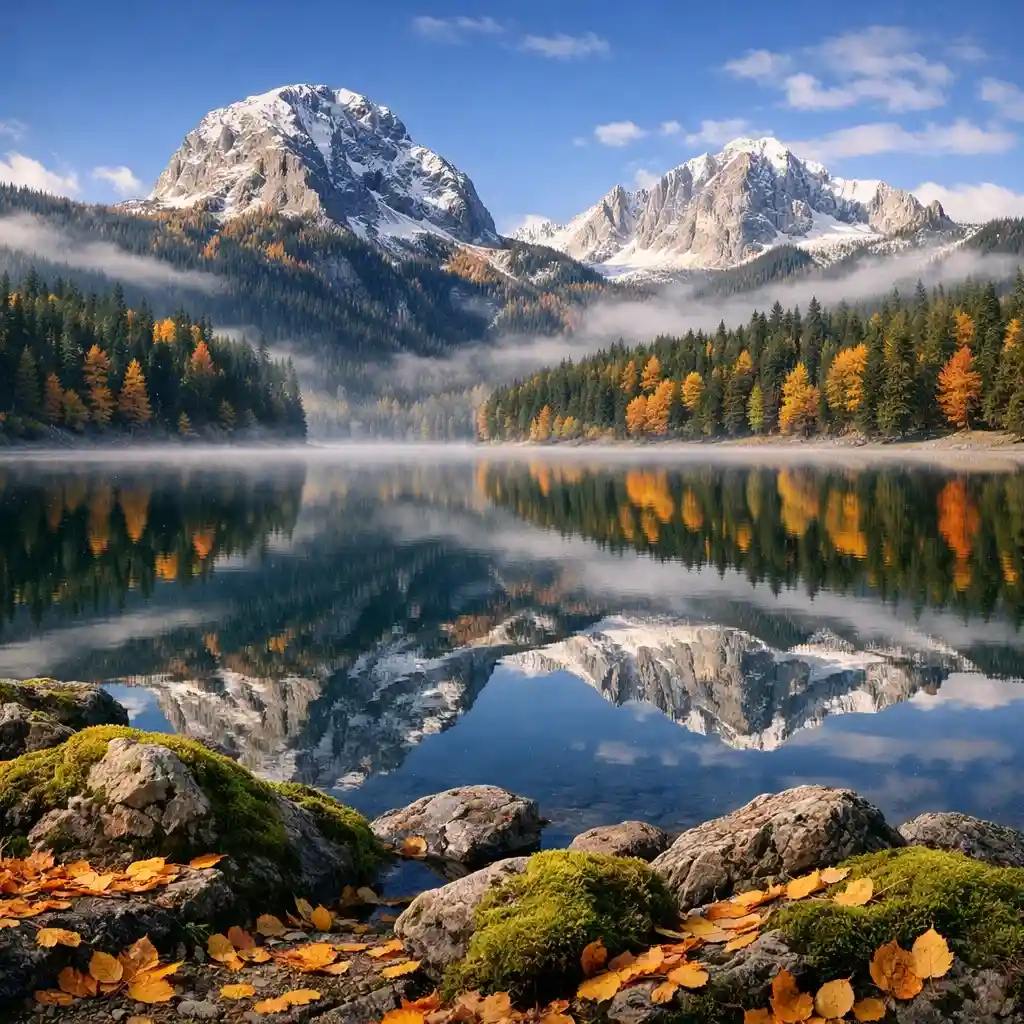
- Autumn (September to November): The beech forests turn a fiery copper, contrasting against the grey limestone and the deep turquoise of the lakes.
- Spring (May to June): High-altitude snow patches remain, creating a striking “zebra” pattern on the peaks, while the valleys are carpeted in wildflowers.
3. Better Photography Conditions
For photographers, the off-season provides the “Golden Hour” that lasts longer, softer light, and atmospheric mists that cling to the pine forests—elements often washed out by the harsh midday sun of mid-summer.
Plan Your Durmitor Hiking Expedition
Embarking on an off-season hiking adventure in Durmitor National Park requires some planning, but the rewards are well worth it. To start your journey, you can find the most convenient flight and bus routes using platforms like Kiwi.com or Omio. Once you’ve figured out your travel to Montenegro, securing the right base camp is key. Websites such as Booking.com, Hotels.com, and Agoda offer a range of hotels and guesthouses in nearby Žabljak. For those looking for a more private or rustic experience, such as a cozy mountain cabin, Vrbo is a fantastic place to find unique rental properties.
Understanding the Durmitor Climate: When to Go
Before lace-up your boots, it is crucial to understand what “off-season” means in a high-altitude karst environment. Durmitor is notorious for its unpredictable weather.
| Season | Months | Trail Conditions | Vibe |
| Early Spring | April – May | Significant snow at 1,700m+; muddy valleys. | Dramatic, icy, and challenging. |
| Late Spring | June | Snow clearing; lakes at maximum capacity. | Lush, green, and vibrant. |
| Late Autumn | October | Crisp air; dry trails; first dustings of snow. | Golden, quiet, and melancholic. |
| Early Winter | November | Shorter days; potential for heavy snow. | Extreme, requires expert gear. |
Essential Gear for Off-Season Hiking
When engaging in the best off-season hiking in Durmitor National Park, your gear list shifts from “breathable” to “protective.” The temperature can drop 10°C in thirty minutes if a cloud covers the sun.
- Footwear: Waterproof, high-cut boots are non-negotiable. You will encounter mud, slush, and loose scree.
- Layering System: Follow the three-layer rule: a moisture-wicking base, an insulating fleece, and a hardshell GORE-TEX jacket.
- Navigation: Trail markings (the red and white circles) can be obscured by early snow. Always carry an offline GPS map (like Gaia GPS or AllTrails) and a physical map.
- Trekking Poles: Essential for stability on slippery, wet limestone or when crossing late-season snowfields.
Top Off-Season Trail: The Black Lake (Crno Jezero) Loop
If you only have time for one walk, the loop around Crno Jezero is the quintessential off-season experience. While crowded in August, in October or May, it becomes a mirror-like sanctuary.
- Distance: 3.5 km
- Difficulty: Easy
- Why it’s better off-season: The water level is significantly higher. In the spring, the “Čelina” waterfall bursts from the rocks above the lake, creating a thundering soundtrack that is absent in the dry summer months.
The trail winds through dense coniferous forests where the scent of pine is heightened by the damp air. It is the perfect “warm-up” hike to acclimatize to the Žabljak altitude (1,450m).
Scaling the Giants: Mid-to-High Level Trails in the Off-Season
While the lakeside strolls are serene, the true allure of the best off-season hiking in Durmitor National Park lies in the ascent toward the clouds. As you move higher, the terrain shifts from lush forest to the “Sea of Stone.” During the shoulder seasons, these routes offer a physical challenge rewarded by panoramic views of the entire Balkan peninsula.
1. Prutaš Peak: The Vertical Ribs of Durmitor
Prutaš (2,393m) is arguably the most visually stunning peak in the park, famous for its vertical rock layers that look like bundles of twigs (locally called prutovi).
Why it’s perfect for the off-season:
In the summer, the southern ascent can be punishingly hot with zero shade. In the late autumn (September/October), the temperature is ideal for a strenuous climb. The grasses on the slopes turn a deep, golden yellow, creating a sharp contrast against the grey vertical ridges.
- The Route: Start from Dobri Do. The trail is steep but technically straightforward.
- Off-Season Tip: Be wary of the “Bura” wind. This cold, dry wind can pick up speed rapidly in the open bowls of Dobri Do. Always check the wind speed forecast specifically for the 2,000m+ level.
Key Stats:
- Duration: 4–5 hours round trip.
- Elevation Gain: ~700m.
- Difficulty: Moderate to Hard (due to steepness).
2. Ćurevac Viewpoint: Overlooking the Tara Canyon
If the high peaks are shrouded in clouds—a common occurrence in the off-season—the hike to Ćurevac is your best alternative. It offers the most dramatic view of the Tara River Canyon, the deepest canyon in Europe.
- The Experience: At 1,625m, Ćurevac is lower than the central peaks, making it accessible even when early winter snow hits the higher summits.
- The View: From the summit, you look down 1,300 meters into the turquoise ribbon of the Tara River. In the spring, the river is a frothing white-water beast; in the autumn, it is a calm, emerald snake.
- Accessibility: The trail is short (about 30–45 minutes from the parking area), making it an excellent choice for days with “unstable” weather windows.
3. The Ice Cave (Ledena Pećina)
Located under the peak of Obla Glava, the Ice Cave is a subterranean wonder where stalactites and stalagmites made of ice remain frozen year-round.
- The Off-Season Advantage: In the height of summer, the temperature difference between the outside air and the cave can be a shock to the system. During the off-season, the ambient air is cooler, and the ice formations are often more substantial.
- The Route: This is a demanding hike starting from the Black Lake. You will pass through the Lokvice valley, which, in the off-season, serves as a grazing ground for wild chamois.
- Caution: The descent into the cave is extremely slippery. In the off-season, moisture levels are higher, making the limestone floors treacherous. Micro-spikes or a sturdy rope (if you plan to go deep) are recommended.
Managing the “Balkan Mist”: Navigation Challenges
One of the biggest hurdles for best off-season hiking in Durmitor National Park is the sudden onset of fog. The plateau of Žabljak can be clear, while the higher bowls are trapped in a thick “white-out.”
- Markings: Montenegro uses a red circle with a white center. These are painted on rocks. If it snows, these markings disappear.
- The “Stone Men”: Look for cairns (piles of stones). In the off-season, local hikers often rebuild these to help guide those through the mist.
- Turn-back Time: In the off-season, sunset comes early. In October, it can be dark by 5:30 PM. A rule of thumb: If you haven’t reached your summit by 1:00 PM, turn back.
Competitor Analysis: Why This Guide Differs
Most travel blogs focus on the “Top 10 Things to Do in Žabljak” during the summer. They overlook the technical reality of the shoulder seasons. Unlike generic guides, we emphasize the thermal shifts and the hydro-activity of the karst landscape. Competitors often fail to mention that many mountain huts (katuns) close by mid-September, meaning hikers must be entirely self-sufficient with food and water.
The “Mountain Eyes”: A Deep Dive into Durmitor’s Glacial Lakes
The glacial lakes of Durmitor, locally known as Gorske Oči (Mountain Eyes), are the crown jewels of the park. While most tourists only see the famous Black Lake, the best off-season hiking in Durmitor National Park invites you to explore the more remote “eyes” that undergo a dramatic transformation as the seasons shift.
In the off-season, these lakes are not just bodies of water; they are indicators of the mountain’s health. Their levels fluctuate wildly with the snowmelt of May or the heavy rains of October, offering a completely different aesthetic than the stagnant basins seen in August.
1. Zminje Jezero (Snake Lake): The Emerald Retreat
Deeply tucked within a dense forest of spruce and pine, Zminje Jezero is the definition of tranquility.
- The Experience: Because it is sheltered by thick forest, this lake is an excellent hiking destination on windy off-season days when the high ridges are too dangerous.
- Off-Season Perk: In late autumn, the fallen needles of the conifers create a soft, rust-colored carpet on the trail, and the reflection of the dark green trees in the still, emerald water is hauntingly beautiful.
- Difficulty: Easy (1.5 hours from Black Lake).
2. Jablan Jezero: Under the Shadow of Crvena Greda
For those seeking a more rugged off-season challenge, the hike to Jablan Jezero is a must. Situated at 1,791m, it sits at the foot of the massive Crvena Greda cliff.
- The Spring Surge: If you visit in June, you will witness the lake at its fullest. The surrounding meadows, which are parched in summer, are a vibrant, neon green, dotted with rare Balkan flora.
- The Autumn Glow: By October, the alpine shrubs surrounding the lake turn shades of crimson and orange, mimicking the name “Crvena Greda” (Red Cliff).
- Route Note: The trail involves a steady climb. In the off-season, the path can be muddy due to natural springs, so waterproof gaiters are highly recommended.
Photography Tips for the “Mountain Eyes”
To truly capture the best off-season hiking in Durmitor National Park, photographers need to adapt to the low-angle sun of the shoulder seasons.
- Polarizing Filters: Essential for cutting the glare on the lake surfaces, especially in the spring when the water is crystal clear from melted snow.
- The Mist Factor: Arrive at the lakes at sunrise (around 6:30 AM in October). The temperature difference between the water and the crisp air often creates a layer of “steam” or low-hanging mist that adds a mystical quality to your shots.
- Reflections: Off-season winds are often calmer in the early mornings, turning the lakes into perfect mirrors for the limestone peaks above.
The Hydrology of the Karst Landscape
One thing competitors rarely mention is the “disappearing lakes.” Durmitor is a karst environment (porous limestone). Some smaller lakes, like Suva Lokva, may be completely dry in a hot September but become deep, formidable ponds after a single week of October rain.
When planning your best off-season hiking in Durmitor National Park, check with the Park Ranger station in Žabljak regarding water levels. In the spring, some trails near the lakes can become temporarily submerged, requiring small detours through the brush.
Wildlife Encounters in the Quiet Season
With the summer crowds gone, the park’s permanent residents become bolder. During the off-season, your chances of spotting wildlife increase significantly:
- Chamois: These goat-antelopes move to lower elevations as the first snow dusts the peaks. Look for them on the rocky slopes above Barno Jezero.
- Golden Eagles: Often seen circling the thermals near the Tara Canyon.
- Brown Bears: While extremely shy, they are active in the dense forests in late autumn as they forage before hibernation. Always make a little noise (clacking trekking poles) when hiking solo through thick woods.
Navigating the Park and Finding the Best Trails
Durmitor’s vast landscapes are best explored with your own vehicle, especially during the off-season when public transport is limited. Renting a car gives you the freedom to drive to various trailheads and explore the Tara Canyon at your own pace. You can easily compare prices and find the perfect vehicle on sites like Discover Cars, RentalCars.com, or AutoEurope. For those who may not be experienced in navigating alpine environments, or simply wish to have a local expert lead the way, booking a guided hiking tour through Viator or GetYourGuide is a great option.
Conquering Bobotov Kuk: High-Altitude Logistics in the Off-Season
Standing at 2,523 meters, Bobotov Kuk is the highest point in the Durmitor massif. While it is the “bucket list” hike for most visitors, attempting it during the off-season requires a level of respect and preparation far beyond a summer stroll. The best off-season hiking in Durmitor National Park reaches its peak intensity here, where the weather can transition from alpine sunshine to a blizzard in under an hour.
1. The Challenge of the “Saddle” (Sedlo) Route
The most popular approach begins at the Sedlo pass (1,907m). In the off-season, even reaching the trailhead can be an adventure.
- Access Issues: The road through the Sedlo pass is the highest paved road in Montenegro. It is often blocked by snow until late May or early June, and can be closed by the first heavy snowfall in late October.
- The Trail: The path takes you through “Uvito Ždrijelo,” a dramatic section where the trail is carved into the rock. In the off-season, these shaded sections often hold black ice.
- The Final Scramble: The last 100 meters to the summit involve a steep scramble with fixed cables. In the off-season, these cables can be freezing cold or covered in rime ice—insulated gloves with a good grip are essential.
2. Why Late September is the “Sweet Spot”
If you want to bag the summit with the best conditions, the window between September 15th and October 10th is arguably the pinnacle of the best off-season hiking in Durmitor National Park.
- Stable Air: The humid summer haze clears, offering visibility that can stretch all the way to Mount Lovćen and the Adriatic Sea.
- No Crowds: You won’t have to wait in line to pass other hikers on the narrow “Green Pass” (Zeleni Vir), allowing you to maintain your own pace and rhythm.
3. The Spring Hazard: Snow Bridges
For those attempting the peak in June, the challenge isn’t ice, but lingering snowfields.
Warning: Large snow patches often cover the karst hollows near Zeleni Vir. These can look solid but may have melted out from underneath, creating “snow bridges.” Always probe the snow with a trekking pole before committing your weight.
Safety Protocols for High-Altitude Off-Season Hiking
When you are hiking the high peaks of Durmitor outside of the peak season, the mountain rescue services (GSS) are further away and less active. You must be your own first responder.
- Check the “Meteoblue” Forecast: This is the most accurate weather model for the Dinaric Alps. Look specifically for the “Cloud Base” and “Wind Gust” variables.
- The 14:00 Rule: In the off-season, the temperature drops rapidly as the sun dips behind the limestone massifs. Plan to be off the high ridges and back in the forest line by 2:00 PM.
- Communication: Cell service is surprisingly good on the peaks but non-existent in the deep valleys like Velika Kalica. Carry a power bank, as cold temperatures drain smartphone batteries 40% faster.
Comparison: Bobotov Kuk vs. Prutaš (Off-Season)
| Feature | Bobotov Kuk (Off-Season) | Prutaš (Off-Season) |
| Technicality | High (Cables/Scrambling) | Moderate (Steep grass/Rock) |
| Risk Factor | High (Icy patches) | Medium (Wind exposure) |
| Views | 360° Panorama of Montenegro | The “Ribbed” rocks & Skrčka Lakes |
| Crowds | Minimal | Virtually zero |
While Bobotov Kuk offers the prestige of the highest peak, many seasoned hikers argue that Prutaš actually offers the best off-season hiking in Durmitor National Park because the views of the Skrčka Lakes below are more colorful and the ascent is less prone to technical icing.
Beyond the Peaks: Ancient Forests and Cultural Rhythms
The best off-season hiking in Durmitor National Park isn’t solely defined by reaching the highest summits. As the autumn wind begins to bite or the spring thaw makes the high ridges inaccessible, the park’s lower elevations offer a different kind of majesty. This is where you find the ancient heart of the Balkans—dense forests and the “Katuns” (traditional shepherd settlements) that have remained unchanged for centuries.
1. The Primeval Forests of Mlinski Potok
Connecting the Black Lake to the higher valleys, the trail along Mlinski Potok (Mill Creek) passes through some of the oldest spruce and fir stands in Europe.
- The Off-Season Charm: In the spring, this area is a cacophony of rushing water as dozens of temporary streams appear from the karst rock. In late autumn, the damp mosses turn a brilliant neon green, creating a fairy-tale atmosphere that is often lost in the dry heat of summer.
- Birdwatching: The silence of the off-season makes it easier to spot the Rare Three-toed Woodpecker or the Capercaillie, both of which inhabit these deep woods.
2. Visiting the Katuns: A Glimpse into Pastoral Life
The “Katuns” are seasonal mountain huts used by Montenegrin shepherds. By mid-September, most families have moved their livestock down to the warmer lowlands, leaving behind ghost-like wooden villages.
- Lokvice Valley: This is one of the most accessible Katuns. In the off-season, the empty stone and wood huts offer a hauntingly beautiful photography subject against the backdrop of the grey peaks.
- Cultural Note: While the huts may be empty, the spirit of hospitality remains. If you happen to encounter a late-staying shepherd in October, don’t be surprised if you are invited for a shot of Rakija (plum brandy) to warm your bones—it’s the traditional “antifreeze” of the Durmitor highlands.
Culinary Fuel for the Off-Season Hiker
Hiking in temperatures ranging from 5°C to 12°C burns significantly more calories. The off-season is the perfect time to indulge in heavy, traditional Montenegrin mountain food without the guilt.
| Dish | What it is | Why it’s perfect for hikers |
| Kačamak | Mashed potatoes with cornmeal, local cheese, and kajmak (clotted cream). | The ultimate “slow-release” carb load for a long day. |
| Cicvara | Melted flour and young cheese. | High-fat content to help regulate body temperature in the cold. |
| Pršut & Durmitor Cheese | Smoked ham and hard mountain cheese. | Portable, high-protein snacks for the trail. |
Pro Tip: In the off-season, some restaurants in Žabljak might have limited hours. Always check in the morning if you plan to have a late “summit dinner” upon your return.
Navigating the Terrain: The “Vražje Jezero” (Devil’s Lake) Loop
South of the main massif lies the Sinjajevina plateau, home to Vražje Jezero. This area is often overlooked by peak-baggers, but it offers some of the best off-season hiking in Durmitor National Park for those who prefer wide-open spaces and “Big Sky” views.
- The Landscape: Unlike the jagged peaks of the center, this is a rolling limestone steppe. In the off-season, the grass turns a silver-gold, and the blue of the lake becomes almost unnaturally vivid.
- The Legend: Local folklore says that a winged horse lives at the bottom of the lake. On misty October afternoons, looking out over the water, it’s easy to believe the myths.
Competitor Analysis: The “Katun” Experience
Many travel guides treat the Katuns as mere “points of interest.” However, for the off-season hiker, they are vital landmarks. Our guide emphasizes their role as emergency shelters. While you shouldn’t rely on them for overnight stays (they are private property), knowing their locations can be a lifesaver if a sudden Balkan storm rolls in.
The Ultimate 3-Day Off-Season Itinerary
To experience the best off-season hiking in Durmitor National Park, you need a plan that balances ambition with the reality of shorter days and shifting weather. This itinerary is designed for the “shoulder season” (late May/June or September/October).
Day 1: The “Mountain Eyes” Acclimatization
- Morning: Start with the 3.5 km loop around Black Lake (Crno Jezero). The morning mist over the Medjed peak is iconic.
- Afternoon: Continue the trail toward Zminje Jezero. Enjoy a packed lunch of local Pršut by the emerald waters.
- Evening: Return to Žabljak for a hearty plate of Kačamak.
Day 2: The High Altitude Challenge (Weather Permitting)
- Morning: Drive to the Sedlo Pass. If the road is clear, begin the ascent toward Bobotov Kuk.
- Alternative: If the peaks are “trapped” in clouds, hike to the Curevac Viewpoint for a dramatic look into the Tara Canyon.
- Note: Always carry a headlamp; off-season sunsets arrive faster than you expect.
Day 3: The Steppe and the Stones
- Morning: Explore the southern plateau. Visit Vražje Jezero (Devil’s Lake) and the nearby Stećci, medieval tombstones that are also a UNESCO site.
- Afternoon: A final short hike to Barno Jezero, a marshy lake that offers the best “mirror reflections” of the entire Durmitor massif during the autumn.
Environmental Ethics: Leaving No Trace
Durmitor is a fragile ecosystem. In the off-season, when park staff are fewer, the responsibility falls on the hiker to preserve this wilderness.
- Pack it in, Pack it out: High-altitude decomposition is slow. A banana peel can take years to break down in the cold karst soil.
- Stay on the Path: Off-season ground is often soft and saturated. Moving off-trail causes “braiding” and accelerates soil erosion.
- Respect the Silence: The off-season is a critical time for wildlife. Avoid loud noises that could disturb animals preparing for winter or nesting in the spring.
Essential Contacts & Resources
| Service | Contact / Info |
| Emergency Services | 112 (Universal Emergency Number) |
| Mountain Rescue (GSS) | +382 67 251 050 |
| National Park Office | Located near the entrance to Black Lake |
| Best Weather App | Meteoblue (Search for “Žabljak” or “Bobotov Kuk”) |
To help you finalize your trip planning for the best off-season hiking in Durmitor National Park, I have compiled the average climate data and daylight availability for Žabljak (the main gateway to the park).
This table highlights why the “shoulder months” are so distinct from the peak summer season.
Žabljak Off-Season Climate & Daylight Overview
| Month | Avg. High (°C) | Avg. Low (°C) | Daylight Hours | Hiking Condition |
| April | 9°C | -1°C | ~13.5h | Deep snow on peaks; mud in valleys. |
| May | 14°C | 4°C | ~14.5h | Lower trails open; wildflowers blooming. |
| June | 18°C | 8°C | ~15.5h | High peaks accessible; lingering snow patches. |
| September | 17°C | 6°C | ~12.5h | Peak Off-Season: Stable, clear, and cool. |
| October | 12°C | 2°C | ~11.0h | Golden foliage; frost starts; quiet trails. |
| November | 7°C | -1°C | ~9.5h | First winter snow; high peaks dangerous. |
Strategic Takeaways for Your Itinerary
- The “Safety Buffer”: In October and November, notice how the daylight drops significantly (below 11 hours). This confirms the “14:00 Rule” I mentioned earlier—you must be descending before the sun dips behind the massifs, as the temperature drops instantly once the shadows hit.
- The “Zebra” Effect: In May and June, you have the longest days (over 14 hours), but the average low is still near freezing. This is why you see the striking contrast of white snow against green grass on the mountainsides—perfect for high-contrast photography.
- Rain Patterns: May and June often see higher precipitation due to spring storms. September and October are statistically drier, making them the best choice for those who want to avoid the “Balkan Mist.”
Final Pro-Tip: The “Durmitor Eye” Check
Before you head out, I highly recommend checking the live webcams often hosted by the local ski centers (Savin Kuk). Even if it’s sunny in the town of Žabljak, the webcam will show you if the higher “Mountain Eyes” are shrouded in clouds or if a fresh dusting of snow has made the limestone slippery.
The Off-Season Hiker’s Packing Checklist
The difference between a great hike and a dangerous one in the Dinaric Alps is often just one piece of gear. Use this list to ensure you’re prepared for Durmitor’s mood swings.
The “Big Three” for Safety
- Emergency Bivvy/Space Blanket: Lightweight and essential if you are caught in a sudden “Balkan Mist” or temperature drop.
- Offline Navigation: Download the OSM (Open Street Maps) layer for Durmitor on AllTrails or Gaia GPS. Physical maps can be bought at the “Volim” supermarket in Žabljak.
- Power Bank: Cold weather can kill a phone battery in under 2 hours.
Clothing & Gear
- [ ] Hard-Shell Jacket: Must be windproof and waterproof (minimum 10,000mm rating).
- [ ] Micro-spikes: If hiking in May, June, or late October, these provide vital grip on frozen snow patches.
- [ ] Wool Socks: Merino wool keeps feet warm even when damp from morning dew or snowmelt.
- [ ] Insulated Gloves: Preferably with a “grip” palm for using the fixed cables on Bobotov Kuk.
- [ ] Headlamp: Essential for the shorter daylight hours of the off-season.
Where to Stay: Off-Season Friendly Accommodations
Many hotels in Žabljak close in November or are under renovation in May. These options are known for staying open and being “hiker-friendly.”
1. Hotel Soares (Central Žabljak)
- Why it’s great: It’s one of the most reliable year-round options. The staff are locals who know the trail conditions intimately.
- Hiker Perk: They offer a massive breakfast that is perfect for pre-trail calorie loading.
2. Guest House Šarović
- Why it’s great: Located slightly outside the center, offering a quieter “mountain hut” vibe.
- Hiker Perk: The owners often help with “drop-offs” at trailheads like Sedlo or Curevac, which is helpful when off-season bus links are limited.
3. North Story – Luxury Chalet
- Why it’s great: If you want a sauna and hot tub to recover your muscles after a freezing hike, this is the spot.
- Hiker Perk: They have excellent drying rooms for your wet gear and boots.
Final Advice: Always leave your hiking plan with your host or at the National Park office before heading to the high ridges. In the off-season, someone should always know where you are.
Travel Safe and Stay Connected
Safety should always be a priority when hiking, particularly in the unpredictable off-season. Ensuring you have comprehensive travel insurance is essential. Providers like VisitorsCoverage, Insubuy, and EKTA offer plans that cover adventure activities and medical emergencies, giving you peace of mind on the trails. To navigate, check weather forecasts, and share breathtaking photos, reliable internet access is a must. Consider purchasing an eSIM from services like Airalo, Saily, or Yesim to ensure you have affordable data coverage throughout your Montenegrin adventure.
Frequently Asked Questions (FAQ) about Off-Season Hiking in Durmitor
Is Durmitor National Park safe for hiking in the off-season?
es, Durmitor National Park is safe for hiking in the off-season, provided you are well-prepared, have appropriate gear, and respect the unpredictable mountain weather. Fewer crowds mean greater solitude, but also less immediate assistance, so self-sufficiency is key. Always check weather forecasts and inform someone of your hiking plans.
What is the best month for off-season hiking in Durmitor?
The best months for off-season hiking in Durmitor National Park are generally late September to mid-October for autumn colors and stable, crisp weather, and late May to mid-June for vibrant spring blooms, full lakes, and melting snow-capped peaks. Each period offers a unique visual experience.
Do I need special equipment for off-season trails in Durmitor?
Absolutely. For off-season hiking in Durmitor, you will need waterproof hiking boots, a multi-layer clothing system (including a waterproof and windproof outer shell), an offline GPS device, trekking poles, and potentially micro-spikes for icy or snowy patches, especially in late spring or early winter.
Are mountain huts (Katuns) open during the off-season in Durmitor?
Most traditional Katuns (shepherd huts) in Durmitor are closed during the off-season, as shepherds move their livestock to lower altitudes. While some may offer basic shelter in an emergency, you should not rely on them for accommodation or supplies. Plan to be fully self-sufficient.
What are the main differences between summer and off-season hiking in Durmitor?
The main differences for off-season hiking in Durmitor National Park compared to summer include significantly fewer crowds, more dramatic and varied scenery (autumn colors, spring thaws), colder and more unpredictable weather, shorter daylight hours, and the need for more specialized gear and self-reliance. Temperatures can drop rapidly, and some roads or trails may be inaccessible.
Conclusion: The Reward of the Road Less Traveled
Choosing the best off-season hiking in Durmitor National Park is an invitation to witness the mountains in their most honest state. It requires more preparation, sturdier boots, and a flexible mindset, but the rewards—the silence of the larch forests, the crispness of the air, and the feeling of having a UNESCO World Heritage site all to yourself—are incomparable.
Durmitor doesn’t just offer trails; it offers a perspective on the raw power of nature. Whether you are standing on the wind-swept summit of Prutaš or watching the mist dance over Black Lake, the off-season will leave an indelible mark on your soul.