Sustainable Eco Tours in Theth: Responsible Travel (2026)

Reviewed: 20 October 2026. Sustainable eco tours in Theth National Park should mean more than attaching the word “eco” to a mountain hike. In northern Albania, a responsible visit involves choosing suitable trails, hiring local people on fair terms, reducing waste, protecting rivers and wildlife, and understanding the limits of a small village receiving increasing visitor numbers. This guide turns those principles into a practical two- or three-day travel plan.
You can explore Theth without a private car, sleep in locally operated guesthouses, see Grunas Waterfall and the Blue Eye of Theth, or tackle the demanding Theth–Valbona Pass. None of these activities is automatically sustainable. The choices around transport, group size, accommodation, spending, safety and behavior determine their real impact. Here is how to make those choices without relying on unsupported green claims.
Quick answer: For a balanced, lower-impact first trip, spend two or three nights in Theth, use a confirmed shared transfer from Shkodër, choose a locally run guesthouse that can explain its water and waste practices, and combine one valley walk with one longer hike suited to your fitness. Treat the Valbona Pass as a separate full hiking day with an onward travel plan.
Affiliate disclosure: This article contains a few sponsored booking links. We may earn a commission if you book through them at no additional cost to you. We have not certified the environmental claims of any property, tour or operator.
Table of Contents
Theth National Park vs Albanian Alps National Park: The Name Explained
The village of Theth (Thethi) lies in Shkodër County, surrounded by the Albanian Alps, also called the Accursed Mountains or Prokletije. You will still see “Theth National Park” on maps, tour listings and older guidebooks. However, Albania’s protected-area agency confirms that a 2022 government decision incorporated the former Theth and Valbona protected areas, together with the Gashi River reserve, into the larger Albanian Alps National Park (Parku Kombëtar Alpet e Shqipërisë).
This distinction matters when checking park management, rules and official sources. Theth remains the destination name that travelers know, but advice about protected-area zones should follow the current Albanian Alps park framework, not assumptions based on the old individual-park designation. Consult the Albanian National Agency of Protected Areas for the formal designation and the National Tourism Agency profile of Theth for destination context.
The area contains limestone mountains, forests, rivers, traditional buildings and active village life. It is not an untouched wilderness without residents or infrastructure. Tourism brings income but can also increase traffic, sewage and solid-waste pressure. A useful sustainable tour respects those trade-offs rather than portraying every new guesthouse or road improvement as environmentally harmless.
Choose the Right Type of Eco Tour in Theth
Start by matching your ability and available time to the activity. A guided heritage walk, an easy waterfall hike and a high-pass crossing can all support local livelihoods, but they present very different safety and access requirements. The descriptions below are planning categories, not certified eco-tour products; no specific operator has been audited or endorsed.
| Experience | Time to allow | Physical effort | Responsible choice |
|---|---|---|---|
| Village and heritage walk | Half day | Gentle walking; uneven village tracks | Ask permission before photographing homes and residents; use a local interpreter or guide if desired |
| Grunas Waterfall and canyon area | Roughly 2–3 hours including a relaxed return and pauses | Easy–moderate; stony or slippery sections | Stay on established paths and avoid entering unsafe water or unstable canyon edges |
| Blue Eye of Theth via Ndërlysa | Half day with arranged vehicle transfer; substantially longer on foot from Theth | Moderate, rocky uphill walk | Share the transfer where practical; avoid jumping or damaging spring banks |
| Theth–Valbona Pass crossing | Full hiking day, commonly 6–8+ hours walking | Moderate–challenging with major ascent/descent | Go only in suitable conditions, start early and plan luggage and overnight arrangements |
| Local food or cultural experience | One to several hours, by prior agreement | Low physical effort | Pay the host fairly, participate by invitation and avoid staged or intrusive experiences |
What “eco tour” should mean: Ask where money goes, who owns the operation, how many people travel together, whether walking routes are legal and safe, and how waste is handled. Words such as “authentic,” “green,” “untouched” and “locally inspired” are not proof of sustainable practice.
Getting to Theth from Shkodër Without a Car
Shared Minibus: Often the Best Starting Point
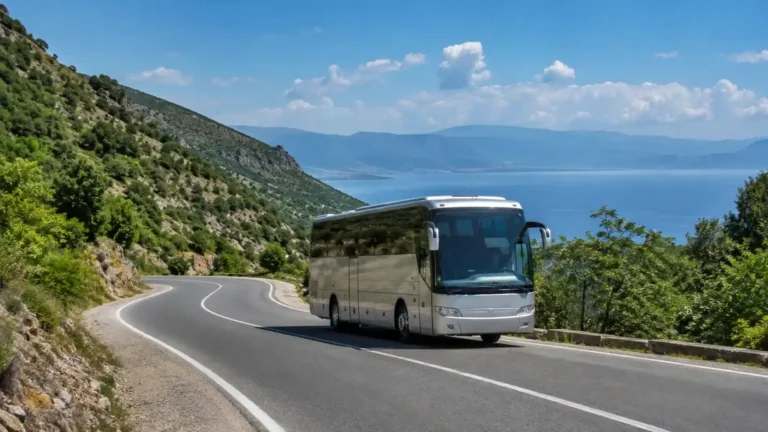
Shkodër is the usual gateway. The road to Theth is paved but steep and winding across high mountain terrain; a road improvement does not eliminate weather or traffic disruption. A seasonal transport provider, Thethi Travel, published a 2026 one-way fare of 1,200 Albanian lek (ALL) and a journey time of roughly two hours on its service page, with scheduled departures during its May–November season. Other local guides describe journeys nearer 2.5–3.5 hours depending on pickups and conditions. These are published planning figures, not live seat availability.
Thethi Travel lists outbound departures from Shkodër at 07:00 and 13:00 and returns from Theth at 10:00 and 17:00. Because mountain services are seasonal and provider-specific, confirm the latest departure, actual meeting place, luggage allowance and payment method directly with the operator before making nonrefundable commitments. Other minibus providers may use different times, including afternoon departures. See the operator schedule and our Shkodër to Theth transport comparison.
On a low-impact itinerary, a shared vehicle often makes more sense than hiring a private car for one or two travelers, but emissions depend on occupancy and vehicle type. Grouping several people into one prearranged transfer also avoids unnecessary repeat mountain-road trips. If you reach Shkodër late, stay overnight rather than assuming there will be a last-minute evening minibus.
Private Transfer or Rental Car: When They Make Sense
A private transfer can be useful for families, travelers with mobility requirements, or someone arriving outside operating hours. Agree on the full price, route, pickup, luggage and return arrangements before booking. For an ethical purchase, compare local operators and avoid assuming a vehicle is environmentally friendly simply because the excursion is advertised as an eco tour.
Self-driving allows stops at approved viewpoints and adds flexibility for a wider northern Albania itinerary, but parking, fuel, narrow switchbacks and winter road conditions matter. Check with a rental company before using mountain roads; do not attempt off-road shortcuts in a protected landscape. Our Shkodër travel guide helps with the gateway city and overnight logistics.
Best Nature Experiences for a Responsible Theth Visit
Grunas Waterfall: A Shorter First-Day Walk
Grunas Waterfall is a practical first hike when you arrive early enough to explore the valley. The familiar route from Theth village is commonly described as roughly 2 km to the waterfall, with approximately 45–60 minutes of walking each way, depending on your starting guesthouse, breaks and conditions. The path is uneven and may include wet stones and short climbs, so “family friendly” should never be confused with accessible to all mobility levels.
Use a marked approach, avoid cutting through gardens or property, and do not climb toward unstable edges to get a photograph. The water beneath a fall can be dangerously cold and turbulent, and conditions change with snowmelt and heavy rain. Avoid presenting a swim beneath the waterfall as a standard part of a responsible tour. You can combine the outing with village sightseeing, but do not treat the nearby gorge as safe for unrestricted scrambling.
Blue Eye of Theth: The Ndërlysa Access Makes a Difference
The Blue Eye of Theth, also called the Blue Eye of Kaprre, is a clear spring-fed pool set in a wooded gorge near Ndërlysa (Nderlysa). It is not the famous Blue Eye near Sarandë in southern Albania. Confusing these two sites produces seriously misleading route and time advice.
Many visitors arrange a vehicle ride from central Theth to the Ndërlysa area, roughly seven kilometers down the valley, then walk the final approximately 2 km each way on a rocky path. The approach typically takes about 40–50 minutes on foot in each direction for a reasonably fit walker, but route surfaces and hiking speed vary. Starting on foot in Theth rather than using a transfer adds substantial distance and time; decide which version of the trip you are booking.
A shared ride may be arranged through a guesthouse; it is not safe to assume the village operates a regular public bus all the way to the spring. Some local services quote around €5 per person each way, but the actual fare, minimum number of passengers and pickup depend on the provider. Ask before setting off. The turquoise water is extremely cold and the rocks can be slippery; avoid diving, jumping from ledges, or trampling vegetation beside the pool.
Theth–Valbona Pass: A Demanding, One-Way Mountain Hike
The classic Theth-to-Valbona hike is a major outing rather than an add-on to a Blue Eye afternoon. Common route estimates are about 17–18 km and 6–8 hours of walking for fit hikers in good weather, with roughly a thousand meters of climbing from the Theth side depending on trailhead and track. The route rises to Valbona Pass, around 1,795–1,800 meters, before descending to the other valley. Descents can be hard on knees, and rain or lingering snow changes the difficulty sharply.
The safe approach is to check recent conditions through hosts or experienced local guides, carry an offline map and sufficient supplies, start early, and avoid the crossing when the pass is snow-covered or thunderstorms are forecast. The usual hiking window is broadly mid-June to early autumn when conditions permit, not a promise that the path is open throughout May or October. You must also plan where you will sleep after the crossing; there is no simple direct valley-to-valley road shuttle over the pass.
The standard Theth–Valbona day hike is within Albania and is not automatically a cross-border permit trek. The longer Peaks of the Balkans circuit can cross international boundaries into Montenegro and Kosovo, where additional authorization may apply. Do not mix these rules up. Read our Valbona hiking and Theth Pass guide and Prokletije cross-border trekking guidance before planning a multi-country route.
How to Tell Whether a Theth Tour Is Genuinely Sustainable
The most useful change a traveler can make is to evaluate an operator rather than trust a label. A small-group hike can still cause damage if it takes shortcuts through fragile vegetation or treats residents like scenery; a conventional transfer can be responsible when it shares seats, uses established roads, and pays its drivers fairly. Ask the company specific questions and listen for specific answers.
| Question to ask before booking | Stronger answer | Warning sign |
|---|---|---|
| Who guides and drives the tour? | Named locally based guide/driver; clear terms and appropriate experience | “Local” on the listing, with no clarity on who provides the actual service |
| How big is the group? | Published maximum, practical route and rest stops | Large group marketed as “private eco adventure” without limits |
| What happens to rubbish? | Carry-out system, refill arrangements, no dumping | Claims the area “takes care of waste naturally” |
| How are village visits arranged? | Hosts agree in advance and are paid or benefit appropriately | Unannounced entry into homes or photography of residents |
| What happens in bad weather? | Alternate walk, cancellation/rescheduling rules and clear risk limits | “Guaranteed” pass hike regardless of conditions |
| Are environmental claims documented? | Plain explanation of transport, water, energy and waste practices | Unverifiable claims that the trip is carbon-neutral or zero-impact |
If a guide or travel platform offers a Theth excursion, check exactly what is included: departure city, transport, trail length, guide qualification, maximum group size, food, cancellations and whether the visit is a demanding trek or mostly road sightseeing. A generic listing for “Albanian Alps” may not include the Blue Eye, a full Valbona crossing or any village spending.
A paid guided option can be worth considering if you want local interpretation or extra navigation support. Compare advertised Theth excursions on GetYourGuide; verify the actual itinerary and operator rather than assuming every listed product is environmentally certified.
Selecting a Local Guesthouse Without Greenwashing
Theth has many family-run guesthouses, often called bujtina, with breakfasts, dinners and help arranging transfers or hiking information. Spending at a locally owned accommodation can keep more money in the village, but local ownership alone does not verify environmental performance. A building with stone walls, a garden or a rustic name is not automatically energy efficient, and there is no evidence that all local accommodations use solar panels, composting toilets or certified waste systems.
When comparing properties, ask who owns and manages the guesthouse, whether meals can be prepared with seasonal ingredients, how drinking water is supplied and treated, what happens to wastewater, whether refillable water is offered, and how rubbish leaves the valley. Ask about heating or cooling only if relevant to your stay; do not assume a particular renewable-energy technology is present. If a property gives clear answers and realistic limitations, that is more useful than a generic “eco lodge” badge.
Where to Stay for Your Walking Plans
Near the village church and central Theth: sensible for village visits and many established walking routes, although some guesthouses are farther apart than map pins suggest. Farther up or down the valley: can provide quieter views, but the final walk after a long hike might be significant. Close to a specific trailhead: helpful for early mountain departures, though you should verify pickup or luggage arrangements before paying. A guesthouse’s displayed location should be checked against your precise planned trail.
Look for the rate basis: per person or per room, with or without meals, private bathroom, local taxes and packed lunch. 2026 destination guides show many simple half-board guesthouses in a broad range around €20–40 per person per night; individual properties and dates can cost considerably more. This is an indicative range drawn from published guides, not an available room quote. For current options, compare Theth guesthouses and their booking terms on Agoda.
Booking reminder: Look at the per-person or per-room basis, meals and cancellation conditions before paying. A booking platform listing is not evidence of an independently audited eco-accommodation.
A Practical 2026 Budget for a Lower-Impact Theth Trip
A responsible itinerary need not be expensive, but it should be priced transparently. Use Albanian lek (ALL) for budgeting local payments. Bring enough cash from Shkodër or Tirana because you cannot rely on a working ATM or card terminal in the village. Confirm whether your guesthouse accepts cards, euros or only lek instead of assuming foreign currency will be accepted.
| Expense | Indicative reference | How to avoid a misleading budget |
|---|---|---|
| Shkodër–Theth shared transport | A named operator publishes 1,200 ALL each way in its 2026 season | Check current seat, return date and any luggage charge |
| Guesthouse and meals | Many published 2026 guides cite roughly €20–40 per person/night for some half-board stays | Check whether rate is per person, per room and which meals are included |
| Blue Eye local transfer | Some services quote about €5 each way per traveler | Confirm exact pickup, group size, return service and whether you can share |
| Local guide or packaged tour | Varies by group size, duration and provider | Request an itemized quote, cancellation rules and what is included |
| Food, drinks and packed lunch | Variable; cash useful | Order packed lunch in advance and check if breakfast/dinner are included |
| Entry and trail rules | Do not assume a universal park-wide ticket or permit policy | Confirm the activity, protected zone and any applicable local requirements |
Worked example, not a market quote: a traveler taking two one-way minibus rides at the published 1,200 ALL rate would budget 2,400 ALL for return shared transport. Add the actual accommodation quote for two nights and any separately charged food or local ride. This method is more useful than claiming that “a sustainable Theth tour costs €50” without saying whether that includes road travel, overnight stays or a guide.
Do not confuse optional tipping with a compulsory guide or driver fee. If you want to thank someone for good service, tipping is voluntary, not a required payment. Paying the agreed service price promptly, respecting cancellation terms and buying meals or produce from willing local providers are more dependable ways to support the local economy.
When to Visit Theth for Responsible Hiking
The best season depends on the specific walk, not simply whether the road to the village is passable. July and August usually offer wider guesthouse choice and an easier time arranging transport, but they bring crowds on iconic routes and greater pressure on small facilities. June and September can be rewarding for strong walkers; fresh snow, late snowmelt or bad weather can still affect higher routes.
| Period | What can work | Important limitation |
|---|---|---|
| April–May | Village scenery, lower-elevation outings when locally safe | Snow, mud and high streams may limit trails; services can be sparse |
| June | Waterfalls, valley walks and potentially the pass later in the month | Verify the pass is snow-free; melting snow affects water crossings |
| July–August | Most established outings and highest availability | Crowds, heat lower in the valley, thunderstorms and higher guesthouse demand |
| September–early October | Quieter walks and often comfortable temperatures | Shorter days, some seasonal services reduce, early snow possible |
| Late autumn–winter | Only specialist local-condition visits | Mountain roads, accommodation and exposed hiking routes may be disrupted |
Early starts are not just about beating crowds. Thunderstorms can build later in the day, and a slow mountain walk should not end after sunset. For a visit outside the main season, ask your accommodation for up-to-date road, trail, transfer and emergency-service information, and plan a shorter, safer alternative if weather worsens.
Two-Day Sustainable Theth Itinerary: First-Time Visitors
Day 1: Reach Theth, Visit the Village and Walk to Grunas
Travel from Shkodër on a confirmed shared morning minibus if available. Check into a guesthouse and settle the return trip before beginning to hike. Spend the late morning or early afternoon walking through the publicly accessible village paths, visiting the exterior of the well-known stone church and, if open and appropriate, learning about the history of the Lock-in Tower (Kulla e Ngujimit). Treat the village as a lived-in community, not an open-air museum; ask permission before entering property or photographing people.
If time, daylight and weather allow, choose Grunas Waterfall as your nature outing. Take a packed snack, use existing trails, and return well before dusk. Eat at your guesthouse or another locally run establishment if it can accommodate you. Ask which ingredients are actually grown or produced nearby rather than expecting every meal to be fully farm-to-table.
Day 2: Choose One Main Nature Experience and Return
If your return vehicle runs late enough and the arrangements are confirmed, visit the Blue Eye via shared transport to Ndërlysa and walk from the proper trailhead. Start early, carry suitable shoes and water, and allow enough time to return to the pickup point. Alternatively, spend the morning on a relaxed local walk and leave more time for the transfer to Shkodër. Do not try to fit the entire Theth–Valbona crossing into a day when your transport is returning to Shkodër.
This itinerary deliberately avoids repeated long vehicle trips, pressure to “do everything,” and hurried visits to several fragile sites. It is also easier to rearrange when the weather changes. If your primary aim is the Valbona crossing, plan a three-day or longer route with the next night in the other valley instead.
Three-Day Option: Theth, the Blue Eye and Valbona Pass
Day 1: Travel Shkodër → Theth, choose accommodation near your planned departure, walk around the village and optionally see Grunas Waterfall if conditions are good. Day 2: Visit Ndërlysa and the Blue Eye using a confirmed shared ride, returning for a second night in Theth. Day 3: Hike the Valbona Pass only if fit, equipped and the high route is confirmed safe. Finish in Valbona for an overnight, with luggage delivery arranged in advance or a light backpack.
After Valbona, returning to Shkodër commonly involves an independently booked local transfer toward Fierzë, the Komani Lake ferry and another onward vehicle; those services have seasonal schedules and separate tickets. It is a beautiful transport loop, not an effortless short hop. Our Theth hiking planning guide explains the broader trail options, while our no-car Balkans itinerary helps place this mountain extension into a longer trip.
Avoid itinerary overload: Theth–Valbona is a point-to-point hike. Booking the same Theth guesthouse for the evening after your crossing creates a serious return-transport problem unless you have deliberately arranged a separate journey.
Village Culture and Community-Based Tourism
Low-impact tourism includes cultural respect. Theth has stone houses, family traditions, agricultural work, religious landmarks and stories connected to the historic Kanun customary framework. A tour should communicate this history carefully without describing current residents as people “unchanged for centuries.” Ask a qualified local guide or informed host what a particular tradition means today rather than turning a complex community into a tourism stereotype.
A thoughtful cultural experience might involve a guided village walk, a paid cooking demonstration hosted by someone who wants to offer one, or a discussion of building and farming traditions. Photography rules are straightforward: request consent, respect private homes and do not enter fields or gardens to capture the perfect alpine church shot. When visiting religious or memorial places, follow posted instructions and do not interrupt an ongoing gathering.
Spend locally in ways that are transparent: food, guiding, accommodation and transport. Local ownership matters, but employee treatment, realistic wages and fair involvement by women and younger residents should also be part of your operator questions. Some experiences may be available only by prior request; do not present an unverified beekeeping demonstration or storytelling session as a daily scheduled attraction.
Wildlife, Water and Waste: Essential Low-Impact Rules
Stay on Designated Routes and Give Wildlife Space
The Albanian Alps support sensitive habitats and species associated with forest and mountain ecosystems. Wildlife sightings are never guaranteed, and responsible visitors do not bait animals, follow them off trail or use drones without checking applicable park restrictions. Keep music quiet; do not pick rare plants or remove natural objects. If you meet livestock or guardian dogs, give them space, avoid sudden movements and follow the advice of local herders.
Rivers and Springs Are Not Automatically Safe Swimming Spots
The Blue Eye pool, Grunas Waterfall and rivers around the valley are visually inviting, but alpine water can be very cold, deep or subject to rapid level changes. Avoid diving, cliff jumping and entering fast-flowing channels. Do not wash dishes or yourself using detergents directly in streams. Use designated facilities and take all hygiene products and waste away from the river.
Pack Out Waste and Follow Protected-Zone Rules
Bring a refillable bottle, food containers, reusable bags and a small rubbish bag. Ask your accommodation whether local tap or spring water is treated or safe for your needs; do not drink untreated river water merely because it looks crystal clear. Carry out wrappers, tissues and cigarette ends. If your accommodation separates waste, ask how it is transported and processed rather than assuming a recycling label means it reaches a recycling facility.
Albania’s protected-areas agency has explained that park management includes zones with different levels of protection. In its published 2026 guidance, it emphasizes that the strictest core zones are for low-impact walking and nature observation rather than off-road recreation. Do not assume wild camping, campfires, motorized off-roading, drones or new trail building are allowed everywhere. Check the park authority and local signage for the particular zone and activity. See the AKZM 2026 protected-area guidance.
Safety, Packing and Accessibility
The valley is mountainous and emergency assistance may take time. Download an offline map, tell your host where you are going, know the sunset time and carry a fully charged phone plus a power bank. Cellular coverage may be patchy, especially on remote trails. For an emergency in Albania, 112 is a general emergency number, but you should not rely solely on connectivity in a gorge or high pass.
- For village and waterfall walks: supportive footwear, rain layer, water, snacks and a small first-aid kit.
- For the Blue Eye: grippy shoes for rocky ground, a secure bag and extra time for the uphill return to Ndërlysa.
- For the Valbona crossing: well-worn hiking shoes or boots, warm layers, waterproof shell, sun protection, enough water and food, offline navigation and a route/condition briefing.
- For families or travelers with mobility constraints: ask about the actual trail grade, stairs, bathrooms and vehicle access; “easy” tourist descriptions may still involve steep terrain.
- For all visitors: passport or ID for general travel, cash in lek, lodging confirmation and any specialist medication.
The popular paths are not universally wheelchair accessible and some require rocky climbs, so avoid promising an “accessible eco tour” without details. A shorter village itinerary with a prearranged local driver may be more suitable than a trail marketed as suitable for everyone. Independent visitors should treat a guide as a useful safety option when their experience, navigation confidence or the forecast does not suit self-guided walking.
Guided vs Self-Guided Eco Tours: A Practical Decision
| If your situation is… | A reasonable approach | What to verify |
|---|---|---|
| Confident walker planning Grunas in stable conditions | Self-guided walk may be suitable | Marked path, local conditions and realistic daylight |
| Visitor to the Blue Eye unfamiliar with the area | Arrange the Ndërlysa transfer; choose a guide if you need route support | Trail start, return vehicle and walking effort |
| First long alpine hike or uncertain pass conditions | Use a qualified local mountain guide or postpone | Guide experience, weather decision and emergency plan |
| Family wanting heritage and light activity | Local guided village walk or flexible private outing | Accessibility, stops, meeting point, group-size fit |
| Multi-country Peaks of the Balkans trek | Specialist route planning and cross-border paperwork | Country-specific permits, dates, overnight stages |
Be wary of any seller promising guaranteed wildlife sightings, a “zero carbon” 4×4 trip without evidence, or an easy Valbona crossing irrespective of fitness. A professional operator should be willing to shorten a route, cancel for unsafe conditions and explain precisely what the price covers. The most sustainable decision may be to remain in the village on a stormy day instead of insisting on an excursion you have already paid for.
Comparing Theth with Valbona and Other Balkan Mountain Destinations
Theth, Valbona and Durmitor in Montenegro offer different kinds of mountain experiences. Theth works especially well for a guesthouse-based stay with one or two valley outings. Valbona suits visitors continuing across the pass or exploring the neighboring valley. Durmitor offers a different network of trails and transport choices near Žabljak. None is universally quieter, cheaper or more sustainable across every season and travel style.
For choosing between these destinations, compare the full route rather than room prices alone: transport from your arrival airport, number of vehicle changes, whether a local guide is needed, accommodation location, weather risk and any protected-area rules. You can compare broader access ideas in our Durmitor without a car guide and Albania–Montenegro itinerary.
Frequently Asked Questions About Sustainable Eco Tours in Theth
Is Theth still a separate national park?
Theth remains a widely used place name and a tourism label, but the former Theth protected area was incorporated into the larger Albanian Alps National Park by the 2022 decision. Check AKZM for the current park framework.
Can you visit Theth sustainably without a car?
Yes. A confirmed shared minibus from Shkodër, a locally operated guesthouse and walking on established routes create a practical car-free plan. However, some trailheads such as Ndërlysa may require a shared local transfer or a longer hike.
Do you need a guide to hike from Theth to Valbona?
A guide is not generally described as mandatory for the standard domestic crossing, but that does not make it risk-free. Consider an experienced local guide if you lack mountain experience or confidence, and postpone when conditions are unsuitable. Rules differ for international Peaks of the Balkans routes.
How many days should you spend in Theth?
Two nights suit an unhurried village visit, Grunas Waterfall and one half-day nature outing. Three or more nights provide flexibility for the Blue Eye and a separate long hike; continuing into Valbona needs its own accommodation and transport plan.
Are all Theth guesthouses environmentally certified?
No such blanket certification should be assumed. Ask individual properties about ownership, wastewater, drinking water, energy, waste removal and local hiring. “Eco” in an accommodation listing is not proof of audited practices.
Is camping or swimming allowed everywhere in the park?
No. Protected-area rules can differ by management zone and may change. Check official notices and ask locally before camping, lighting a fire, leaving marked paths or entering waterways. Natural swimming spots can be hazardous even when no barrier is present.
Official Sources and Final Planning Checklist
For the current protected-area designation and restrictions, use Albania’s National Agency of Protected Areas and the agency’s published activity guidance. For destination background consult the official Albanian tourism profile of Theth. For transport, check the latest published Shkodër–Theth operator schedule and your guesthouse; published times do not equal a reserved seat.
- Book and confirm the actual Shkodër–Theth transfer, including the return.
- Choose accommodation based on transparent environmental practices, not labels alone.
- Decide whether your main hike is Grunas, Blue Eye, or Valbona Pass and match it to fitness and daylight.
- Ask whether meals, luggage transfer, local trailhead rides and guiding are included or extra.
- Carry adequate cash, offline directions, weather protection and a backup day plan.
- Follow protected-area guidance, take waste out and respect community privacy.
- Recheck road, trail and weather conditions immediately before departure.
Final verdict: The most rewarding sustainable eco tours in Theth National Park are carefully planned, small-scale experiences that respect both the Albanian Alps ecosystem and the people who live in it. A longer stay, fewer rushed excursions, fair payment to local providers, responsible guesthouse choices and realistic mountain safety decisions can do more good than any “eco” badge. Start with one or two achievable walks, and let the landscape—not a packed tour checklist—set the pace.