Best Hidden Gems in Mostar for Solo Travelers (2026)

Best hidden gems in Mostar for solo travelers are not necessarily secret attractions. The most rewarding places are the ones that add something to an independent visit: a historic square beyond the Old Bridge, a quieter stretch of the bazaar, a wide hillside view, or a day trip that is genuinely possible without renting a car. Mostar rewards people who give themselves time to explore rather than treating it as a quick photo stop between two buses.
This updated 2026 guide separates walkable places inside Mostar from day trips around Herzegovina. For each, you will find a realistic time allowance, access considerations, when a bus or tour makes sense, and a practical solo-travel verdict. You will also find a first-day walking route, two- and three-day alternatives, budgeting guidance and safety notes for evenings, viewpoints and regional transport.
A few well-known sights appear here deliberately: Blagaj, Počitelj and Kravica Waterfall are not undiscovered locations. They are worthwhile additions when their value and transport requirements are described accurately. If you only have one day, do not try to see every place on this list.
Editorial and affiliate disclosure: This guide uses published operator, heritage and visitor information rather than claiming a firsthand visit. Some optional booking links may earn the website a commission at no extra cost to you. Transport, opening hours and prices should be reconfirmed for the date you travel. Information reviewed October 2026.
Table of Contents
Mostar Hidden Gems: Quick Comparison
| Place | Best for | Allow | Without a car? |
|---|---|---|---|
| Spanish Square & Gymnasium | City history, architecture | 45–75 min | Yes, on foot |
| Kujundžiluk side lanes & Kriva Ćuprija | Quieter old-town wandering | 1–2 hrs | Yes, on foot |
| Koski Mehmed Pasha Mosque area | Old Bridge views, heritage | 30–60 min | Yes, on foot; entry may cost extra |
| Neretva-side viewpoints | Photography and a slower pace | 30–60 min | Yes; paths may be steep |
| Fortica viewpoint / adventure park | Panorama, sunset | 1.5–3 hrs | Taxi or planned uphill walk |
| Blagaj and Buna spring | River landscape, religious heritage | 3–5 hrs | Yes; bus 10/12 with schedule check |
| Počitelj | Stone lanes and fortress | Half day | Possible, but return transport takes planning |
| Radimlja + Stolac | Medieval UNESCO heritage | Half/full day | Car, arranged taxi or planned connections |
| Kravica Waterfall | Nature day | Half/full day | Usually easier with a tour or car |
What Makes a Place a Good Solo-Travel Stop?
In a compact destination, the key is not how obscure a place sounds. A useful solo stop should be worth the time, relatively simple to reach, and have a reliable way back. Places you can explore on foot offer independence; a remote viewpoint may look fantastic but requires more planning when you have no companion or vehicle.
Use three questions before heading out: How will I get there? What will I actually do once I arrive? And how will I return if buses stop running or darkness arrives earlier than expected? This approach prevents a common mistake: spending more time arranging a remote sight than enjoying it.
Walkable Hidden Gems Inside Mostar
The old center is small enough to explore without transport. Start with the famous Stari Most for orientation, then move into streets and squares with very different architecture and atmosphere. All the stops in this section can be part of one deliberately unhurried city day.
1. Spanish Square and Mostar Gymnasium
Spanish Square (Španjolski trg) feels distinct from the Ottoman-era bridge quarter. The colorful façade of Mostar Gymnasium reflects the city’s Austro-Hungarian urban history, while the square itself commemorates Spanish members of international forces who lost their lives during the 1990s conflict. It is a meaningful starting point for understanding why Mostar contains several historical layers in such a small space.
Spend time looking at the school from the public square, then continue through nearby streets and parts of the Boulevard. You do not need to enter the school: it is an educational institution, not an open tourist museum. The transition between this district and the stone lanes near the Neretva helps explain the city beyond a single postcard bridge.
- Allow: 45–75 minutes as part of a city walk.
- Cost: viewing the square and school exterior is free.
- Solo advantage: central location, flexible stop, useful orientation for exploring outside the busiest bazaar streets.
- Respect: approach war-related memorials thoughtfully; the neighborhood is more than a backdrop for photos.
2. Kujundžiluk Side Streets and the Crooked Bridge
The main old bazaar, Kujundžiluk, is undeniably busy and is not a hidden attraction. The less rushed experience comes from leaving its main flow, exploring short stone lanes on both sides of the river, and continuing toward the smaller Crooked Bridge (Kriva Ćuprija). You gain similar historic character without spending the entire morning following guided-tour crowds.
Go early to see Stari Most with fewer people, then browse workshops, courtyard lanes and quieter café terraces. The value here is freedom: you can stop for photographs, sit over a Bosnian coffee, and watch daily life without a rigid meeting time. Some lanes lead to private homes or guesthouse entrances; do not assume an attractive doorway is a public passage.
The stone steps and paving can be slippery when wet, especially when polished by years of foot traffic. Choose shoes with grip, watch your footing on riverside steps and do not attempt to reach the Neretva over unofficial shortcuts.
- Allow: 60–120 minutes, including a relaxed coffee.
- Cost: free to walk; food, museums and shops are optional.
- Best for: independent photography, local atmosphere and low-cost exploration.
3. Koski Mehmed Pasha Mosque: A More Thoughtful Bridge View
The mosque is a well-known landmark, but its position gives the Old Bridge a different perspective from the standard photos taken on the approach to Stari Most. It fits naturally into your Old Town walk and requires no transport. Whether you visit the interior, courtyard or a viewpoint depends on current access rules, prayer times and admission options.
Do not copy an old entrance fee without checking: access packages and prices can change. This is an active religious place, so follow clothing and photography rules, avoid interrupting prayer and ask permission where necessary. The goal should be to appreciate the architecture and the place’s role in Mostar, not simply rush in for a photograph.
- Allow: 30–60 minutes.
- Budget: exterior surroundings can be viewed on foot; admission to specific spaces may be ticketed.
- Solo advice: visit outside the busiest midday period if possible and check any current entry restrictions at the site.
4. Neretva River Views Without an Expensive Tour
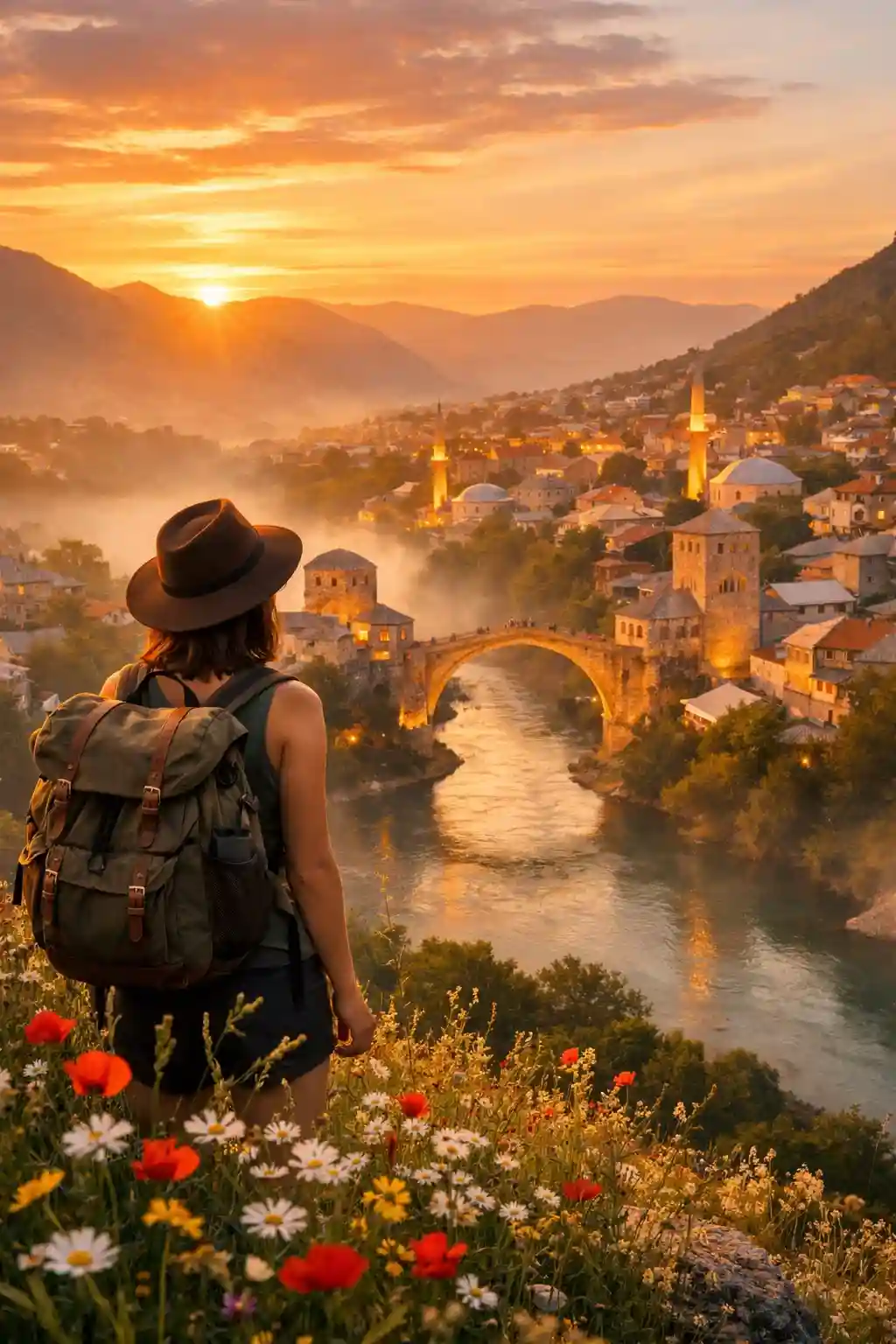
The Neretva is central to Mostar’s character. Instead of treating the river as something visible only from the Old Bridge, give yourself time to look from public terraces and accessible streets on both banks. Different angles reveal the height of the bridge, the tight urban fabric and the steep limestone setting.
The safest way to explore is to choose signed public paths and established viewing areas. Some attractive riverside images online are taken from slippery boulders or awkward banks. Do not descend steep, unstable or restricted approaches for a solo photograph, and never assume the river is safe for swimming simply because it looks clear. Its current and temperature can be hazardous.
If you prefer a calm afternoon, combine a river viewpoint with a bakery lunch and a slower walk toward the quieter edges of the historic core. It costs very little and keeps the day flexible when Mostar is hot or crowded.
5. Fortica Hill: Big Views, More Planning
Fortica rises above Mostar and offers a broad panorama of the city and its surrounding mountains. The area is associated with a sports and adventure park, ziplining, biking and other outdoor activities. It has a different feel from the historic center and can be especially appealing later in the day.
But do not interpret “close on a map” as “easy on foot.” The uphill route can be steep and exposed, with heat a serious concern in summer. A short taxi ride or prearranged transport is often the better solo option. The zipline operator publishes activities and contact details at ZIPLine Fortica; confirm whether a particular activity is operating and whether advance booking is needed.
A sunset is not a good reason to improvise a descent alone on unfamiliar roads. If you take a taxi up, ask about a scheduled pickup or agree on a return arrangement in advance. Bring water, a charged phone, offline maps and a light layer outside summer.
- Allow: 1.5–3 hours with transfer and viewpoint time; more for an organized adventure activity.
- Independent difficulty: moderate mainly because of transport and terrain.
- Do not assume: the skywalk, zipline or other activity has fixed daily opening hours; weather and operations matter.
- Best substitute: a central river viewpoint if you cannot confidently organize the return.
Half-Day and Full-Day Trips From Mostar
The next four places lie outside the city. Unlike the Old Town, they are not all straightforward by public transport. The easiest regional trip for a car-free visitor is generally Blagaj; the others require careful connections, an arranged driver or a small-group tour.
6. Blagaj: Buna Spring and the Tekke
Blagaj sits roughly 12 km southeast of Mostar. The defining view combines the steep cliff, powerful Buna spring and the white historic Tekke beside the water. It is popular, not hidden, but a change of pace from the city’s urban stone landscape. It also works well as a stand-alone half-day rather than part of a rushed six-stop bus tour.
Mostar Bus publishes Line 10 (Sjeverni logor–Blagaj) and Line 12 (Sjeverni logor–Blagaj–Malo Polje). Check the latest operator timetable, starting stop, service day and return departure at Mostar Bus. These routes are not necessarily as frequent or convenient as city services.
The operator announced an additional promotional Sunday summer service starting 21 June 2026, with a published 1.80 KM one-way fare and a three-month summer operating period. That is historical evidence of a particular seasonal initiative, not a year-round guarantee. For trips outside that period, use the regular timetable and confirm locally.
Plan time for the riverside walk, a thoughtful visit to the Tekke if open, and a café stop. The complex is a cultural and religious site; dress respectfully and obey any visitor restrictions. A taxi can still be appropriate when return buses do not work, but agree on the cost and pickup before you go. The most important detail for solo travelers is not the outward journey: it is knowing how to return.
- Allow: around 3–5 hours including transport, depending on connections.
- Ideal for: first-time independent travelers wanting nature and heritage in one place.
- Cost: bus fare plus optional refreshments and any applicable site admission; verify prices rather than assuming the Tekke is free.
- Solo checklist: save the bus stop, return timetable and accommodation location offline.
7. Počitelj: Historic Stone Village Above the Neretva
Počitelj is one of the region’s most striking hillside settlements, with stone homes, steps, the historic mosque and fortification remains above the Neretva. It is popular with tours and is not a hidden village, but staying longer than a quick group photo can make the experience feel completely different.
Allow time to climb slowly, look at the landscape from safe vantage points and appreciate how the settlement sits on the hillside. Stone steps can be uneven and very hot in summer. Take water, wear proper shoes and do not treat every tower or ruined-looking structure as open for entry. Posted access instructions take priority over online descriptions.
The transport problem is a reliable return from Počitelj. An intercity bus may follow the nearby corridor, but not every service will stop where you expect, and departure times may be unsuitable. If traveling without a car, confirm both directions with the actual bus operator before committing; otherwise arrange a taxi or a small-group excursion that includes Počitelj. A road-trip-style detour with no return plan is not sensible on a short solo stay.
- Allow: around 1–2 hours in the village; half a day once transfers are counted.
- Good for: photography, architecture, slower historic sightseeing.
- Physical demands: substantial stairs and exposed uphill paths.
- Best timing: earlier or later in the day in hot weather.
8. Radimlja and Stolac: A Quieter UNESCO Heritage Day
For travelers who want a location that feels less dominated by Mostar’s day-trip circuit, Radimlja is particularly worthwhile. This medieval necropolis near Stolac contains distinctive carved stećci tombstones. UNESCO includes Radimlja as one of the 28 components of the transnational Stećci Medieval Tombstone Graveyards World Heritage property.
Do not confuse the UNESCO status of the necropolis with a claim that every attraction in Stolac has the same designation. The region has several important historic places, and the town itself gives useful context to a visit focused on medieval burial traditions. The UNESCO property covers selected tombstone sites across four countries, with tombstones dating broadly from the 12th to 16th centuries.
Combine Radimlja with Stolac rather than arranging a complicated trip solely for a short stop at the stones. Allow time for the river landscape and historic town streets as well as the necropolis. The burial ground is a heritage site, not an adventure playground: do not climb on, touch or move stone monuments.
Radimlja lies outside the Stolac town center. Getting to Stolac by regional transport does not automatically solve the final leg. For many solo travelers a day rental car, local taxi arrangement, or organized heritage route is simplest. If using buses, verify the return service and the last-mile transfer before departing Mostar.
- Allow: a half day at minimum, ideally a fuller day for Stolac and Radimlja together.
- Best for: archaeology, carved medieval art, travellers interested in regional history.
- Logistics: moderate to challenging without arranged transport; check any site opening hours and admission on the day.
- Solo note: avoid isolated unofficial walking shortcuts between town and roadside heritage sites.
9. Kravica Waterfall: A Worthwhile Day Trip, Not a Secret
Kravica (also often spelled Kravice) Waterfall is famous and can be busy. Include it if you want a nature-focused day or if a combined Herzegovina excursion takes you there; do not add it to a list of “unknown” locations simply to increase the number of recommendations. The falls are more rewarding when you have time for the visitor paths and scenic views rather than arriving only for a hurried photograph.
The official visitor site lists 20 KM for a standard adult ticket year-round, with specific discounts and separate vehicle parking charges. Its published opening hours vary by month, and swimming is at visitors’ own risk. Check official Kravica visitor information for your date, including any changes to access or weather conditions.
For a car-free solo traveler, the main obstacle is not the attraction itself but the lack of a simple onward transport network between Mostar, Počitelj and the falls. If you want all three in one day, a group excursion often makes better logistical sense than several individual taxis.
Compare the current itinerary of a Mostar-based small-group Herzegovina tour if it suits your interests, and check whether Kravica admission, lunch and pickup are included. A place being included in a tour description is not proof that an operator runs on your specific date.
Which Mostar Hidden Gems Should You Choose?
| Your priority | Best choice | Why it works | What to watch |
|---|---|---|---|
| Lowest cost | Old Bazaar side lanes + Spanish Square | Mostly free and walkable | Heat and polished stones |
| Historic architecture | Spanish Square + Počitelj | Distinct Ottoman and Austro-Hungarian layers | Počitelj return logistics |
| Medieval history | Radimlja + Stolac | More specialized heritage experience | Last-mile transport |
| Landscapes near town | Blagaj | Practical half-day with bus planning | Timetable and return bus |
| Wide city panorama | Fortica | Hillside perspective | Sunset return and exposed climb |
| Nature and waterfall | Kravica | Fuller nature day | Entry fee and transit |
| No transport planning | City day + one organized excursion | Simple for a first solo trip | Confirm tour inclusions |
Getting to Mostar Without a Car
Most visitors arriving without a car come from Sarajevo, Dubrovnik or the wider Adriatic and Balkan bus network. A train can be attractive from Sarajevo when it operates, but published timetables do not guarantee a service on the travel date, especially after an interruption or temporary change. Check the railway operator and the day-specific service before making a connection you cannot miss.
For detailed station, ticket and service-status guidance, read our Sarajevo to Mostar train guide. For a longer trip that also includes Sarajevo, see our seven-day Bosnia and Herzegovina itinerary. They are better places to research intercity schedules than this local hidden-gems guide.
Buses also connect Mostar with major destinations. To compare a travel date you can use Sarajevo–Mostar buses on Busbud, but check the exact station, departure and luggage terms before purchase. Mostar has different bus stopping points; confirm where your specific operator departs.
Coming from Croatia or Montenegro adds international border formalities. Our Dubrovnik to Mostar guide compares border and bus-versus-tour decisions, while the Kotor to Mostar bus guide explains why cross-border schedules need particular care. Do not combine a tight international arrival with a nonrefundable Fortica activity or late regional pickup.
How to Move Around Mostar on Your Own
Walking: the default option
Most central sights are close enough to explore on foot. A hotel within reasonable walking distance of Stari Most and the main bus or rail station minimizes transport costs. Plan a route through the Old Town in the morning, an afternoon rest when it is very hot, and Spanish Square or a second viewpoint later. Use established pedestrian streets and expect stairs, bridges and uneven stones.
Local buses: useful for Blagaj, not every day trip
For Blagaj, the official Mostar Bus timetable is the starting point. Look at route number, the named origin stop, weekday/weekend status and return time. The service marked Mostar–Blagaj in an old blog may be a summer exception; do not apply it automatically to winter or a holiday.
Taxis: arrange the return before you go
A taxi can be worthwhile for Fortica, Blagaj after the last useful bus or a transfer to a less accessible regional stop. Ask about the price or meter policy, clarify whether waiting is included, and share the destination and pickup point in writing where possible. For an isolated viewpoint, try to book a return before you get dropped off.
Organized trips: most useful for multiple scattered stops
A tour is not necessary for the city centre. It can become cost-effective for one traveler who would otherwise pay for several taxi legs to Počitelj, Kravica or Radimlja. Before booking, confirm where you meet, the minimum group size, cancellation terms, admission exclusions and how long you actually spend at each location.
How Much Does a Solo Mostar Trip Cost in 2026?
These are planning allowances, not live quotes. Prices vary substantially with season, accommodation type and whether you travel with a tour. The official Kravica admission is given separately because it has a publicly listed fee; all other estimated amounts should be checked for your dates.
| Expense | Budget planning range | What changes the price |
|---|---|---|
| Dorm bed / simple room | Roughly 15–45 KM per night | Season, private bathroom, location |
| Private room / small hotel | Roughly 60–140+ KM per night | Summer demand and proximity to Old Town |
| Budget food day | Roughly 20–35 KM | Bakery breakfast, simple lunch, casual dinner |
| Comfort food day | Roughly 35–65+ KM | Sit-down meals, drinks, waterfront location |
| City walking | Usually free | Optional mosque/museum entries |
| Blagaj by public bus | Check operator fare; seasonal promotional service was 1.80 KM one way | Service day and 2026 summer-only promotions |
| Kravica adult admission | 20 KM standard entry | Official published rate; parking extra |
| Fortica adventure activity | Ask operator for a current quote | Which activity, weather, operating day |
| Regional small-group tour | Check live listing | Route, entry tickets, season and group size |
For example, a solo visitor who stays in a dorm and spends a day walking around Mostar can keep that day relatively inexpensive, while a private room, Fortica taxi and multi-stop excursion can change the budget quickly. Do not rely on a universal €25-per-day promise or fixed summer fares. Build your actual budget from a room quote, meals, your chosen paid sights and the cost of any out-of-town transport.
Bosnia and Herzegovina uses the convertible mark (BAM or KM). Although some visitor-facing prices are quoted in euros, carry marks for small purchases, taxis, local buses or cash-only attractions. Tipping, if you choose to leave any, is optional; it is not a mandatory supplement to displayed prices.
Where to Stay in Mostar for Solo Convenience
Near the Old Town
The strongest base for a short visit is within an easy walk of the old core, preferably on a street with clear night-time access. You can visit the bridge early, take a midday break and return after crowds disperse. The trade-off is possible noise from visitors and riverside venues. Check recent reviews for room quietness rather than relying solely on a map pin that says “old town.”
On the edge of the Old Town
Staying a few minutes outside the highest foot-traffic lanes often balances price, quieter nights and access to transport. This can be especially practical for solo travelers joining tours from a road-accessible meeting point rather than carrying luggage through narrow cobbled lanes.
Near the bus or rail stations
If your schedule begins with an early intercity departure, a station-area property may simplify the morning. Measure the actual walk to Stari Most and check the route after dark before paying for an inconvenient bargain. Not every accommodation described as “central” has the same accessibility.
You can compare Mostar accommodation on Trip.com. For solo travel, prioritize recent information about secure check-in, clean bathrooms, helpful hosts, late arrivals and whether the location feels straightforward to navigate at night.
Solo Female Travel, Evening Walks and Common-Sense Safety
Mostar’s busy historic centre can be comfortable to explore alone, but responsible advice is more useful than declaring any city universally safe. The risks most relevant to this itinerary are uneven paving, summer heat, unfamiliar quiet routes after dark, transport failures and exposed hillside walks. Use normal urban precautions with valuables and avoid leaving your return plan to chance.
- Book with clear check-in instructions. Confirm how to enter the property after a late coach or rail arrival.
- Keep a simple return route. Save your accommodation, bus stations and an agreed taxi pickup spot offline.
- Use daylight for Fortica and rural sightseeing. If you visit at sunset, arrange a driver or other reliable transport back.
- Share a trip plan when heading outside town. It is sensible for any solo hiker or traveler in remote areas, regardless of gender.
- Do not enter abandoned war-damaged structures. Some are unstable or unsafe. Avoid unmarked rural shortcuts and follow established tracks.
- Leave room for delays. Do not depend on the final bus from an unfamiliar village if missing it would strand you.
- Dress respectfully at religious sites. Observe prayer-time restrictions, covered areas and photography notices.
You do not need a guided tour simply because you are traveling alone. Guided help becomes particularly valuable where local logistics, physical activities or historical context justify it. For the Old Town, independent walking is usually the most practical introduction.
Eating Solo in Mostar: Simple and Good-Value Choices
Independent dining is uncomplicated in Mostar. Bakeries are useful for inexpensive breakfasts and early departure days; casual grills serve ćevapi and other local dishes; and coffee shops make it easy to take a break alone. Choose restaurants based on menus, location and current quality rather than spending precious sightseeing time crossing town for an unverified “number one” recommendation.
Try burek or another pita from a bakery, a plate of ćevapi with bread and onion, and Bosnian coffee when you have time to sit. Near the river, trout can also be a good regional option. Vegetarians should check ingredients carefully, especially in filled pastries and soups. Plan a couple of flexible meals instead of tying your itinerary to bookings that may not be needed.
One-Day Mostar Walking Route for Solo Travelers
| Part of the day | Plan | Reason |
|---|---|---|
| Early morning | Stari Most and nearby public viewpoints | Quieter photos before group traffic |
| Morning | Kujundžiluk side lanes, Crooked Bridge, coffee | Explore beyond the standard bridge approach |
| Late morning | Koski Mehmed Pasha Mosque area | Different bridge perspective and cultural stop |
| Lunch / hottest period | Casual lunch and rest | Avoid exposed uphill walking in summer |
| Late afternoon | Spanish Square and Mostar Gymnasium exterior | Different architecture and city history |
| Evening | Old Town or safe riverside viewpoint | Enjoy the city without a rushed departure |
| Optional only | Fortica with confirmed taxi/return | Panorama if conditions and logistics permit |
This is a city itinerary, not a day-trip itinerary. It deliberately avoids squeezing Blagaj and Počitelj into the same afternoon. Solo travel is often better with fewer, more meaningful stops and enough time to explore something that catches your attention.
Two Days in Mostar: Choose One Regional Excursion
Day 1: Mostar old and new
Follow the one-day walking route above. Do not overplan the museums or river viewpoints: choose the sites that interest you and let the city day remain flexible. Stay overnight so you can enjoy the atmosphere after day-trip groups leave.
Day 2: Pick your direction
- Most independent and economical: Blagaj by local bus, subject to the current timetable. Spend several hours beside the Buna and return to Mostar.
- Architecture and viewpoints: Počitelj with a prearranged return or tour, not an assumed roadside bus.
- Medieval history: Stolac plus Radimlja with the last leg arranged.
- Several highlights with less logistics: a small-group Herzegovina tour combining appropriate stops such as Blagaj, Počitelj and Kravica.
If you have an early international departure from Mostar on Day 2, do not book a long excursion. Choose a short walk, a safe lunch stop and a generous check-in buffer at the bus terminal instead.
Three Days in Mostar: A Slower Regional Plan
Day 1: Stari Most, side streets, city history at Spanish Square and a comfortable evening. Day 2: Blagaj with an independently verified local bus or arranged taxi; leave the afternoon open for a museum, long lunch or an additional Mostar walk. Day 3: choose either Radimlja–Stolac for medieval heritage or Počitelj–Kravica for architecture and nature. Do not attempt both branches unless you have the transport and energy for a genuinely long day.
If you are visiting Mostar as part of a wider journey through the region, the Balkans itinerary without a car explains realistic cross-country transfer days. If you are combining Serbia, Bosnia and Montenegro, see our 10-day Serbia–Bosnia–Montenegro route instead of adding more towns to your Mostar stay.
Best Time to Visit Mostar Beyond the Old Bridge
| Season | What works best | Practical caution |
|---|---|---|
| Spring | City walks, Blagaj spring scenery, Stolac | Rain changes river and trail conditions |
| Summer | Long evenings, excursions and outdoor activities | Intense heat; crowded Old Bridge; prebook some tours |
| Early autumn | Quieter city walks and hill viewpoints | Check seasonal bus and tour changes |
| Winter | Museums, urban history, cafés and slow travel | Short daylight and reduced outdoor operations |
Summer is the season when a midday climb at Fortica or Počitelj can be especially uncomfortable. Adjust your plan to the forecast, carry water and schedule uphill walks early or late. Outside summer, do not assume a seasonal tourism bus or adventure park activity is still running just because an online listing remains visible.
A Practical Checklist Before You Leave Mostar
- Confirm where your next bus or train departs, including which Mostar station your ticket names.
- Check the latest Mostar Bus listing if Blagaj is on your plan; note both outward and return times.
- Save offline maps of Old Town, your room, Fortica and any regional excursion meeting point.
- If visiting Radimlja or Počitelj independently, solve the final-mile and return transport in advance.
- Carry some convertible marks and water, and wear footwear suitable for smooth stones and steps.
- Read current admission and opening rules for paid attractions and religious sites.
- Leave a buffer after regional or international travel rather than booking back-to-back tours.
If you need mobile data for timetables, route changes and messages, you may compare Bosnia and Herzegovina eSIM plans on Airalo if your phone supports eSIM. Internet access does not replace offline maps or a confirmed return from remote stops.
Frequently Asked Questions About Solo Travel in Mostar
What are the best hidden gems inside Mostar itself?
Spanish Square and the Gymnasium exterior, Old Bazaar side lanes around the Crooked Bridge, quieter Neretva viewpoints and the Koski Mehmed Pasha Mosque area are easy to combine on foot. Fortica is a worthwhile hillside addition only when you have a safe return plan.
Is Mostar a good place to visit alone?
Yes for many independent travelers: the center is compact, sightseeing can be self-guided, and casual dining is easy. Treat hillside routes, late-night returns and remote day trips with the extra planning you would use anywhere.
Can I get to Blagaj without a car?
Yes. The Mostar Bus operator lists lines 10 and 12 toward Blagaj. Check today’s or your travel-date timetable and the return stop, since holiday patterns and seasonal services are not interchangeable.
Are Počitelj and Kravica hidden places?
No. Both are established Herzegovina sights. They are included because they are useful alternatives for a solo traveler extending a Mostar stay, especially with a tour or arranged car-based itinerary.
Is Fortica walkable from the Old Town?
It can be reached on foot by fit, prepared walkers, but the uphill route is not a casual city stroll. Heat, daylight and safe return logistics matter. A taxi can be more sensible when visiting for sunset or an adventure activity.
Is Radimlja part of UNESCO World Heritage?
Yes. The Radimlja necropolis near Stolac is one of the component sites included in UNESCO’s Stećci Medieval Tombstone Graveyards serial World Heritage property.
Do I need a rental car for Mostar?
Not for Mostar city or, with careful bus planning, for Blagaj. A vehicle or regional tour becomes useful when combining sites such as Počitelj, Radimlja, Stolac and Kravica in one day.
How many days should a solo visitor spend in Mostar?
One day works for the city, two days allow one meaningful regional excursion, and three days are better for a slower city stay plus separate Blagaj and historical or nature-focused trips.
What is the Kravica Waterfall entrance fee?
The official visitor site currently publishes a standard adult entry price of 20 convertible marks. Check any discounts, parking fees and seasonal opening hours directly before visiting.
Is Mostar better as a day trip or an overnight stop?
An overnight stay lets you explore the bridge area early and late, avoid midday crowds and add a less tourist-focused city route. A short day trip can be worthwhile, but it offers much less time for the city beyond Stari Most.
Sources and Fact-Checking Notes
Key logistics and heritage information is based on the Mostar Bus timetable and its 2026 summer-service announcement, the UNESCO stećci listing and official Kravica visitor information. Fortica activities can be checked directly with the local adventure operator. These sources provide published information, not a guarantee of a specific departure, price or opening on every future date.
Final Thoughts: The Mostar You Can Explore Alone
The best hidden gems in Mostar for solo travelers are the experiences that let you see more of the city without complicating your journey. Take time for Spanish Square, the side lanes of the old bazaar and views of the Neretva. Add Fortica when you can return safely. If you have another day, Blagaj offers a practical contrast; Počitelj or Radimlja–Stolac let you explore a different chapter of Herzegovina history.
You do not need to call every popular attraction a secret, or fit five out-of-town stops into one day. Mostar becomes a better solo destination when you let transport, weather, your interests and your own pace shape the plan rather than chasing the longest sightseeing checklist.