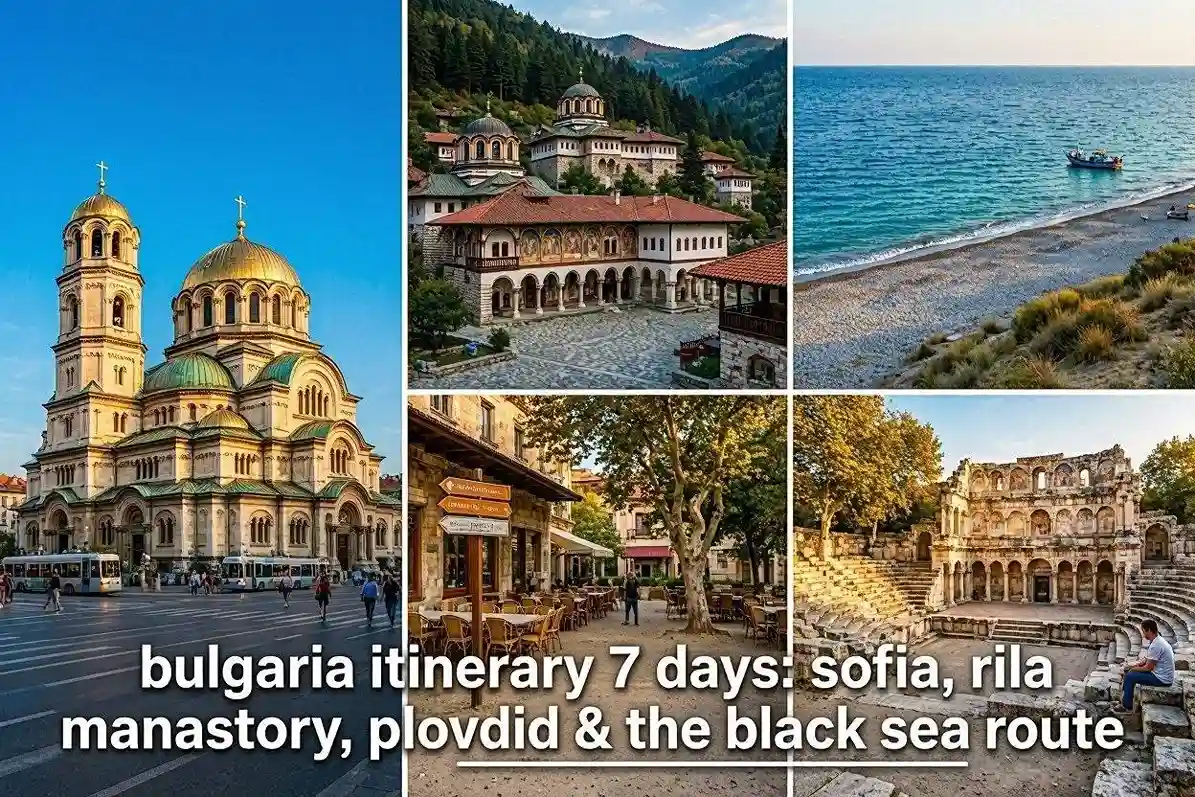
Bulgaria Itinerary 7 Days: Sofia, Rila & Plovdiv (2026)

A Bulgaria itinerary 7 days long can combine Sofia’s Roman ruins and lively cafés, the frescoes of Rila Monastery, Plovdiv’s historic hills and a final stop in Veliko Tarnovo. The trick is to choose an itinerary that fits actual bus and train connections instead of trying to collect every famous place in one week.
This guide gives you a practical seven-day, six-night inland route, plus a different summer option that swaps Veliko Tarnovo for the Black Sea. Both versions explain how to get around without a car, where to stay, when to book and how to build a realistic budget. It is written for independent international travelers—not as a claim that every timetable or price is guaranteed.
Table of Contents
Bulgaria Itinerary 7 Days: At a Glance
| Day | Plan | Overnight | Transport |
|---|---|---|---|
| 1 | Arrive, settle in and walk central Sofia | Sofia | Airport metro/taxi |
| 2 | Sofia: cathedral, Serdica, old and new city | Sofia | Walk/metro |
| 3 | Rila Monastery from Sofia | Sofia | Tour, suitable bus connection or car |
| 4 | Sofia → Plovdiv; Kapana and Roman Stadium | Plovdiv | Train or bus |
| 5 | Plovdiv Old Town, theatre and viewpoints | Plovdiv | Walk |
| 6 | Plovdiv → Veliko Tarnovo; Tsarevets | Veliko Tarnovo | Confirmed bus/train connection or car |
| 7 | Return to Sofia / onward departure | — | Intercity transport; leave flight buffer |
Overnight count: three nights in Sofia, two in Plovdiv and one in Veliko Tarnovo—six nights total. The seventh day is your departure day. If you have a morning flight from Sofia on Day 7, replace the Veliko Tarnovo night with a Sofia night and make Day 6 a less demanding travel day.
Which One-Week Route Should You Choose?
| Route | Best for | Travel reality | Final airport |
|---|---|---|---|
| Classic inland: Sofia–Rila–Plovdiv–Veliko Tarnovo | History, culture, varied cities | Possible without a car but Day 6 needs careful booking | Sofia, with buffer |
| Slow no-car: Sofia–Rila–Plovdiv–Sofia | Families, flexible travelers, early return flights | Fewest difficult transfers; more time in Plovdiv | Sofia |
| Summer coast: Sofia–Rila–Plovdiv–Burgas/Sozopol | Beaches in late spring to early autumn | Longer Day 5 transfer; cut Veliko Tarnovo | Burgas, preferably |
The Black Sea is an alternative route, not an extra stop that fits neatly into Day 6 of the inland itinerary. Varna and Burgas are different regional bases; choose the one that matches your onward flights and the beaches you want. Trying to add both coastal cities, Nessebar, Sozopol and Veliko Tarnovo in seven days defeats the purpose of a manageable trip.
Before You Travel: Practical Essentials for 2026
Bulgaria Uses the Euro, Not the Lev
From 1 January 2026 Bulgaria adopted the euro; since 1 February 2026 euro notes and coins have been the only legal tender. Some older guidebooks and websites still quote Bulgarian lev (BGN) amounts. The irrevocable conversion rate was €1 = BGN 1.95583, but use current euro prices when shopping and budgeting. The European Commission’s euro changeover guidance explains the transition.
Credit cards are common in major cities, but having a little euro cash remains useful at small cafés, regional bus offices, markets and mountain kiosks. Ask for a receipt and verify prices shown in an older currency rather than assuming a displayed lev number is payable as-is.
Schengen Entry, Visas and Insurance
Bulgaria is part of the Schengen Area, with internal land-border checks lifted from 1 January 2025. Whether you need a visa depends on nationality, residence status and travel-document type. If you travel under the Schengen 90-days-in-180 rule, time spent in Bulgaria counts with time in other Schengen countries. Check current entry conditions via your government and Bulgaria’s foreign ministry; do not assume that a visa-free stay elsewhere in the Balkans gives you entry to Bulgaria.
Travel insurance should cover your activities, particularly winter driving or mountain hiking. Check emergency medical cover, evacuation benefits and any sport exclusions before setting off.
Trains, Buses and Booking Ahead
For rail travel, use the official Bulgarian State Railways (BDZ) timetable and its linked online ticket system. Services, engineering works and ticket availability can change. For buses, check the operating company, departure bus station, arrival station and booking terms: larger cities can have more than one terminal.
The Sofia–Plovdiv corridor is straightforward compared with rural mountain trips. Do not assume there is always a simple public bus to Rila Monastery or a conveniently timed direct bus from Plovdiv to Veliko Tarnovo: look up the actual itinerary and return options before deciding.
Arrival at Sofia Airport
The M4 metro reaches Sofia Airport Terminal 2 and connects with central stops such as Serdika. Terminal 1 passengers may need the airport’s free interterminal shuttle to reach the metro. A ticket or contactless bank card can be used according to the current transport system rules. For late flights or considerable luggage, use an official taxi or prebooked transfer rather than a random driver.
Sofia is the most useful arrival point for this inland itinerary. Compare flight dates and luggage terms before fixing hotel nights: compare flights to Sofia on Trip.com.
Day 1 — Arrive in Sofia and Get Oriented
Make your first day easy. After checking into a hotel around Serdika, Vitosha Boulevard or the central pedestrian area, walk a short loop and allow time for a proper meal. Sofia combines Roman ruins, Orthodox churches, broad boulevards and contemporary cafés; those layers are more rewarding when you have not just stepped off an overnight flight.
An Easy Arrival-Day Walk
- Start at Vitosha Boulevard if your accommodation is nearby; it is convenient for food and orientation.
- Continue toward the National Palace of Culture gardens if you have time and energy.
- Alternatively, choose a short walk in central Sofia around Serdika and save the longer historical route for Day 2.
- Find dinner near your accommodation so you do not need a late taxi or another metro trip.
Where to stay: Serdika is useful for historic sights and metro connections; the Vitosha Boulevard area offers restaurants and evening atmosphere. A room near the central railway station can suit an early departure but should be judged by its actual walking route and neighborhood, not just price.
Day 2 — Explore Sofia’s Roman and Orthodox Heritage
Dedicate the day to a walking route through central Sofia. Several key places are near each other, while museums and interiors have opening times and may involve admission. Choose one or two paid activities instead of trying to visit every building.
Suggested Morning Walking Route
- Alexander Nevsky Cathedral: monumental architecture and a major city landmark; follow the rules for photography and services.
- Saint Sofia Church: an important historic building near the cathedral.
- Rotunda of St George: a remarkable surviving ancient church set among later buildings.
- Serdica archaeological remains: Roman-era remains integrated into the modern central area.
- Banya Bashi Mosque area: a good place to appreciate Sofia’s layered religious and architectural history from public spaces.
Afternoon Choices That Fit a Real Day
Visit the Regional History Museum or the National Archaeological Museum if you want indoor context; check the correct opening days and ticket prices. Otherwise, spend time around the National Theatre, gardens and central cafés. A relaxed afternoon leaves enough energy to enjoy traditional Bulgarian food in the evening.
Try shopska salad, banitsa and a slow-cooked local dish such as kavarma. Restaurants near headline tourist streets tend to be more expensive; a short detour often gives more choice. Tipping is optional, not a required fee.
Optional Vitosha Mountain Detour
If nature matters more than museums, use part of the day for a trip toward Vitosha Mountain, subject to public transport and weather. This is not an effortless add-on to every city checklist: trail access and operating lifts can change, and fog or winter ice will alter the plan. A first-time city visitor can save mountain hiking for another day.
Day 3 — Rila Monastery Day Trip from Sofia
Rila Monastery is the major excursion on this seven-day Bulgaria route. The UNESCO World Heritage-listed complex lies in the Rila Mountains, surrounded by forest, mountain slopes and some of the country’s most distinctive religious architecture. It was founded in the 10th century and much of its present visual character comes from the 19th-century reconstruction. Read the UNESCO Rila Monastery profile for historical context.
Getting There and Back
| Option | Why choose it | What to verify |
|---|---|---|
| Organized day trip | Most convenient for a traveler without a car | Pickup, return location, time at monastery, inclusions |
| Rental car | Freedom to stop at Rila town or Stob if conditions permit | Mountain road, weather, parking and rental insurance |
| Public bus / shuttle | Possible on selected services; may be less expensive | Exact service date, return ticket, departure location and transfer needs |
| Private driver | Useful for families or luggage-heavy groups | Total quoted fare and waiting time |
Allow approximately two hours each way by car as a broad planning assumption, with weather and traffic able to change it. For a public-transport trip, verify a same-day return rather than treating an online search result as a year-round local bus schedule. Rila town, Rila Monastery and the Seven Rila Lakes are separate destinations; a bus to one does not necessarily serve the others.
If the return bus timetable does not work, compare guided or transport-inclusive day trips and check what is included: compare Rila Monastery tours on GetYourGuide.
What to See—and What Not to Cram In
- The colonnaded courtyard and church exterior, with their distinctive striped arches.
- Religious frescoes and architecture; observe signs and photography restrictions.
- The monastery museum or tower, if open and if you want a deeper historical visit.
- Views of the surrounding Rila Mountains, without leaving safe paths.
Dress modestly, keep voices low and respect worshippers. Access to museum exhibitions may require a separate ticket even when entering the main courtyard does not. The monastery is a living religious place, not a film set.
Do not automatically add a full Seven Rila Lakes hike: the lakes are in a different part of the mountain range and a combined day is long and highly dependent on season, weather and transport. If hiking matters, read our Rila Monastery day hikes from Sofia guide and consider a separate hiking day.
Day 4 — Travel from Sofia to Plovdiv
Head east to Plovdiv, one of the country’s most appealing city stops. Both train and bus can work; compare the current door-to-door journey, not just the advertised vehicle time. Trains arrive at Plovdiv railway station, which may require a local bus or taxi to your accommodation.
Train, Bus or Rental Car?
Check Sofia–Plovdiv trains through BDZ; a number of services operate on this key corridor, but departures and durations vary by date and engineering work. For buses, confirm whether you are departing from Sofia’s Central Bus Station and exactly which terminal in Plovdiv the operator uses. In a car, you gain flexibility for countryside detours but also pay for parking while exploring a mostly walkable center.
Arriving around midday gives time for a first walk through central Plovdiv, a view of the Roman Stadium area and dinner in Kapana. Save the upper Old Town and Ancient Theatre for tomorrow when you have enough time to enjoy them.
Where to Stay for Two Nights
Kapana is convenient for cafés, restaurants and evening activity but can be lively at night. The central pedestrian streets are practical for first-time visitors. Plovdiv’s Old Town has attractive historic stays, although cobblestones and slopes can be inconvenient with rolling luggage. See our detailed Plovdiv travel guide for more neighborhood and attraction detail.
Day 5 — Plovdiv Old Town, Roman Theatre and Kapana
With a full day in Plovdiv you can explore its cultural layers without another hotel move. Most of the headline sights are within a manageable walking area, although Old Town slopes and uneven paving call for suitable shoes.
Morning: The Old Town and Ancient Theatre
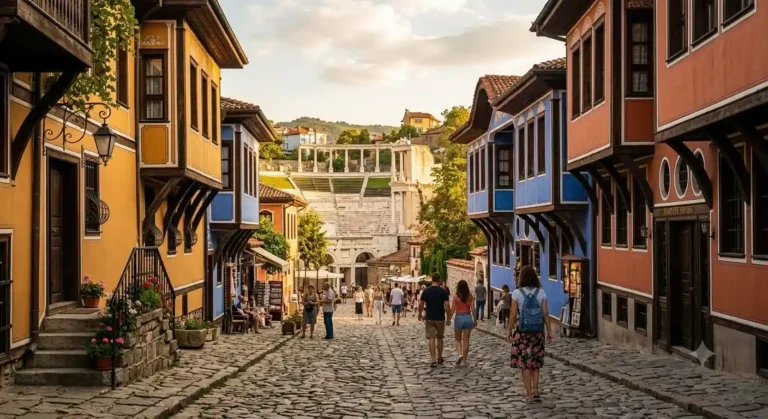
- Walk into the Old Town past Bulgarian National Revival-era houses and historic streets.
- Visit the Ancient Theatre of Philippopolis if open; performances and site access sometimes affect visits.
- Look for viewpoints from the upper historic neighborhood, rather than racing between every house museum.
Afternoon: Roman Stadium, Kapana and Nebet Tepe
Return to the Roman Stadium area and follow the central pedestrian axis. Explore one or two cafés and small design shops in Kapana. If conditions and site access permit, head to Nebet Tepe later for elevated views of the city. The hill may be affected by conservation works or access limits, so have a simple alternative viewpoint in mind.
If you have a car and strongly prefer a monastery or fortress instead of a full city day, Bachkovo Monastery and Asen’s Fortress make possible regional excursions. They are not free additions to a pedestrian day in Plovdiv. Pick between extra culture in the city and the out-of-town excursion, especially if traveling with children.
Plovdiv works well independently, but a guide can help connect the Roman and Revival-era history: browse Plovdiv tours and activities on GetYourGuide.
Day 6 — Plovdiv to Veliko Tarnovo (Inland Route)
Veliko Tarnovo adds a very different historic setting: hills, steep streets, views over the Yantra River and the imposing Tsarevets Fortress. It deserves an afternoon and evening, but the connection from Plovdiv needs more care than Sofia–Plovdiv. Bus availability and the best station can vary by date; some train journeys need connections or take a circuitous route.
Make the Transport Feasible First
Check Plovdiv → Veliko Tarnovo for the date you will travel, including the departure station and whether a connection is involved. If public transport cannot get you there until evening, do not book the overnight just to keep the article’s route intact. Instead, either hire a suitable transfer/car, move directly back toward Sofia, or add another Plovdiv night and skip Veliko Tarnovo.
What to See After Arriving
- Tsarevets Fortress: the central historical attraction; verify opening times before arrival.
- Samovodska Charshiya: a craft and old-town street worth wandering when workshops are open.
- Yantra River viewpoints: allow time for the town’s layered hillside scenery.
- Arbanasi: a nearby village to consider only with extra time and transport.
Stay near the old-town center or a practical arrival point, taking account of hilly streets and steps. Do not count on Tsarevets’ sound-and-light show running every night; events follow their own schedule.
Day 7 — Return to Sofia or Depart Bulgaria
If you spent the night in Veliko Tarnovo, Day 7 is primarily a transfer day. Check return buses or trains to Sofia, and budget ample time to reach the airport after arriving in the capital. A morning or midday flight from Sofia does not pair well with starting that day in Veliko Tarnovo. For early flights, redesign the sixth night around Sofia instead.
If you are continuing overland into another country, verify the border, train or bus connection independently. Bulgaria’s Schengen status affects entry conditions for some travelers, but it does not guarantee that international transport connections are frequent or direct.
Summer Alternative: Replace Veliko Tarnovo with the Black Sea
A summer Bulgaria itinerary 7 days long can end at the Black Sea, but the practical change is larger than simply switching Day 6. Use Plovdiv → Burgas on Day 5 or 6 and stay on the coast until departure. If your main flight must depart from Sofia, you are likely to lose much of the final day crossing the country.
| Day | Summer alternative | Overnight |
|---|---|---|
| 1 | Arrive and walk in Sofia | Sofia |
| 2 | Sofia sightseeing | Sofia |
| 3 | Rila Monastery excursion; travel timing to be planned | Sofia |
| 4 | Transfer to Plovdiv; explore Old Town/Kapana | Plovdiv |
| 5 | Spend part of day in Plovdiv; transfer to Burgas | Burgas or Sozopol |
| 6 | Choose Nessebar or Sozopol/beach day | Burgas or Sozopol |
| 7 | Depart from Burgas; Varna only if you separately plan the transfer | — |
Why Burgas and the Southern Coast Work Better Here
Plovdiv has direct rail services to Burgas taking around four hours on selected timetables, along with intercity buses that may use different Plovdiv and Burgas stations. Confirm schedules and seats with BDZ or the bus operator. Burgas is a workable transport base for Sozopol or Nessebar, but neither should be treated as a five-minute extension of the city.
For this exact route, choosing Burgas rather than adding Varna keeps the travel direction simpler. Varna makes sense for travelers prioritizing the northern coast, Golden Sands or Varna itself, or those with a confirmed flight departing from there. Do not plan a casual day trip from Burgas to every northern beach.
Which Coastal Town Should You Choose?
- Burgas: convenient regional transport and Sea Garden, useful as a practical base.
- Sozopol: old-town atmosphere and nearby beaches; allow for extra bus or taxi travel.
- Nessebar: UNESCO-listed historic peninsula; possible as a focused excursion from the Burgas area.
- Varna: better for travelers who build a dedicated northern Black Sea route rather than this Plovdiv–Burgas variant.
For more specific beach ideas, see our guide to quieter Bulgarian Black Sea beaches. Remote and protected beaches may need a car or hike and can have limited facilities, so they should not be assumed suitable for an unplanned public-transport day.
Bulgaria Itinerary Without a Car vs Self-Drive
| Question | Without a car | Rental car |
|---|---|---|
| Sofia and Plovdiv | Very practical with walking, metro, train and bus | Usually unnecessary in the city centers |
| Rila Monastery | Book a suitable day tour or confirm the exact bus/shuttle | More schedule freedom; watch winter roads |
| Plovdiv to Veliko Tarnovo | Possible, but verify the specific connection | More flexible and easier for Arbanasi detour |
| Black Sea | Straightforward to Burgas with planned train/bus; local transfers afterward | Useful for remote coves but adds parking costs |
| Costs | Usually lower for solo travelers | Can work well for groups, subject to insurance and fuel |
If renting a car, clarify deposit, insurance excess, tyre and winter requirements, parking and motorway vignette obligations. Verify whether the rental includes a valid Bulgarian e-vignette and whether crossing borders is permitted; neither should be assumed. A hybrid plan—walk in Sofia, take rail to Plovdiv, rent briefly for an out-of-town excursion—can be efficient, but only if pickup and return logistics make sense.
Compare rental terms carefully, including insurance excess, mileage and parking arrangements: compare car rentals in Sofia with DiscoverCars.
How Much Does a 7-Day Trip to Bulgaria Cost?
The following are illustrative planning allowances in euros for one traveler, not price quotes from a particular hotel, carrier or attraction. They cover six nights and seven calendar days; they exclude international flights, visas, unusually expensive paid tours and travel insurance. Summer coastal stays, private transfers and late booking can increase the total.
| Expense | Budget example | Mid-range example |
|---|---|---|
| Six nights accommodation | €180 (6 × €30) | €390 (6 × €65) |
| Seven days food and drinks | €140 (7 × €20) | €231 (7 × €33) |
| Intercity + local transport | €70 | €115 |
| Rila excursion transport | €40 | €60 |
| Attractions / museums | €35 | €65 |
| Contingency | €50 | €70 |
| Illustrative total | €515 | €931 |
These examples assume an independent traveler. A budget guesthouse or hostel and a few bakery meals might save money; a solo private room in a busy resort can cost more than the mid-range allowance. If you rent a car, replace the public-transport allowance with the actual rental quote, fuel, toll/vignette and parking. If you take a Rila tour that already includes transport, do not double-count it under local fares.
Where Spending Changes Most
- Sofia: convenient metro access may save several taxi trips.
- Plovdiv: a central hotel reduces the need for transport but may be pricier on weekends.
- Veliko Tarnovo: transport flexibility can be worth more than shaving a small amount off the room rate.
- Black Sea in July–August: seasonal demand and hotel location can have a larger effect than museum fees.
Before booking, compare refundable rates for Sofia, Plovdiv and your chosen last city; check the map and total price: compare accommodation across Bulgaria on Agoda.
Best Time to Follow This Route
April–June: Great for the Inland Loop
The weather is often comfortable for walking around Sofia, Plovdiv and Veliko Tarnovo. Rila remains cooler than the cities and mountain rain is possible. Late spring is especially attractive if you care more about cultural visits than swimming.
July–August: Consider a Coastal Finish
This is the easiest seasonal case for spending two nights at the Black Sea, but popular seaside accommodation can be busier and more expensive. Sofia and Plovdiv may be hot at midday, so do the major outdoor sightseeing early and reserve afternoons for shade or indoor stops.
September–October: Cities and Autumn Atmosphere
Early autumn is generally appealing for old towns and walking. The coast can remain pleasant in early September but swimming weather is less predictable as the season progresses. Reconfirm transport and attraction hours after summer.
November–March: Simpler, More Weather-Resilient Plans
Winter means shorter daylight, possible mountain road disruptions and more limited usefulness for a beach itinerary. Consider spending more time in Sofia and Plovdiv, and treat Rila transport and any mountain walk as weather-dependent.
Practical Travel Tips and Common Mistakes
- Do not use old lev prices as 2026 cash instructions: the euro is now the currency.
- Do not confuse Rila Monastery with the Seven Rila Lakes: they require different access planning.
- Check which Plovdiv bus station a service uses: not all coaches leave from one terminal.
- Do not book a fixed morning Sofia flight after sleeping in Veliko Tarnovo: protect your connection with a Sofia overnight.
- Do not add the entire Black Sea to Day 6: make it a genuine alternative itinerary, ideally ending with a coastal flight.
- Check seasonal and religious opening hours: active churches and monasteries may restrict visits during services.
- Pack for cobblestones and temperature changes: supportive shoes, rain layer, sun protection and a warmer layer for Rila.
- Keep ticket information offline: train tickets, hotel addresses and international documents should work even without mobile data.
- Ask about luggage and early check-in: several nights involve station-to-hotel transfers.
Families or travelers who need a slower pace should consider cutting Veliko Tarnovo and keeping the final night near Sofia. Couples focused on culture may prioritize an extra Plovdiv evening; beach lovers can reduce inland sights rather than running the trip on a checklist.
Frequently Asked Questions About a 7-Day Bulgaria Itinerary
Is seven days enough to see Bulgaria?
Seven days is enough for a good introduction to Sofia, Rila Monastery and Plovdiv, plus one further area. It is not enough for a relaxed visit to all Bulgaria’s historic towns, mountains and Black Sea resorts.
What is the best Bulgaria itinerary for first-time visitors?
The inland route of Sofia, Rila Monastery, Plovdiv and Veliko Tarnovo is a strong choice if connections work. With an early Sofia return flight, keep the final night in Sofia instead of Veliko Tarnovo.
Can I visit Bulgaria for a week without renting a car?
Yes. Sofia and Plovdiv work particularly well using metro, train, buses and walking. For Rila Monastery, confirm a suitable shuttle/public bus or book a day trip. Check onward transport before committing to Veliko Tarnovo.
What currency does Bulgaria use in 2026?
The euro. Bulgaria adopted it on 1 January 2026 and euro banknotes and coins became the sole legal tender from 1 February 2026. Older Bulgarian lev prices may still appear in outdated online guides.
Can I see Sofia, Plovdiv and the Black Sea in seven days?
Yes, if you keep each stop limited and ideally fly home from Burgas or Varna. This becomes a summer-focused route that replaces Veliko Tarnovo rather than adding the sea to the inland loop.
How do I reach Rila Monastery from Sofia?
You can use an organized tour, a suitable prebooked bus/shuttle, a private transfer or a rental car. Public transport arrangements require current-date verification, particularly for a reliable same-day return.
Should I fly home from Sofia, Burgas or Varna?
For the classic inland trip, Sofia usually makes sense. For the southern Black Sea option, a Burgas departure prevents lengthy backtracking. Choose Varna if you build your trip around the northern coast and verify airport connections.
Final Thoughts: The Most Realistic Week in Bulgaria
A memorable Bulgaria itinerary 7 days does not need every attraction. Three nights in Sofia, including a Rila Monastery day trip, followed by two nights in Plovdiv provide a varied and manageable core. Veliko Tarnovo adds history and views if your final transport fits, while the Black Sea is a worthwhile alternative for summer travelers who can depart from the coast.
Decide your departure airport first, confirm the least flexible transport links before paying for hotels, and budget in euros rather than relying on old lev figures. With realistic connections and enough time in each place, a week in Bulgaria delivers much more than a rushed country checklist.