How to Get Around the Balkans by Bus, Train & Car: What Actually Works

Knowing how to get around the Balkans is one of the most important parts of planning a successful trip in this region. The Balkans are beautiful, affordable, and full of amazing cities, mountains, coastlines, old towns, lakes, and villages. But transport here does not always work like Western Europe. Trains are not everywhere, bus schedules can change, border crossings can take time, and some of the most beautiful places are not easy to reach without a car.
For most first-time visitors, buses are usually the most useful way to travel between Balkan cities. They connect places that trains do not reach, they are often cheaper than private transfers, and they work well for popular routes such as Belgrade to Sarajevo, Sarajevo to Mostar, Kotor to Budva, and Tirana to Shkoder. However, buses are not perfect. They can be slow, some stations feel confusing at first, and online information is not always complete.
Trains can be comfortable and scenic, especially on selected routes such as Sarajevo to Mostar, Belgrade to Novi Sad, Sofia to Plovdiv, and the famous Bar to Belgrade railway. But Balkan train travel is limited compared with Central or Western Europe. If you build your full itinerary only around trains, you may miss many destinations or spend too much time waiting for connections.
Rental cars give you the most freedom, especially for national parks, mountain villages, hidden beaches, viewpoints, and monasteries. A Balkans road trip can be unforgettable, but it also requires planning. You must check border crossing permission, Green Card insurance, parking rules, one-way rental fees, mountain roads, and summer traffic on the Adriatic coast. This guide explains what actually works, what is slow, and how to choose the best transport option for your trip.
Quick Answer: What Is the Best Way to Get Around the Balkans?
The best way to get around the Balkans depends on your route, budget, travel style, and how much flexibility you want. But for most first-time travelers, the simple answer is:
- Buses are best for most cross-border routes and many city-to-city journeys.
- Trains are useful only on selected routes, especially where the route is scenic or reliable.
- Rental cars are best for nature, villages, national parks, beaches, and flexible road trips.
- Private transfers and tours are useful for difficult routes, short trips, or places with poor public transport.
If you are planning your first trip and want a practical rule, use Balkans by bus for major cities, add trains only where they make sense, and rent a car only for the part of the trip where public transport becomes too slow or limited. This approach keeps your itinerary realistic and helps you avoid one of the biggest first-time mistakes: trying to visit too many countries in too few days.
Table of Contents
Balkans Transport at a Glance
Before choosing between bus, train, car, ferry, or private transfer, it helps to understand the role of each transport option. The Balkans are not one single transport system. Each country has its own networks, companies, stations, road conditions, and booking habits. A route that is easy in Serbia may be slower in Bosnia and Herzegovina. A coastal trip in Croatia may work well by ferry, while a mountain trip in Montenegro may be much easier by car.
| Transport | Best for | Pros | Cons | Best countries/routes | Approximate cost level |
|---|---|---|---|---|---|
| Bus | City-to-city travel, cross-border routes, budget trips | Wide coverage, usually affordable, many direct routes | Can be slow, schedules may change, stations can be confusing | Serbia, Bosnia, Montenegro, Albania, Kosovo, North Macedonia | Low to medium |
| Train | Scenic journeys, selected domestic routes, relaxed travel | Comfortable, scenic, less stressful than driving | Limited network, slow on many routes, weak cross-border coverage | Sarajevo–Mostar, Belgrade–Novi Sad, Sofia–Plovdiv, Bar–Belgrade | Low to medium |
| Rental car | Nature, mountains, villages, families, road trips | Maximum freedom, easier access to remote places | Border rules, insurance, parking, one-way fees, mountain roads | Montenegro, Albania, Serbia, Bosnia, Croatia | Medium to high |
| Private transfer | Hard routes, airport transfers, short trips, groups | Door-to-door, flexible, saves time | More expensive than buses | Mostar–Kotor, Dubrovnik–Kotor, Tirana–Ohrid, rural areas | Medium to high |
| Ferry | Islands and coastal travel | Scenic, useful on the Adriatic coast | Seasonal routes, weather changes, limited inland use | Croatia coast, selected Montenegro or Albania connections | Low to medium |
| Domestic flight | Long distances or avoiding very slow routes | Can save time on longer journeys | Limited usefulness, airport transfer time, not always cheap | Larger hubs such as Belgrade, Sofia, Zagreb, Tirana | Medium to high |
Important planning note: Do not assume that the fastest-looking route on a map is the easiest route in real life. Mountains, borders, road conditions, limited timetables, and seasonal traffic can make short distances take longer than expected.
Getting Around the Balkans by Bus
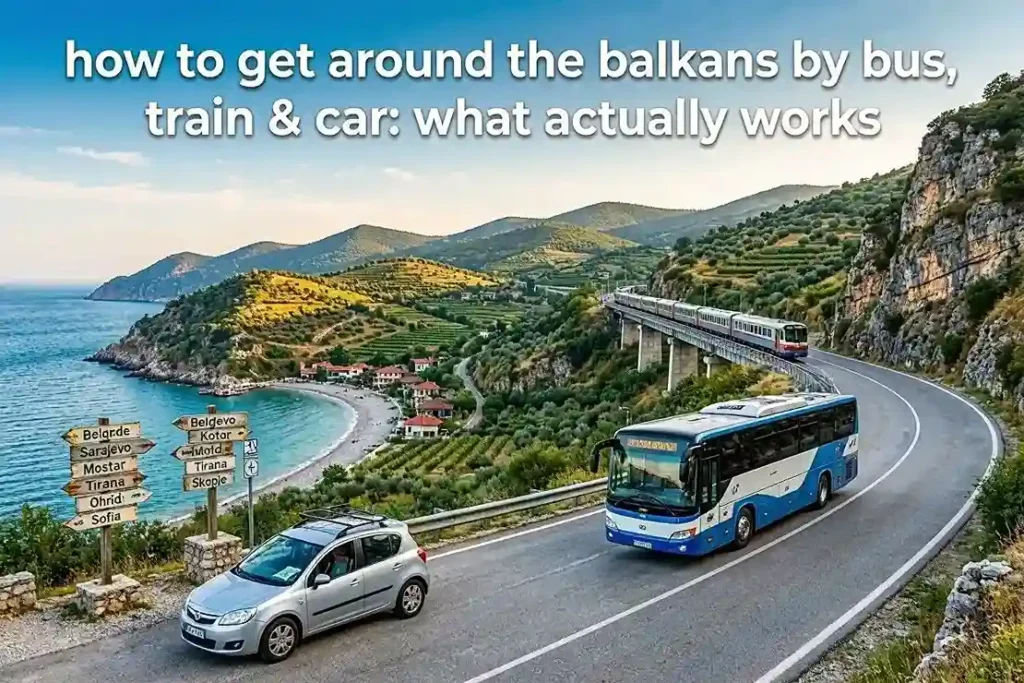
Buses are the backbone of Balkans public transport. If you are trying to understand how to get around the Balkans without renting a car, start with buses. They are usually the most practical option for crossing borders, reaching medium-sized towns, and connecting popular travel stops that do not have reliable train service.
In many parts of the region, the bus network is stronger than the rail network. This is especially true in Bosnia and Herzegovina, Montenegro, Albania, Kosovo, and North Macedonia. You may find direct or semi-direct buses between major cities, but you should still check details carefully. Some routes operate daily, some are seasonal, and some may require a change even when the distance looks simple on a map.
Cross-Border Buses
Cross-border buses are one of the main reasons travelers choose Balkans by bus. They can connect capitals, coastal towns, and inland cities without the need to rent a car. Routes such as Belgrade to Sarajevo, Dubrovnik to Kotor, Skopje to Sofia, and Budva to Tirana are common examples of journeys where buses often make more sense than trains.
However, cross-border buses are not always fast. The bus may stop at more than one town, luggage may be checked, and every passenger must pass border control. In summer, coastal borders can be slow, especially around Croatia, Montenegro, Albania, and Bosnia and Herzegovina. For this reason, it is smart to avoid tight same-day connections after an international bus journey.
For many city-to-city and cross-border journeys, buses are one of the most practical ways to travel around the Balkans. You can compare Balkan bus routes and tickets on Busbud and check available departure times, operators and prices before building the next stage of your itinerary.
Local Buses, Minibuses, and Shared Vans
Local buses are useful for shorter trips, especially between nearby towns. In some countries, especially Albania and parts of Kosovo and North Macedonia, you may also find minibuses or shared vans. These can be very practical, but they may feel informal if you are used to Western European transport systems.
For example, a traveler going from Tirana to Shkoder may find regular bus or minibus-style transport. Someone going toward Theth or Valbona may need a combination of bus, shared van, ferry, or local transfer depending on the season and exact route. This does not mean the trip is impossible. It simply means you should confirm the current option before booking non-refundable accommodation.
Bus Stations and Tickets
Bus stations in the Balkans vary a lot. Some are modern and easy to understand. Others are older, busy, or confusing for first-time travelers. In many places, you may buy tickets at the station window, from a small agency, online through a booking platform, or sometimes directly from the driver. Always keep some cash with you because card payment is not guaranteed everywhere, especially for local routes, luggage fees, toilets, and small station charges.
Luggage rules also vary. On some longer bus routes, larger bags go under the bus and a small extra luggage fee may be collected in cash. This is usually not a big amount, but it is one of those small details that surprises first-time visitors. Keep your passport, wallet, phone, medication, and important documents with you inside the bus, not in the luggage hold.
First-time traveler warning: Do not rely on one old timetable screenshot from a blog, forum, or social media post. Balkan bus routes can change by season, company, roadworks, holidays, and demand. Check again close to your travel date.
Useful Bus Route Examples
These are examples of routes where buses are often useful for travelers planning a multi-country itinerary. Travel times and availability can change, so treat them as planning examples, not fixed schedules.
| Route | Why it works by bus | Planning note |
|---|---|---|
| Belgrade to Sarajevo | A practical cross-border connection between two major Balkan cities. | Expect a long journey and allow buffer time for the border. |
| Sarajevo to Mostar | Buses are common, though the train is also a beautiful option. | Compare bus and train times before choosing. |
| Mostar to Kotor | Useful for connecting Bosnia and Herzegovina with Montenegro. | This can be slower or less frequent than it looks on a map. |
| Kotor to Budva | A short coastal route where buses are usually convenient. | Summer traffic can make short distances slower. |
| Budva to Tirana | A useful cross-border route for combining Montenegro and Albania. | Check seasonal frequency and border timing. |
| Tirana to Shkoder | A common domestic route in northern Albania. | Useful before heading toward Lake Shkoder, Theth, or Valbona. |
| Ohrid to Skopje | One of the most useful public transport routes in North Macedonia. | Good for travelers combining Lake Ohrid with the capital. |
| Sofia to Plovdiv | Both buses and trains can work well on this route. | Compare comfort, timing, and station location before booking. |
The key lesson is simple: buses give you the widest reach. If your goal is to travel around the Balkans without a car, learn how to use bus stations, build buffer time into your plan, and confirm each important route before locking in hotels.
Getting Around the Balkans by Train
Traveling through the Balkans by train can be beautiful, relaxed, and memorable, but it is not always the most practical way to build a full itinerary. This is one of the most important things to understand when learning how to get around the Balkans. Trains exist in several countries, and some routes are genuinely worth taking, but the railway network is not as connected or frequent as in Western Europe.
Many first-time visitors imagine they can move around the Balkans like they would in Italy, Germany, France, Austria, or Switzerland. In reality, that approach can lead to frustration. Some countries have useful domestic train routes. Some have scenic journeys. Others have limited international train options or no useful train connection for the route you actually want.
Where Trains Work Well
Trains work best when you choose routes that are known to be practical, scenic, or both. For example, the train between Sarajevo and Mostar is one of the most attractive rail journeys in the region. It passes through dramatic mountains and river valleys, making it a great choice if the schedule fits your plan.
In Serbia, the route between Belgrade and Novi Sad can be useful for travelers who want an easy city connection. In Bulgaria, Sofia to Plovdiv is another route where both trains and buses may work, depending on your preferred departure time, comfort level, and station location. If you enjoy scenic rail travel, the famous Bar to Belgrade railway is also worth considering, especially for travelers who want the journey itself to be part of the experience.
Travel tip: Use trains in the Balkans when the route is scenic, direct, and easy to confirm. Do not use trains simply because they look more romantic or more “European” than buses.
Where Trains Are Limited
The main limitation of Balkan train travel is coverage. Some major tourist routes are not well served by train. For example, travelers moving between coastal Montenegro, Albania, Kosovo, North Macedonia, and Bosnia often find buses much more useful. In Albania, public transport is mostly based on buses and minibuses for travelers. In Montenegro, trains can be interesting for certain inland routes, but buses are usually more practical for Kotor, Budva, and the coast.
Cross-border train planning can also be difficult. A route may look possible on a map, but the actual service may be limited, seasonal, suspended, indirect, or slower than expected. This is why many travelers use a mix of trains and buses instead of trying to complete the whole region by rail.
Why Trains Can Be Slower Than Expected
Trains in the Balkans can be slower than expected for several reasons. Some lines pass through mountains, older infrastructure, or rural areas where speed is not the priority. In some cases, the train station may also be less convenient than the bus station. A bus may leave from a central station and arrive closer to your destination, while a train may require extra taxi or local transport at the beginning or end.
This does not mean trains are bad. It simply means they should be chosen carefully. If the route is scenic and you are not in a rush, a train can be one of the best memories of your trip. If you are trying to move quickly between countries, a bus or private transfer may be better.
Practical warning: Do not build a tight Balkan itinerary around trains unless you have already checked the exact route, station, travel time, and current timetable. A beautiful train journey is great. A missed connection can ruin a travel day.
Getting Around the Balkans by Rental Car
Traveling through the Balkans by car gives you a completely different experience. A rental car is not necessary for every traveler, and it is not always the cheapest option. But for the right itinerary, it can be the best decision you make. It gives you freedom to stop at viewpoints, visit villages, reach national parks, explore hidden beaches, and move at your own pace.
A Balkans road trip works especially well if your trip focuses on nature rather than only capital cities. If you want to visit mountain regions, remote monasteries, lakes, small villages, or rural guesthouses, public transport may become slow or inconvenient. A journey that takes a full day by bus and transfer may take only a few flexible hours by car.
When Renting a Car Is Worth It
Renting a car is usually worth it if your Balkan trip includes:
- National parks such as Durmitor in Montenegro or Tara National Park in Serbia.
- Mountain villages, viewpoints, hiking bases, and rural guesthouses.
- Hidden beaches or small coastal villages that are not well connected by bus.
- Remote monasteries, lakes, and countryside stops.
- Family travel where flexibility matters more than the lowest possible price.
- Group travel where the total cost can be shared between several people.
For example, you can visit Belgrade, Sarajevo, Mostar, Kotor, Budva, Tirana, Ohrid, Skopje, and Sofia by public transport if you plan carefully. But if you want to add mountain roads, small villages, remote lakes, Albanian Riviera stops, Durmitor viewpoints, or rural Bosnia, a car becomes much more useful.
Rental Car Challenges in the Balkans
The main challenge with renting a car in the Balkans is not driving itself. Many main roads are perfectly manageable for confident drivers. The bigger challenge is paperwork, borders, parking, and planning. If you rent a car in one country and want to drive into another, you must confirm that the rental company allows it.
- Border crossing permission: Always tell the rental company which countries you plan to enter.
- Green Card insurance: Some cross-border trips require extra insurance documents.
- One-way rental fees: Picking up a car in one country and dropping it in another can be expensive.
- Parking: Old towns such as Kotor, Dubrovnik, Mostar, and coastal resorts can have limited or expensive parking.
- Mountain roads: Roads can be narrow, winding, and slow, especially in rural or highland areas.
- Summer traffic: Coastal roads in Montenegro, Croatia, and Albania can become very busy in peak season.
Do not skip this: If you plan to cross borders with a rental car, confirm permission in writing before booking. Do not assume every rental car can be driven into every Balkan country.
A rental car can be especially useful for national parks, mountain villages, remote beaches and countryside routes where public transport is limited. You can compare car rental options on DiscoverCars before deciding where to add a car to your itinerary. For multi-country trips, always confirm the supplier’s cross-border policy, required documents and additional fees before booking.
Bus vs Train vs Car: Which One Should You Choose?
Choosing between bus, train, and car is the heart of any good Balkans transportation guide. There is no single perfect option for everyone. The best choice depends on whether you want to save money, avoid stress, travel slowly, see nature, or cover several countries in one trip.
| Traveler type | Best option | Why |
|---|---|---|
| First-time travelers | Bus + selected trains | This gives good coverage without the stress of driving across borders. |
| Budget travelers | Bus | Buses are usually the most affordable way to connect major cities and towns. |
| Families | Rental car or private transfer | More comfort, luggage space, and flexibility for children and slower travel days. |
| Nature lovers | Rental car | National parks, mountains, and villages are often easier with your own vehicle. |
| Short trips | Direct bus, tour, or private transfer | You save time by avoiding complicated connections. |
| Multi-country itineraries | Bus + occasional car or transfer | This is usually the most realistic way to balance cost, time, and flexibility. |
For most travelers, the smartest strategy is not choosing only one method. Use buses for the major Balkan bus routes, trains for scenic or reliable sections, and a rental car for the places where public transport becomes too limited. This mixed approach is often the most realistic way to get around the Balkans without wasting time or money.
Simple strategy: If your route is mostly Belgrade, Sarajevo, Mostar, Kotor, Budva, Tirana, Ohrid, Skopje, and Sofia, public transport can work. If your route includes mountains, villages, hidden beaches, and national parks, add a car for that section only.
Country-by-Country Transport Guide
One of the best ways to understand how to get around the Balkans is to look at each country separately. The region may look compact on a map, but transport quality, route frequency, and travel style can change a lot from one country to another. Some places are easy by bus, some are better by train, and some become much easier with a car.
Serbia
Serbia is one of the easier Balkan countries for first-time travelers to navigate. Belgrade is the main transport hub, with bus connections to many Serbian cities and international routes to Bosnia and Herzegovina, Montenegro, North Macedonia, Bulgaria, Croatia, and beyond. If your itinerary starts in Belgrade, you will usually have several practical options for continuing your trip.
For domestic travel, buses are useful for routes to Niš, Novi Sad, Zlatibor, and smaller towns. Trains can also work well on selected routes, especially between Belgrade and Novi Sad. For nature-focused trips such as Tara National Park, Uvac Canyon, mountain viewpoints, monasteries, or rural guesthouses, renting a car can save a lot of time.
Best Serbia strategy: Use Belgrade as your main base, take buses or trains for city routes, and consider a car for Tara National Park, monasteries, countryside stops, and mountain areas.
Bosnia and Herzegovina
Bosnia and Herzegovina is beautiful, but transport can be slower than first-time visitors expect. Sarajevo and Mostar are the two main stops for many travelers, and both are connected by bus and train. The Sarajevo to Mostar train is one of the most scenic rail journeys in the Balkans, so it is worth checking if the timing works for your plan.
Buses are useful for Sarajevo, Mostar, Jajce, Travnik, and cross-border routes, but rural access can be limited. If you want to visit waterfalls, mountain villages, remote viewpoints, or countryside areas, a tour, private transfer, or rental car may be easier than trying to combine several local buses in one day.
Montenegro
Montenegro is small, but travel times can be longer than they look because of mountains, coastal traffic, and winding roads. Coastal buses are useful between Kotor, Budva, Tivat, Herceg Novi, Bar, and Ulcinj. If your trip is focused only on the coast, you can often manage without a car, especially outside very busy travel days.
For Durmitor National Park, Žabljak, mountain roads, viewpoints, and remote lake areas, a car becomes much more useful. Public transport may be possible to some mountain towns, but it is not always flexible enough for hiking, photography stops, or visiting several viewpoints in one day.
Montenegro warning: Do not judge travel time by distance only. Kotor to Budva looks short, but summer traffic can make the journey much slower than expected.
Albania
Albania is one of the most rewarding Balkan countries, but it requires flexible planning. Tirana is the main hub for many bus and minibus routes. Travelers often use buses or minibuses for Tirana to Shkoder, Tirana to Berat, Tirana to Gjirokaster, Tirana to Saranda, and connections toward Lake Ohrid.
For northern Albania, including Shkoder, Theth, Valbona, and the Komani Lake ferry route, public transport may involve a combination of vans, boats, and local transfers. It can work well, but you should confirm the current arrangement locally, especially outside peak season.
The Albanian Riviera is possible by bus or minibus, but a car gives more freedom if you want to stop at smaller beaches, viewpoints, and villages. Parking and summer traffic can be challenging in popular coastal towns, so a car is useful, but not always relaxing.
North Macedonia
North Macedonia is relatively simple for travelers using buses. Skopje and Ohrid are the two main stops for many visitors, and buses are usually the most practical way to connect them. Matka Canyon is close to Skopje and can be visited by local transport, taxi, tour, or rental car, depending on your comfort level and timing.
For a first-time itinerary, buses are usually enough for Skopje, Ohrid, and some common domestic routes. If you want to explore rural areas, monasteries, mountain landscapes, or lake villages at your own pace, a car can add flexibility.
Kosovo
Kosovo is generally practical by bus. Pristina, Prizren, Peja, and other towns are connected by frequent local or regional buses. For travelers who want a simple city-based route, Kosovo can be easier than expected. Prizren is especially popular for travelers combining Kosovo with North Macedonia or Albania.
For Rugova Canyon, mountain areas near Peja, hiking routes, and remote villages, you may need a taxi, local tour, or car. As always in the Balkans, city-to-city travel is usually easier than nature-focused travel.
Bulgaria
Bulgaria has one of the more useful combinations of buses and trains in the region. Sofia is the main hub, and Plovdiv is one of the easiest major city additions. Both buses and trains can work for Sofia to Plovdiv, so it is worth comparing departure times, comfort, and station convenience.
For Rila Monastery, many travelers use day tours, rental cars, or organized transport because public transport can be less convenient for a simple day trip. For the Black Sea, buses and trains may both be options depending on your destination, season, and available schedule.
Croatia
Croatia is often included in Balkan routes because it connects naturally with Bosnia and Herzegovina, Montenegro, and sometimes Slovenia or Serbia. Buses are very useful between Dubrovnik, Split, Zagreb, and nearby cross-border destinations. Dubrovnik to Kotor and Split to Mostar are common examples of routes travelers often research when planning a wider Balkan itinerary.
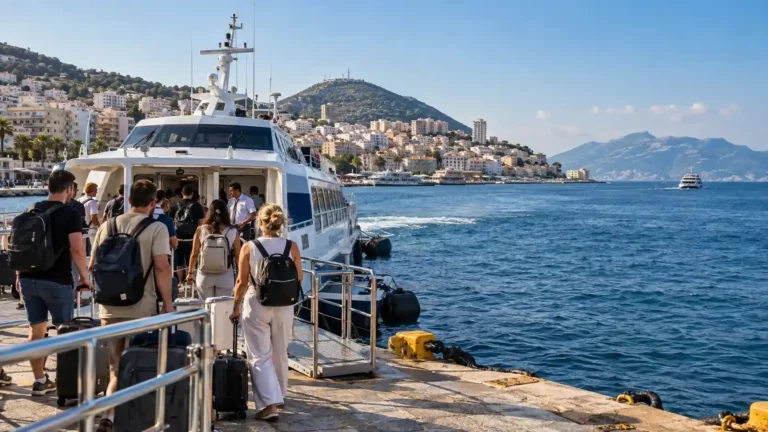
Ferries are important on the Croatian coast and islands, especially in warmer months. If your route includes islands, always check ferry schedules directly with operators because routes can be seasonal and weather can affect plans. A car is helpful in some areas, but parking in Dubrovnik, Split, and coastal old towns can be expensive and stressful.
Best Balkan Routes by Public Transport
The following routes are useful examples for travelers planning the Balkans by bus, train, or a mix of both. They are not fixed schedules, and they should not be treated as guaranteed daily services. They are practical route ideas to help you understand which connections usually make sense when planning a real itinerary.
| Route | Best transport | Approximate travel style | Difficulty level | Notes |
|---|---|---|---|---|
| Belgrade to Sarajevo | Bus | Long cross-border city connection | Medium | Allow buffer time for border checks and possible delays. |
| Sarajevo to Mostar | Train or bus | Scenic domestic route | Easy | The train is scenic if the timetable fits your plan. |
| Mostar to Kotor | Bus or transfer | Cross-border mountain/coastal connection | Medium to hard | Check current frequency carefully; transfers may save time. |
| Kotor to Budva | Bus | Short coastal route | Easy | Very useful, but summer traffic can slow the journey. |
| Budva to Tirana | Bus | Cross-border coastal-to-capital route | Medium | Check seasonality and avoid tight onward plans. |
| Tirana to Shkoder | Bus or minibus | Domestic city route | Easy | Good gateway for northern Albania and Lake Shkoder. |
| Tirana to Ohrid | Bus or transfer | Cross-border lake route | Medium | Direct options can vary; check before booking accommodation. |
| Ohrid to Skopje | Bus | Domestic lake-to-capital route | Easy | One of the most useful routes in North Macedonia. |
| Skopje to Sofia | Bus | Cross-border capital connection | Medium | A useful link between North Macedonia and Bulgaria. |
| Sofia to Plovdiv | Train or bus | Easy domestic city route | Easy | Compare train and bus times before choosing. |
| Dubrovnik to Kotor | Bus or transfer | Popular coastal border route | Medium | Border delays are common in busy periods. |
| Split to Mostar | Bus or transfer | Coast-to-inland cross-border route | Medium | Useful for combining Croatia with Bosnia and Herzegovina. |
This is why realistic route planning matters. A good Balkan itinerary follows actual transport links, not just a wish list of famous places. If two cities have a direct bus, they are much easier to combine. If a route requires three transfers, a border crossing, and a late arrival, it may be better to change the order of your trip or use a transfer for that section.
Routes That Are Easier by Car
Public transport can take you to many of the most popular cities in the Balkans, but not every beautiful place is easy to reach by bus or train. Some destinations are technically possible without a car, but the journey may require multiple transfers, limited departure times, taxis, or an overnight stay that you did not originally plan.
This is where renting a car becomes useful. You do not need a car for the entire trip, but adding one for a few days can make your itinerary much smoother. This is especially true if your trip includes mountains, rural villages, national parks, hidden beaches, or remote monasteries.
- Durmitor National Park, Montenegro: Easier by car if you want viewpoints, lakes, short hikes, and flexible stops around Žabljak.
- Tara National Park, Serbia: Possible with planning, but a car gives better access to viewpoints, villages, and nature stops.
- Prokletije Mountains: Public transport can be limited, and local transfers may be needed.
- Remote monasteries in Serbia: Some are hard to combine by public transport in one day.
- Hidden beaches in Montenegro: Coastal buses help, but a car is better for smaller beaches and early morning visits.
- Albanian Riviera villages: Buses and minibuses exist, but a car gives more freedom for beaches, viewpoints, and small coastal stops.
- Rural Bosnia: Waterfalls, mountain villages, and countryside guesthouses are often easier with a car, tour, or transfer.
Best practical approach: Use buses and trains between major cities, then rent a car for only the nature section of your trip. This keeps costs lower while still giving you flexibility where it matters most.
How to Plan Border Crossings in the Balkans
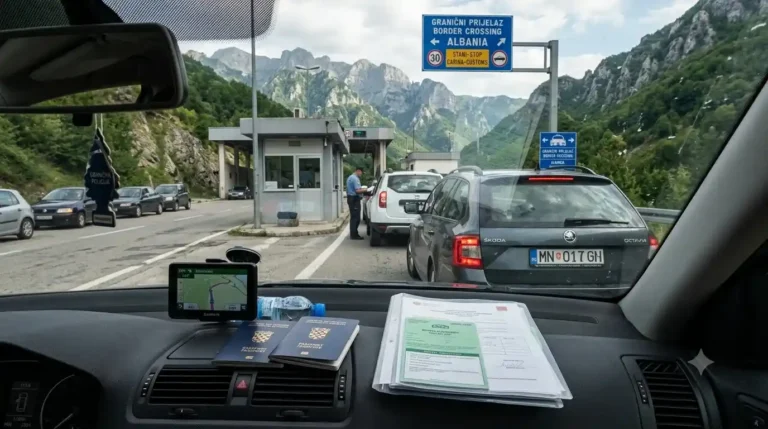
Border crossings are a normal part of many Balkan itineraries. The region includes EU countries, non-EU countries, Schengen and non-Schengen situations, and different entry rules depending on your nationality. For this reason, you should never treat border crossings as a small detail at the end of your planning.
When traveling by bus, passengers usually leave the bus or hand over passports for checks depending on the border and procedure. The process may be quick, or it may take longer if there are many vehicles, several buses, summer traffic, or extra checks. On coastal routes, delays can be more common in July and August.
Direct Buses vs Multiple Transfers
A direct cross-border bus is usually easier than planning several short connections yourself. Even if the journey is long, it removes the stress of changing stations, finding another ticket office, or missing the next bus after a slow border. If there is no direct bus, check whether a private transfer, shuttle, or organized tour is worth the extra cost.
When a direct bus is unavailable or several connections would make the journey unnecessarily complicated, a private transfer may be worth comparing. You can search city-to-city and airport transfers with Kiwitaxi and compare the cost with buses before deciding whether the extra convenience makes sense for that section of your trip.
Important warning: Avoid tight same-day connections after an international bus. A border delay can easily affect your next bus, train, ferry, tour, or hotel check-in.
Rental Cars and Borders
If you travel around the Balkans by car, border planning becomes even more important. Not every rental company allows every border crossing. Some companies charge extra fees, some require advance permission, and some countries may need specific insurance documents such as a Green Card.
Before booking, send the rental company your planned countries in writing and ask them to confirm if the car can enter each one. Also ask about one-way drop-off fees if you plan to collect the car in one country and return it in another. These fees can sometimes be much higher than expected.
How Much Does Transport Cost in the Balkans?
Transport in the Balkans is often more affordable than in Western Europe, but costs depend on the country, season, route, booking method, luggage, and whether you choose public transport or private services. The following ranges are only general planning estimates. Prices and schedules can change, so always verify before booking.
| Transport type | Approximate budget range | Notes |
|---|---|---|
| Local bus | Low cost | Usually cheap, but cash may be needed for tickets or small fees. |
| Intercity bus | Low to medium cost | One of the best-value ways to get around the Balkans between major towns. |
| Cross-border bus | Medium cost | Usually cheaper than transfers, but slower and less flexible. |
| Scenic train | Low to medium cost | Good value when the route is scenic and the timetable fits. |
| Taxi | Low to medium for short rides | Use official taxis or reliable ride apps where available; confirm price if needed. |
| Private transfer | Medium to high cost | Worth considering for difficult routes, groups, families, or late arrivals. |
| Rental car | Medium to high cost | Price depends on season, insurance, border permission, car type, and pickup location. |
| Fuel and parking | Variable | Parking is often the hidden cost in old towns and coastal destinations. |
| Ferry | Low to medium cost | Relevant mostly for Croatia, islands, and selected coastal or lake routes. |
A budget traveler using mostly buses will usually spend much less than someone using private transfers or renting a car for the full trip. Families and groups may find that a rental car or transfer becomes better value when the cost is shared. Solo travelers usually save more by using buses and selected trains.
Where to Check Tickets and Timetables
One of the most useful habits when planning Balkan transport is checking information from more than one place. No single website covers every Balkan route perfectly. Some routes are easy to find online, while others are better confirmed locally at the bus station, hotel reception, or a local agency.
- Local bus stations: Often the best source for current departure times, especially for domestic and regional buses.
- Official railway websites: Useful for routes such as Sarajevo to Mostar, Belgrade to Novi Sad, Sofia to Plovdiv, and other confirmed rail lines.
- Reliable transport booking platforms: Helpful for popular international buses, but they may not show every local route.
- Hotel reception: Very useful in smaller towns where staff often know current local transport details.
- Local travel agencies: Good for transfers, day trips, mountain routes, and routes with several steps.
- Ferry operators: Always check ferry routes directly, especially in Croatia and seasonal coastal areas.
- Tour platforms: Useful for difficult day trips such as Rila Monastery, Durmitor, rural Bosnia, or mountain excursions.
Some national parks, monasteries, mountain areas and rural attractions are possible by public transport but require awkward connections or limited schedules. You can browse Balkan tours and day trips on GetYourGuide and compare organized options when independent transport would take too much time or require several separate connections.
Planning tip: Check your next transport before you book your accommodation. In the Balkans, the best hotel deal is not useful if there is no realistic bus, train, or transfer to get there.
When traveling through several Balkan destinations, location can matter more than finding the absolute cheapest room. Once you have confirmed your bus, train or transfer connections, you can compare accommodation on Agoda and check map locations near bus stations, city centers or other useful transport points before booking.
Common Mistakes When Getting Around the Balkans
The Balkans are a wonderful region for independent travel, but many first-time visitors make the same transport mistakes. Most problems happen because travelers plan the region like Western Europe, where fast trains, frequent departures, and easy cross-border connections are common.
- Planning too many countries in too few days: Short distances on a map can still mean long travel days.
- Assuming trains work like Western Europe: Trains are useful on selected routes, but they are not the backbone of the whole region.
- Trusting outdated timetables: Always verify important routes close to your travel date.
- Booking accommodation before checking transport: This can leave you with an awkward or expensive transfer.
- Arriving late in small towns: Local transport may stop earlier than expected.
- Forgetting cash: Small bus stations, luggage fees, taxis, toilets, and local buses may not accept cards.
- Not checking rental car border rules: This can cause problems at pickup or at the border.
- Not leaving buffer time: Border checks, traffic, weather, and roadworks can slow your trip.
Best Transport Strategy for a First-Time Balkans Trip
For most first-time travelers, the best strategy is simple: build your trip around direct routes. This is the most practical answer to how to get around the Balkans without wasting time. Instead of choosing ten dream destinations first and trying to connect them later, start with the transport links that actually work.
- Use buses between major cities: They are usually the most useful option for cross-border and intercity travel.
- Use trains only on scenic or reliable routes: Good examples include Sarajevo to Mostar, Belgrade to Novi Sad, Sofia to Plovdiv, and Bar to Belgrade if it fits your itinerary.
- Rent a car only for nature sections: This is ideal for Durmitor, Tara National Park, villages, remote beaches, and mountain roads.
- Use tours for hard-to-reach places: Day tours can be smart for monasteries, canyons, national parks, and rural areas.
- Leave buffer days: A slower itinerary is usually better than a rushed checklist.
Best first-time formula: Bus between cities, train for the scenic sections, rental car for mountains and villages, and private tours or transfers when public transport is too slow.
Suggested 7, 10 and 14-Day Transport Plans
These short examples are transport-focused route ideas, not full destination guides. They are designed to show how you can connect popular Balkan stops in a realistic order. For a deeper step-by-step route, read our detailed guide to a Balkans itinerary without a car.
| Trip length | Suggested route | Best transport style |
|---|---|---|
| 7 days | Belgrade → Sarajevo → Mostar → Kotor | Mostly buses, with the option to take the scenic Sarajevo to Mostar train. |
| 10 days | Belgrade → Sarajevo → Mostar → Kotor → Budva → Tirana | Buses for most routes; transfer possible for difficult sections. |
| 14 days | Belgrade → Sarajevo → Mostar → Kotor → Budva → Shkoder → Tirana → Ohrid → Skopje | A realistic public transport route if you confirm schedules and avoid rushing. |
The 14-day route is a good example of how to get around the Balkans without a car while still seeing different cultures, landscapes, cities, and coastal areas. It works best if you travel slowly, check each connection, and avoid adding too many extra stops.
Conclusion: What Actually Works?
The best way to get around the Balkans is not one single method. For most travelers, buses are the most practical choice because they connect many major cities and cross-border routes. Trains are useful on selected scenic or reliable routes, but they should not be your only plan. Rental cars are excellent for mountains, villages, national parks, hidden beaches, and flexible road trips, but they require more attention to borders, insurance, parking, and road conditions.
Private transfers, shuttles, and tours are also useful tools, especially when a route is difficult by public transport or when you have limited time. The smartest Balkan itinerary is usually a mixed itinerary: buses for the main route, trains where they add value, a car for nature, and tours for hard-to-reach places.
If you remember one thing from this guide, remember this: plan slowly. The Balkans reward travelers who leave space for delays, scenic stops, local advice, and unexpected discoveries. Do not squeeze too many countries into one trip just because they look close on a map. Build your route around real transport connections, check timetables before booking, and your trip will feel much smoother.
Planning a Balkans Trip Without Renting a Car?
If you want a route that uses buses, trains, and realistic connections, read our detailed guide to a Balkans itinerary without a car. It includes practical 7, 10, and 14-day route ideas for first-time travelers.
Recommended next read: Balkans Itinerary Without a Car: 7, 10 & 14-Day Bus Routes for First-Timers