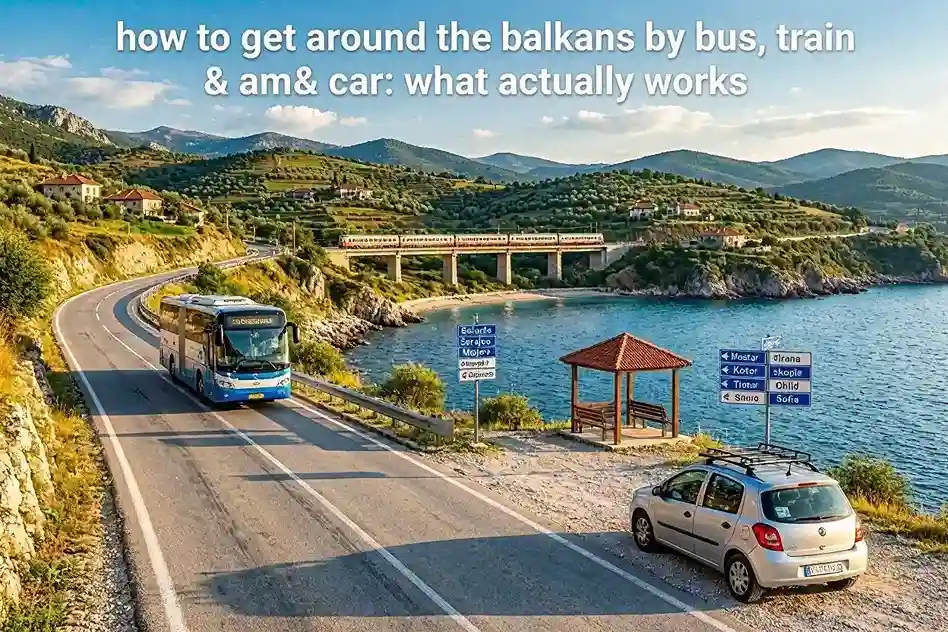
How to Get Around the Balkans by Bus, Train & Car (2026)

How to get around the Balkans depends less on which country looks closest on a map and more on the actual bus, train and road connections between your stops. For most first-time visitors, intercity buses form the backbone of the journey, trains work especially well on a handful of domestic and scenic lines, and rental cars are most valuable for rural destinations rather than city centres.
The challenge is that the region is not one integrated transport network. A coach that connects two cities may use a station far from the old town, a railway may be temporarily suspended, and a cross-border drive may require rental permission that your booking confirmation does not provide. A small difference in route order can turn two difficult transfers into one manageable travel day.
This independently researched, October 2026 planning guide compares buses, trains, rental cars, ferries and transfers; explains ticket buying, realistic costs and border paperwork; and gives workable 7-, 10- and 14-day route examples. It distinguishes confirmed transport systems from schedules that still need checking for your own departure date.
Disclosure: This guide includes a few clearly marked affiliate booking links. We may earn a commission if you buy through them, at no additional cost to you. Recommendations focus on when each transport option actually helps.
Quick answer: Use buses between major cities, add trains where an operating service fits your route, and rent a car for a short nature-focused portion if you genuinely need it. Do not hire a car for every country simply because some rural areas are difficult to reach. Choose fewer stops and protect time for border delays and transfers.
Table of Contents
How to Get Around the Balkans: Transport Comparison
| Transport | Best use | Main advantage | Biggest limitation | Typical value |
|---|---|---|---|---|
| Intercity bus | Most capitals, cities, coast connections | Wide coverage and frequent choices on some corridors | Border waits and terminal changes | Usually best for a solo budget trip |
| Domestic train | Selected Serbian, Bosnian, Bulgarian and Montenegrin routes | Comfort, scenery and less road traffic | Network gaps; specific station and service changes | Excellent when the timetable matches |
| Rental car | National parks, mountain viewpoints, villages | Flexible last-mile access | Insurance, parking and international rules | Better when shared or used intensively |
| Taxi/private transfer | Airport, late arrivals, difficult short connections | Door-to-door transport | Higher cost; needs reliable pickup details | Worth comparing for groups |
| Ferry or boat | Croatian islands, Saranda–Corfu, special crossings | The only practical option on some water routes | Weather, border formalities and seasonality | Route-specific, not a universal replacement |
| Flight | Widely separated hubs | Can save a full road day | Airport time, luggage and indirect routes | Compare the whole journey, not flying time |
A transport mode is only as useful as its first and last kilometre. Check the exact bus terminal, rail halt or ferry terminal, how far it is from your hotel, and whether onward local transport will still run when you arrive.
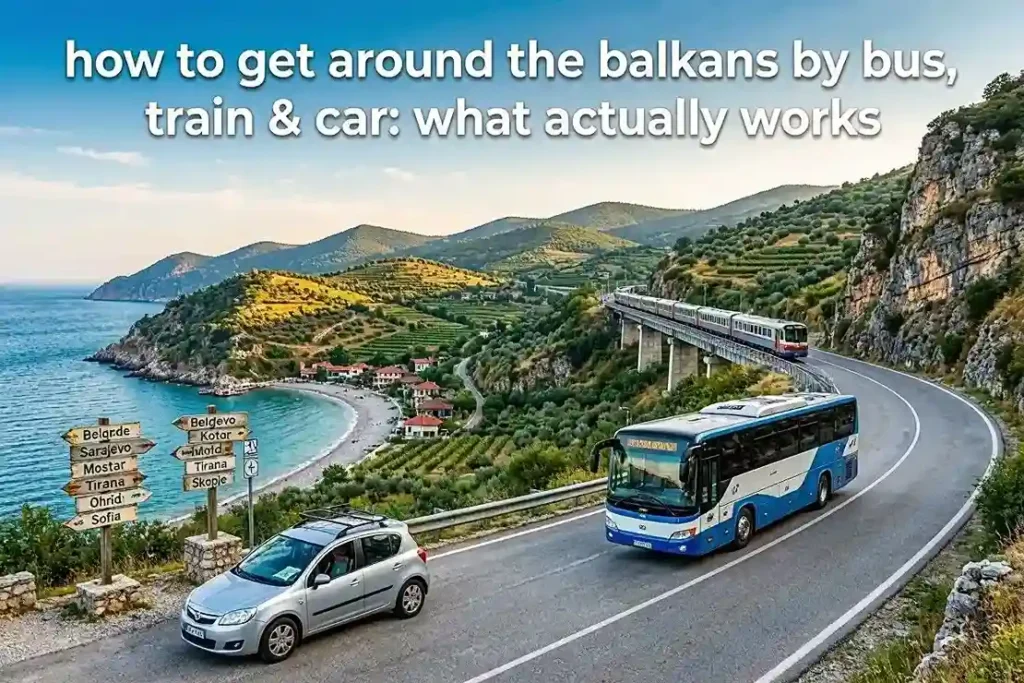
Choose Your Transport in Five Steps
- List overnight towns first. Mark the nights you actually plan to sleep in each place, rather than collecting attractions without a route.
- Search the longest transfer first. Find an operating direct service and its arrival terminal before arranging hotels or non-refundable tours.
- Check the last mile. Identify the walk, taxi, shuttle or second bus between the station and your accommodation.
- Price the complete journey. Add luggage charges, transfers, parking, insurance and any international one-way rental fee—not just the headline ticket.
- Insert a margin. Do not assume a coach crossing a frontier will arrive precisely on time, or that a seasonal train will run on your intended day.
If one leg requires two poorly timed buses and a long taxi ride, changing your overnight town may improve the trip more than paying for a premium vehicle. Our 7-, 10- and 14-day Balkans itinerary without a car develops this method into complete city-to-city sequences.
Getting Around the Balkans by Bus
Intercity buses reach destinations that the railway does not, especially across Albania, Montenegro, Kosovo and North Macedonia. Coaches also connect important cross-border city pairs, although not every operator runs every day and some summer routes are reduced outside the season. You should treat a published example timetable as a starting point, never proof of a ticket available for a particular date.
Which bus services should you book?
Choose the actual operating carrier and terminal first. Large coaches normally use intercity stations. Local buses serve neighbourhoods or beaches, and minibuses may use a roadside departure point instead of the long-distance station. An airport shuttle can be a fourth, separate service. For example, a ticket from Tirana to southern Albania may depart from the regional terminal rather than Skanderbeg Square, and a beach bus around Budva is not the same service as an international coach to Tirana.
For an initial route search, compare published bus journeys and booking options on Busbud. Then check the carrier or station information for the exact route. Bosnia’s Centrotrans booking site is one example of an operator that sells some of its own services directly. Online platforms can omit local departures or intermediate stops.
How tickets, luggage and station payments work
- Ticket purchase: Depending on the route, you may book online, pay at a ticket window or buy from the driver. Some e-tickets are accepted on a phone; others require additional validation or collection.
- Boarding terminal: Save the address, not only the city name. Some cities have multiple bus terminals and operators may use different pickup points.
- Station fees: A local station or platform fee may be separate from the online ticket; check the operator’s instructions and keep modest cash.
- Hold luggage: Some carriers charge a small bag-handling amount. Keep your passport, medication, money and electronics inside the coach.
- Arrival: Confirm whether the bus arrives at the central terminal, an outlying station or a stop on the edge of town.
- Seat and flexibility: Check luggage allowance, cancellation rules, seat reservation and whether the service allows changing to another departure.
Arriving 30 minutes before departure is a practical buffer for many intercity buses; allow longer at a large or unfamiliar terminal, or follow a stricter check-in time printed on your ticket. This is planning advice, not a universal legal boarding rule.
Cross-border buses: allow more than driving time
On an international coach, passengers may have to present documents, step off the bus, or wait while luggage and vehicle checks are completed. Serbia, Bosnia and Herzegovina, Montenegro, Albania, Kosovo and North Macedonia each have their own entry regimes. Croatia and Bulgaria are Schengen countries, but their land borders with non-Schengen neighbours still involve external-border procedures.
A road distance of 150 km does not tell you the full bus journey time. Add intermediate stops, traffic, passport processing and the possibility of a missed onward departure. For an international arrival, avoid a non-refundable flight or ferry booked immediately afterward. Ideally make the border-crossing coach your main travel event that day.
Useful Balkan bus corridors
| Journey | Why a bus is practical | What to verify |
|---|---|---|
| Belgrade → Sarajevo | City-to-city journey without a useful direct passenger-train alternative for most visitors | Which Sarajevo bus terminal and the border route |
| Mostar ↔ Kotor | Connects Bosnia with Montenegro | Direct departure availability, operating dates and border time |
| Kotor → Budva | Frequent useful coastal corridor | Summer congestion; local versus intercity boarding |
| Budva → Tirana | Logical Montenegro–Albania link | Which international operator runs on your date |
| Tirana → Saranda | One long domestic leg instead of a rental car | Tirana departure point and current Saranda arrival terminal |
| Ohrid ↔ Skopje | Useful domestic North Macedonia link | Current departure/arrival stations and operator |
| Sofia ↔ Plovdiv | Bus competes with a useful railway | Station location, road traffic and rail alternatives |
For detailed terminal and fare guidance, see our Tirana to Saranda bus guide. For an awkward cross-border mountain/coast link, Kotor to Mostar bus guide explains why availability and station details matter more than a straight-line map route.
When a minibus or shared van is the only realistic option
In parts of northern Albania, rural Montenegro and mountain areas, transport can depend on small local vehicles and arrangements coordinated by guesthouses. A “public transport connection” may mean a scheduled coach to the nearest town and a prearranged van or taxi for the last leg. Ask the accommodation provider to identify the operating service, departure address, luggage capacity and return option before relying on it.
For example, visiting the Albanian Alps may involve Shkodër, a road transfer, and possibly a separate Lake Koman boat journey. Theth and Valbona are not interchangeable bus-stop names. Weather and seasonal road conditions may materially alter the route. Do not add them as a quick stop between Tirana and Ohrid.
Getting Around the Balkans by Train in 2026
Trains are not a substitute for every Balkan bus. They are most useful where a verified service connects two places you actually want to visit. Four corridors deserve special attention: Belgrade–Novi Sad, Sarajevo–Mostar, Sofia–Plovdiv and Belgrade–Bar. But each needs its own current-status check; they have different ticketing systems, seasonal patterns and station logistics.
Belgrade to Novi Sad: fast service, changed station arrangements
Serbia’s Belgrade–Novi Sad railway is a genuinely useful journey, including fast SOKO services. However, as of 12 October 2026, a new passenger stop at TPS Novi Sad changed arrangements for services from Belgrade; it is not the old central station building. The SOKO ride is approximately 46 minutes in the published October pattern, but you still need time to reach central Novi Sad from the halt. Individual stopping patterns and engineering notices can change.
Search your departure on the official Srbija Voz website and read the station name printed on the ticket. For the detailed latest changes and final connection into the centre, consult our Belgrade to Novi Sad train guide.
Sarajevo to Mostar: services resumed on 15 October 2026
The scenic Sarajevo–Mostar railway is one of the strongest train experiences in the Western Balkans when it is running. It was affected by a suspension beginning in September 2026 after a fire near the Konjic rail corridor. The operator, Željeznice Federacije Bosne i Hercegovine, announced the resumption of regular Sarajevo–Mostar–Čapljina passenger services from 15 October 2026.
That restoration makes the train a worthwhile first choice again, provided your exact departure is operating. Compare it with an intercity coach, and do not assume old seasonal tourism timetables or schedules published during the suspension still apply. Our Sarajevo to Mostar train guide covers the tickets, stations and scenic route.
Sofia to Plovdiv: useful domestic rail, not a high-speed assumption
Bulgaria has a working national passenger-rail network. BDZ’s timetable search lists Sofia–Plovdiv trains and lets you check whether a service is direct, delayed or rerouted via another station. Some services involve substantial extra time or changes, so choose a departure by its actual itinerary, not the fact that a rail line exists. Bus services compete well here; the better option depends on when you leave and where you are staying.
Belgrade to Bar: the timetable changes with the season
The international Serbia–Montenegro railway is scenic, but the regular all-year option is not identical to the high-season timetable. Published 2026 information shows that the seasonal daytime train ended in late September, while the overnight Lovćen service remained listed after the summer timetable ended. Sleeper, couchette and vehicle-carriage availability should be checked for your exact departure; a train being shown as operating does not guarantee every accommodation type is available.
An overnight train can save a hotel night, but arriving at Bar does not put you in Kotor. To reach the Bay of Kotor, plan another bus or transfer. Likewise, the scenic line does not reach Budva or the coast north of Bar directly.
Where a train-only Balkans itinerary breaks down
- Kotor, Budva and Dubrovnik are not joined by an intercity passenger railway; buses or road transfers matter here.
- Albania’s everyday intercity tourist transport relies on road services rather than a connected nationwide passenger-rail network.
- Many cross-border rail links have limited, suspended or seasonal services; do not assume an old direct train still runs.
- Different national operators do not provide one comprehensive regional ticketing system for all railway journeys.
- Railway engineering works can change the station and bus substitution arrangements at short notice.
Practical train rule: Use a train when the operator publishes a suitable dated service and the station works for your itinerary. Otherwise, travel by bus. A rail route drawn on a map is not evidence that a passenger train is available.
When Renting a Car in the Balkans Makes Sense
A rental car is valuable when it makes a place genuinely more accessible, not automatically because you are visiting multiple countries. The best strategy for many trips is to use public transport between major cities, then hire a vehicle for two to four days in one country to explore nature and rural sights. Returning it where you picked it up can avoid an expensive international one-way rental fee.
Good car-hire use cases
- Durmitor National Park: Base yourself near Žabljak and use a car for viewpoints and scattered trailheads if suitable public transport is unavailable.
- Tara National Park and rural Serbia: A car makes countryside lookouts and small villages easier to connect.
- Interior Albania: Useful for villages and multiple stops, though mountain access and road-condition restrictions need checking.
- Rural Bosnia and Herzegovina: Can reduce dependence on infrequent connections when visiting waterfalls or distant guesthouses.
- Families and groups: Shared rental costs may be attractive when travelling beyond places served by direct coaches.
Importantly, Durmitor National Park without a car is still possible for selected activities and an overnight base; “nature” does not automatically mean a car is mandatory. A bus into a mountain town plus a tour or local taxi can sometimes cost less than multiple rental days.
What to confirm before booking any cross-border rental
- Explicit permitted countries. Ask whether you may drive into every state on your intended route. “Europe cover” on a comparison page is not permission.
- Written authorization. Get confirmation from the actual rental supplier, not only from a third-party booking site.
- Insurance recognition. Green Card or other motor-insurance evidence rules differ according to registration country and destination. Do not generalise a rule from Serbia–Bulgaria to every border.
- Vehicle and driver documents. Check licence format, international driving permit where applicable, registration, rental papers and roadside-assistance contact.
- One-way return restrictions. Verify the exact return branch, fee, office hours and whether international drop-off is even permitted.
- Road restrictions. Some contracts prohibit unpaved mountain roads or ferry carriage even if the route is technically driveable.
If a car is appropriate, compare rental categories and supplier conditions on DiscoverCars. Look past the daily rate to deposits, excess, accepted credit/debit cards, mileage, insurance and permitted cross-border travel. A supplier may insist on a physical payment card in the lead driver’s name even if you prepaid online.
Tolls, vignettes and parking
Different countries charge for roads in different ways. Serbia and Croatia have tolled motorway sections, while Bulgaria uses an electronic vignette for many ordinary passenger vehicles on charged roads. The official purchase service is BG Toll. Montenegro, Albania and Bosnia and Herzegovina also have route-specific road charges or toll sections; the rule should be checked for the roads you actually plan to drive.
Parking can be the hidden cost of a “cheap” rental. In Dubrovnik, Split, Kotor, central Sarajevo, Budva and other historic or coastal areas, finding a legal space close to an old-town hotel can be expensive or impractical. Ask whether your accommodation provides reserved parking, whether access roads are restricted and whether large vehicles fit through the approach.
A sample car-rental budget: calculate the entire trip
Consider a hypothetical three-day rental with the following illustrative inputs. These numbers demonstrate the arithmetic and are not a quote for any 2026 destination or travel date:
| Item | Illustrative amount | What to check |
|---|---|---|
| Rental base: 3 × €35 | €105 | Actual dates, vehicle class and supplier |
| Fuel | €45 | Vehicle economy and planned distance |
| Road tolls / vignette | €15 | Whether each road requires payment |
| Parking | €24 | Hotel and sightseeing locations |
| Chosen extras | €30 | Optional coverage or additional driver |
| Total trip expense | €219 | This excludes refundable deposit holds |
| Refundable deposit hold (example) | €500 hold | Not the same as the €219 expense; must fit your card limit |
For three people sharing the hypothetical €219 running cost, that is €73 each before any unrelated accommodation. For a solo traveller visiting only cities, three bus tickets might be much less expensive. Always compare the same number of travel days and the same actual destinations.
Country-by-Country Transport Decisions
Serbia
Use Belgrade for rail and bus connections and verify the current departure terminal. For Novi Sad, the train can be excellent but the 2026 station changes must be accounted for. Niš, Zlatibor and smaller towns often depend on buses and particular rail routes. A car has its biggest advantage in Tara National Park, countryside monasteries and remote viewpoints rather than central Belgrade.
Bosnia and Herzegovina
Buses link the main cities and many smaller towns; Sarajevo–Mostar is a notable rail exception if the current service is running. Do not confuse Sarajevo’s central bus station with East Sarajevo departures. Travelling from Mostar to the Montenegrin coast is a longer cross-border task requiring a carefully chosen coach or transfer; a simple map search can hide a transfer or a different arrival terminal.
Montenegro
Use intercity buses along the coast and between Podgorica, Bar, Budva and Kotor; separate local lines serve smaller bay settlements. Rail is useful for the Bar–Podgorica direction, not for a train into Kotor or Budva. For mountain bases, check the coach to Žabljak, then arrange a walk, local driver or car depending on the sights you want. The full Montenegro without a car guide compares bases and last-mile access.
Budva’s local beach buses are different from long-distance coaches. Our Budva beaches by bus guide explains why some easy beach outings do not require a car at all.
Albania
For most visitors, buses and minibuses connect Tirana with Shkodër, Berat, Gjirokastër, Saranda and many other towns. Some routes depart from different Tirana terminals or roadside locations, and not every journey can be booked on a single platform. The Albanian Riviera is accessible in parts without a car, but reaching a small beach after the coach arrives can require a separate local bus or taxi.
For Theth, Valbona and rural northern Albania, ask the guesthouse about the full chain of services and seasonal access. Allow a dedicated travel day when crossing from one valley or transport hub to another. Albania’s mountain itineraries should not be squeezed between unrelated international coach tickets.
North Macedonia
Skopje and Ohrid are well suited to a public-transport-focused trip when current intercity departures fit. Ohrid’s nearby villages and lake shore can require local bus, taxi, boat or tour depending on the exact destination. North Macedonia is not an easy country for rail-only sightseeing, so treat road transport as your default when planning beyond the capital.
Kosovo
Pristina, Prizren and Peja have useful intercity road connections. Mountain destinations such as Rugova require another transport leg. The Serbia–Kosovo direction deserves separate border planning: nationality, your previous route, the document used to enter Kosovo and current official rules may affect a planned onward journey into Serbia. Do not assume an itinerary that drives into Kosovo from Albania and then continues into Serbia is automatically straightforward for every traveller.
Bulgaria
Both domestic trains and buses work for important routes such as Sofia–Plovdiv; for Rila Monastery and scattered mountain stops, a tour or car may be more convenient. Bulgaria adopted the euro in January 2026; old transport guides quoting the lev as the currency to obtain are outdated. Travellers crossing from Serbia enter the external Schengen border at checkpoints such as Gradina–Kalotina. Read our Serbia Bulgaria border crossing guide for document, insurance and vignette details.
Croatia
Long-distance coaches serve Zagreb, Split, Dubrovnik and inland towns, while ferries are essential for many island connections. Check whether a specific ferry is passenger-only or can take a car, as well as its season and departure port. The Adriatic coast can be very congested in July and August; a rental car parked throughout a Dubrovnik visit may offer little advantage over buses and walking.
Border Rules That Can Change Your Transport Choice
A bus ticket or car booking does not override immigration rules. Verify entry and re-entry requirements separately for each country, especially if you plan to move in and out of Schengen. Croatia and Bulgaria are Schengen members; Serbia, Bosnia and Herzegovina, Montenegro, Albania, North Macedonia and Kosovo are outside Schengen. Even when a route looks domestic to the Balkan region as a whole, a crossing can involve immigration and customs checks.
EES and ETIAS: two different processes in October 2026
The EU Entry/Exit System (EES) has been fully operational since 10 April 2026 for covered non-EU short-stay travellers at external Schengen borders; this may involve biometric enrolment or checks. ETIAS is separate: as of 19 October 2026 it has not started operating and no applications are being accepted. See the European Commission EES explanation and official ETIAS website before travel.
Entry eligibility also depends on nationality, passport validity, visas or residence documents and prior travel history. A valid visa for one Balkan country does not automatically permit entry to a neighbouring country. If you have a single-entry Schengen visa, leaving the Schengen Area and attempting to return can be a particular problem even when you have unused days on the visa.
Border delays, mobile service and currency
The practical border cost is often time rather than an admission fee. Build a margin for passport checks, queues and the time needed to reach the next terminal. As a rule, do not promise fixed border-processing minutes. A live queue report for one checkpoint or one side of a border is not a guarantee for the entire crossing.
The Western Balkans have regional roaming arrangements, but do not assume a phone package works at domestic rates across both EU and non-EU countries. Check your actual carrier and the nations covered by the package, or download offline maps. Cash varies: Serbia uses RSD, Bosnia and Herzegovina uses BAM, Albania ALL, North Macedonia MKD; Montenegro, Kosovo, Croatia and Bulgaria use EUR. Cards are common in many cities, but keep modest local cash for station extras and rural services.
Ferries, Flights and Private Transfers
Ferries: check the international border, not just the sea time
Croatian island ferries and high-speed catamarans are often essential parts of coastal itineraries. A passenger-only catamaran does not solve a car-transfer problem, and a summer-only island route may not exist in November. Read the exact vessel and service calendar before reserving island accommodation.
The Saranda to Corfu ferry is another example of a route with short sailing time but substantial extra logistics: it crosses from non-Schengen Albania to Schengen Greece. Allow time for ticket check-in, immigration and onward transport from Corfu New Port. It should not be treated like a domestic water taxi.
Private transfers: use strategically, not for every leg
A transfer can make sense for an expensive or risky last connection, a late flight, a group with suitcases or a rural guesthouse with no workable public service. Ask for the total price, pickup address, luggage allowance, border-document requirements where relevant, cancellation conditions and whether waiting time is included. If a door-to-door transfer replaces two taxis and a difficult bus connection, the higher price may be justified.
For an airport arrival or a difficult intercity journey, compare available door-to-door transfer routes on Kiwitaxi. Do not assume the service is available on every rural route; the booking must explicitly confirm origin, destination and actual pickup time.
When flying may be smarter than a long overland detour
A flight can be useful between far-apart hubs, but check door-to-door time: reaching the departure airport, baggage and security, potential connections, the flight and the transfer from the arrival airport. If a flight requires a long layover outside the region, a direct overnight coach or train may be simpler. A domestic flight is not a standard practical replacement for short Balkan city journeys.
How Much Does Getting Around the Balkans Cost?
It is tempting to publish one universal “Balkans bus price”, but that would be misleading. Prices differ by country, booking platform, summer demand and journey length. A meaningful budget compares one specific dated itinerary with all local transfers. International coach tickets may be much more expensive than domestic trips of similar distance.
| Cost component | Bus/train itinerary | Rental-car itinerary |
|---|---|---|
| Main transport | Sum of tickets, seat or booking fees | Daily rental charge for actual days used |
| Luggage | Possible station or carrier bag charge | Included in car capacity; no separate bag fee |
| Local transport | Airport shuttles, station taxis, local buses | Fuel and parking; transfers before/after hire |
| Cross-border | Occasional fare difference; visa/doc checks still apply | Written rental permission, insurance, cross-border fees |
| Flexibility | May lose a day if a departure is missed | Can change stops, but return place/time is contractual |
| Financial hold | Usually no large vehicle deposit | Credit-card security deposit may be required |
| Best comparison | Cost per person for entire route | Entire vehicle cost divided by travellers |
An especially useful rule is to compare the marginal car days. You may need a vehicle for Durmitor viewpoints but not for three days of walking in Kotor Old Town. Renting for only the mountain segment avoids paying for parked days, although you must account for the cost and practicality of reaching the rental location.
Where to Check Schedules and Book Tickets
| Journey type | First place to check | What to double-check |
|---|---|---|
| Serbian trains | Srbija Voz official ticket/search site | Actual station, service class and dated engineering alerts |
| Bosnian Sarajevo–Mostar train | ŽFBH official site | Current operating status and departure time |
| Bulgarian trains | BDZ official timetable | Direct versus connecting train; engineering changes |
| Montenegro intercity coach | Operating carrier or station / regional bus-timetable site | Exact boarding point and last return bus |
| Albanian intercity bus | Operator, local terminal, or a date-specific platform | Physical terminal; some routes not fully available online |
| Croatian ferries | Ferry operating company | Foot-passenger versus vehicle sailing; seasonal calendar |
| International coach | Carrier plus comparison platform | Passport rules, overnight or cross-border wait, station fees |
For every booking, record five things in your phone: date, local departure time, street address of boarding point, destination address and operator contact. A screenshot of a timetable is not enough if the city has several terminals. Download the ticket and store a copy that opens without an internet connection.
Realistic 7-, 10- and 14-Day Routes Without a Car
These are planning frameworks, not claims that a particular carrier operates on every date. They work best as one-way, open-jaw trips: travel into the first city and out of a different city instead of retracing your route. Check actual flights and land transfers before choosing your final night.
7 days: Belgrade → Sarajevo → Mostar → Kotor
| Days | Overnight base | Transport reality |
|---|---|---|
| 1–2 | Belgrade | Arrival and a full city day; no international bus immediately after landing |
| 3–4 | Sarajevo | Day 3 bus from Belgrade; preserve daylight or a full Day 4 for Sarajevo |
| 5 | Mostar | Sarajevo → Mostar by operating train or suitable bus |
| 6–7 | Kotor | Mostar → Kotor cross-border transfer day, then a full bay day |
This is an active itinerary with two substantial cross-border travel days. If you are flying out on Day 7 rather than staying the night, cut sightseeing rather than adding another destination. Avoid attaching the Albanian Alps or Dubrovnik to this one-week route.
10 days: Add the Montenegrin coast and Tirana
| Days | Overnight base | Transport task |
|---|---|---|
| 1–2 | Belgrade | Explore and verify Sarajevo bus |
| 3–4 | Sarajevo | International bus, then full city day |
| 5 | Mostar | Train or bus from Sarajevo |
| 6–7 | Kotor | Border-coach/transfer day, then day around the bay |
| 8 | Budva | Shorter coastal bus, beach or Old Town afternoon |
| 9–10 | Tirana | International coach from Budva, then a city day |
This version makes the Montenegro–Albania connection a separate trip rather than trying to combine an early Kotor excursion, Budva and an international coach on the same afternoon. Confirm the final airport connection if your departure is on Day 10; a flexible open-jaw flight itinerary is easier than driving back to Belgrade.
14 days: Four-country route at a more comfortable pace
| Days | Overnight base | Main planning focus |
|---|---|---|
| 1–2 | Belgrade | Two days to settle in and explore |
| 3–4 | Sarajevo | Travel day and full city day |
| 5 | Mostar | Scenic rail or bus, historic centre |
| 6–8 | Kotor | Border day plus two days to explore the bay |
| 9–10 | Budva | Coast and beach days by local bus |
| 11–12 | Shkodër | Cross into Albania and explore city/lake; no forced same-day Alps transfer |
| 13–14 | Tirana | Bus to the capital, city day and departure arrangements |
Four countries in fourteen days is already a substantial trip. To add Ohrid and Skopje, remove overnight stops elsewhere rather than simply inserting two more international travel legs. If mountain hiking is the priority, sacrifice an entire city stop so you have multiple nights in the relevant valley.
Common Mistakes When Travelling Between Balkan Countries
- Assuming Google Maps displays a complete regional public-transport network. It may miss small operators, minibus stops and seasonality.
- Using the wrong station. Check the printed ticket address and current railway service notice rather than heading to a landmark named “main station.”
- Planning five borders in five days. Every border makes a journey less predictable and reduces sightseeing time.
- Relying on an outdated scenic-train schedule. Check current operations, especially after fires, infrastructure work or the end of summer.
- Hiring a car before asking about countries. Compare the actual vehicle supplier’s written insurance and border terms before paying.
- Forgetting separate road or parking charges. The advertised rental rate is not your road-trip budget.
- Booking a tight ferry or flight after a long international coach. Leave a substantial delay buffer, or overnight at the connection city.
- Thinking the nearest coastal village is walkable from a highway bus stop. Check safe pedestrian access and terrain.
- Using an eSIM or roaming plan without checking country coverage. EU and non-EU tariff areas can differ.
- Not confirming the return service. A lovely remote beach or trail is less useful if no bus is running back that day.
FAQ: How to Get Around the Balkans
Can you travel around the Balkans without a car?
Yes. A bus-led itinerary works for many major cities and coastal towns; selected trains, local buses, taxis and transfers cover gaps. Remote viewpoints and mountain accommodation need more careful last-mile planning.
Is it better to travel the Balkans by bus or train?
For a multi-country first trip, buses normally offer wider coverage. Choose trains on a confirmed useful route, such as Sofia–Plovdiv or the operating Sarajevo–Mostar service, instead of trying to replace every bus with rail.
Is the Belgrade to Novi Sad train running in October 2026?
Services are operating in the current published pattern, but station arrangements changed from 12 October 2026. Confirm the exact stop and connection to the city on the official Srbija Voz timetable.
Is the Sarajevo to Mostar train running in October 2026?
ŽFBH announced the return of regular passenger services on 15 October 2026 after a September suspension. Confirm your travel-date service with the operator before committing to a tight itinerary.
Can I drive a rental car between Balkan countries?
Sometimes, but only when the individual rental supplier allows each destination country and any ferries in the itinerary. Written permission, documentation, insurance and fees vary by company and vehicle.
Are border checks required between Balkan countries?
Frequently, yes. Croatia and Bulgaria are in Schengen, while several Western Balkan countries are outside it. You may cross external Schengen borders or other national borders with separate entry rules.
How should I plan a Balkans itinerary on a budget?
Choose a sensible one-way route, stay two or more nights in useful bases, use direct buses, add confirmed trains and compare only the car-hire days that solve a real last-mile problem.
Do I need cash for buses in the Balkans?
Carry a modest amount of local currency for small stations, luggage or local services. Payment methods differ by operator; online payment is not universal.
Should I buy intercity bus tickets in advance?
For peak summer, weekends, international trips and one essential departure, advance booking is useful where supported. For informal local routes, confirm the operator and on-the-day purchase process.
Is ETIAS required for travel to the Balkans in October 2026?
As of 19 October 2026, ETIAS was not yet operational and no applications were being accepted. Schengen visa and entry eligibility are separate questions; check the official EU site for later travel dates.
Final Verdict: What Actually Works?
The most reliable answer to how to get around the Balkans is a mixed, transport-first itinerary. Take a bus where the road network offers the practical link, choose rail where a current train gives you a better journey, and reserve a car for the places that public transport genuinely struggles to serve. Add taxis, transfers or boats only when they solve a specific gap rather than using them as an expensive default.
Before committing to accommodation, verify the next important departure, both station addresses and entry requirements. In October 2026 especially, updated train operations and Schengen systems show why checking a dated official source is worth more than copying last year’s travel times. Build in time to enjoy places instead of spending every afternoon catching up with a timetable.