Balkan Border Crossings 2026: Visas, Schengen & Car Rules

Balkan border crossings are a routine part of travelling between Southeast European countries, but the rules are not identical on every route. A coach from Dubrovnik to Mostar leaves the Schengen Area; a trip from Croatia to Slovenia generally stays inside it; and a journey involving Kosovo and Serbia can raise a separate entry-record question. The right advice depends on your passport, the border you use and whether you travel by bus or car.
This updated guide explains how to identify an external Schengen border, check visa and passport conditions, understand the EU Entry/Exit System (EES), prepare vehicle insurance and avoid difficult connections. It is aimed at international visitors arranging a multi-country Balkan itinerary rather than people travelling under one particular nationality’s rules.
Identify (1) whether your route enters or exits Schengen; (2) the visa rights for your passport; (3) your transport operator’s exact border route; (4) vehicle permission and motor insurance if driving; and (5) enough time for border checks. Check the official information again shortly before departure.
The regional membership, EES/ETIAS and Kosovo–Serbia information below was checked against official EU and government material. A rule described here is not approval for entry: immigration officers apply current rules to your individual circumstances.
Table of Contents
Which Balkan Countries Are in Schengen in 2026?
The European Union (EU) and the Schengen Area are different concepts. Being in the EU does not automatically mean a country belongs to Schengen, and entering a non-Schengen Balkan country is not simply another stop inside the same immigration zone. Bulgaria and Romania became full Schengen members at their land borders on 1 January 2025, according to the European Commission.
| Country or territory | EU member? | In Schengen? | What this means for common tourist routes |
|---|---|---|---|
| Croatia | Yes | Yes | Croatia → Bosnia or Montenegro is an external Schengen crossing. |
| Slovenia | Yes | Yes | Slovenia → Croatia is normally internal Schengen travel. |
| Bulgaria | Yes | Yes | Bulgaria → Serbia or North Macedonia crosses an external Schengen border. |
| Romania | Yes | Yes | Romania → Serbia crosses an external Schengen border. |
| Greece | Yes | Yes | Greece → Albania or North Macedonia crosses an external Schengen border. |
| Bosnia and Herzegovina | No | No | Normal international entry/exit controls apply. |
| Montenegro | No | No | Separate entry conditions and immigration rules. |
| Serbia | No | No | Separate entry conditions; extra care for Kosovo routes. |
| Albania | No | No | Separate entry conditions; Albanian time does not automatically count as Schengen time. |
| North Macedonia | No | No | Separate entry conditions. |
| Kosovo | No | No | Separate entry rules and special Serbia-related route issues. |
A crossing between two Schengen countries normally does not involve routine immigration control at an internal border, but targeted checks or temporary restrictions can still occur. For example, Slovenian police reported that temporary controls at the borders with Croatia and Hungary were lifted on 11 June 2026. Check the current police advice rather than assuming there can never be a check. Slovenian police information.
Schengen 90/180 Days, Visas and Re-entry
For most short-stay visitors subject to the Schengen time limit, the standard maximum is 90 days in any rolling 180-day period across the Schengen Area as a whole, not 90 days per country. A week in Croatia and a week in Bulgaria generally contribute to the same Schengen allowance. Time spent in non-Schengen Montenegro or Bosnia and Herzegovina generally does not use Schengen days, but it does not reset earlier Schengen stays. The European Commission short-stay calculator helps you test dates.
Visa requirements vary by nationality and immigration status. Do not assume that because you have a Schengen visa you may enter every non-Schengen Balkan country: some countries offer specific exemptions for holders of certain valid visas or residence permits, but conditions differ. Equally important, a single-entry Schengen visa may not permit you to return to Schengen after leaving it for a non-Schengen country; verify the number of entries and validity shown on your visa before booking a circular route.
This itinerary exits Schengen into Bosnia and Herzegovina and then re-enters Schengen in Croatia. If your nationality requires a Schengen visa, check your right to re-enter, not just your right to leave Croatia. If you are visa-exempt, check remaining permitted days and other entry conditions.
For many non-EU visitors, Schengen passport rules also normally require a document issued within the previous 10 years and valid for at least three months after the intended departure from the area. These are not universal rules for all non-Schengen Balkan destinations. See EU travel-document guidance and confirm nationality-specific requirements with the relevant embassy.
EES vs ETIAS: What Changed by October 2026?
EES is operational at Schengen external borders
The EU Entry/Exit System (EES) became fully operational on 10 April 2026. For eligible non-EU short-stay travellers at participating external Schengen borders, it digitally records entry and exit information and biometric identifiers instead of relying on the old manual passport-stamping process. Your first registration may take longer than a later verification, so allow for this at road crossings too. Official source: European Commission EES announcement.
ETIAS was not operating at the time of this update
ETIAS is different: it will be a travel authorisation for eligible visa-exempt nationals, not a replacement for a visa and not the same as the EES border-registration system. As checked on 12 October 2026, the official EU ETIAS site states that applications are not yet being collected; an exact start date must be officially announced. Do not pay unofficial application sites that imply ETIAS is already required. Check the official ETIAS portal before travelling later in 2026 or beyond.
EES: a border-control registration process for applicable non-EU travellers. ETIAS: a separate pre-travel authorisation for certain visa-exempt travellers, not yet in operation as of this review. Neither removes the need to meet passport, entry and visa rules.
Balkan Border Crossing Documents: A Useful Checklist
- Passport or accepted national ID: use a document valid for the destination and your nationality; do not assume an EU citizen’s ID-card arrangement applies to you.
- Correct visa or exemption: check every destination and any Schengen re-entry, including whether your visa allows more than one entry.
- Previous entry records: relevant entry stamps or digital travel history can matter, especially on some Serbia–Kosovo routes.
- Accommodation and travel purpose: keep an address, itinerary and any requested supporting evidence ready offline.
- Onward travel and funds: officers may ask how long you will stay and whether you can support the trip.
- Children’s documents: children need appropriate travel documents; minors travelling with one parent or another adult may need additional permissions depending on country and circumstances.
- For drivers: driver’s licence valid locally, vehicle registration, rental agreement or owner’s authorisation, permitted-country list and motor insurance.
- Travel health insurance: check whether your visa requires it and whether your policy covers all destinations and planned activities; this is different from vehicle liability insurance.
If you still need accommodation, compare hotels and guesthouses on Agoda and keep the confirmation for your actual reservation available offline. A booking-platform search page itself does not establish a right to enter a country.
For multi-country travel you can also review travel insurance options on VisitorsCoverage. Compare eligible destinations, medical coverage, exclusions and visa-related documentation requirements rather than relying on a generic insurance label.
Crossing Balkan Borders by Bus: What Happens?
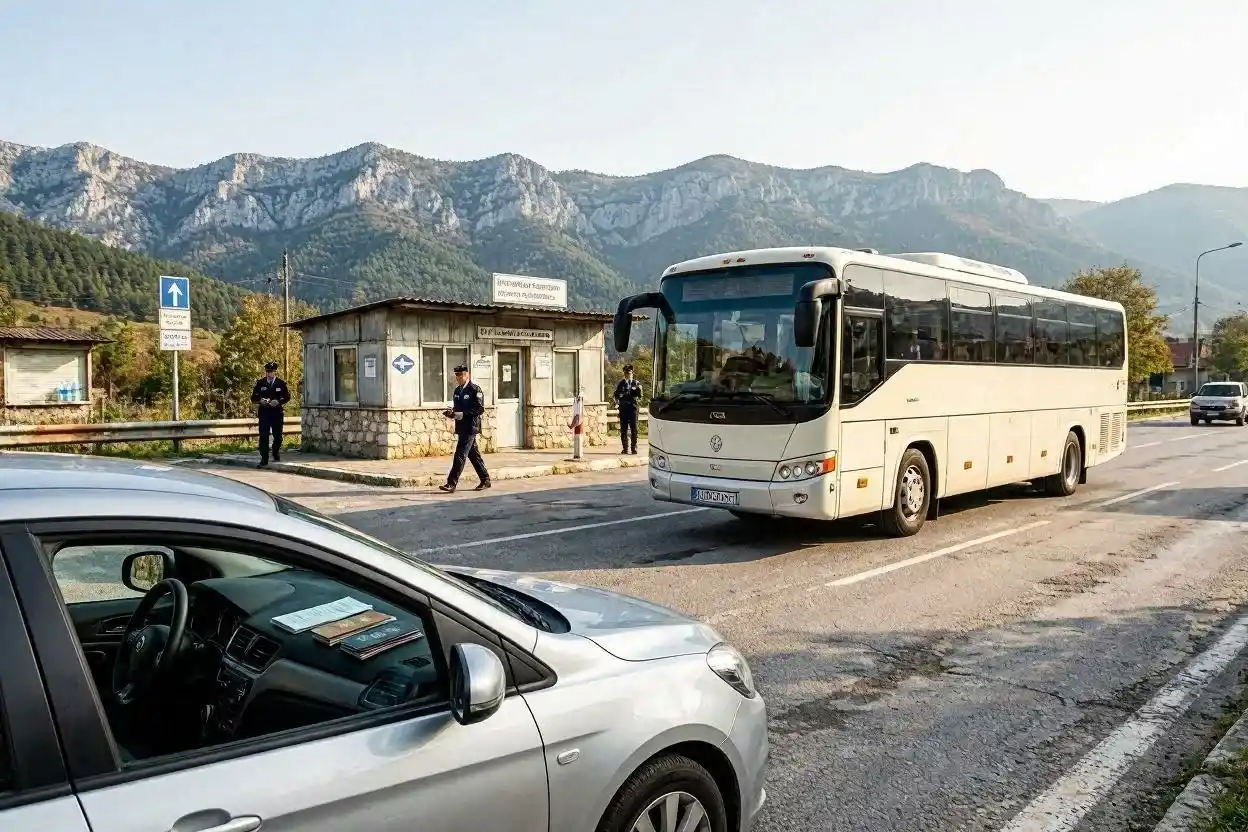
Buses are the most useful cross-border option on many Western Balkans city routes, but a direct service is not automatically a nonstop service. At a border, the bus may stop twice: once for exit checks and once for entry checks. Officers may inspect documents on board, collect passports temporarily through the driver or ask passengers to walk to a control desk; luggage inspections are also possible.
- Before buying: verify that the service really runs on your date, which station it uses and whether the route crosses an additional country.
- At the border: follow staff instructions and keep your passport, ticket, medication and valuables with you rather than packed below the bus.
- After passport control: check that everyone is back on board before the vehicle leaves; keep required documents accessible for the next checkpoint.
- After arrival: avoid a non-refundable same-day flight, ferry or event that depends on the border taking a fixed number of minutes.
For planning, compare bus routes on Busbud and cross-check the exact departure with the carrier or departure station. Booking inventories are not complete for every small Balkan operator, and schedules may change seasonally.
Not every line drawn between neighbouring cities on a map is served by a daily direct bus. A two-bus journey with a border crossing may need an overnight stop; book the hardest connection first, then arrange accommodation.
Crossing with a Rental Car: Permission and Insurance
A rental car can make remote parks, mountain villages and coastal detours easier, but taking it across an international border is not automatic. The car supplier may restrict specific countries even when crossing on foot or by bus is uncomplicated. An approved cross-border journey may also cost more than the headline rental price.
| Before you book | What to request in writing | Why it matters |
|---|---|---|
| Permitted countries | Exact list of every country, including Kosovo if relevant | Some suppliers prohibit or charge extra for particular destinations. |
| Rental contract and documents | Contract, registration paperwork and any border authorisation | Police or border staff may ask to see them. |
| Motor liability insurance | Confirmation that third-party liability cover is valid in every destination | A travel-insurance policy does not replace compulsory vehicle insurance. |
| Green Card / IMIC or frontier insurance | Whether your registration country requires additional proof or local cover | Requirements depend on registration, bureau agreements and destination. |
| Return location | Any international one-way fee or restriction | You may not be able to leave a foreign-registered rental car in another country. |
| Road costs | Tolls, deposits, parking and potential border insurance costs | The cheapest daily car rate is not always the cheapest total trip. |
Use DiscoverCars to compare available rentals if a car fits your itinerary, but make the supplier’s cross-border permission and insurance terms the final authority before paying.
Green Card is not universally required at every border
The Green Card / International Motor Insurance Card (IMIC) is proof of third-party motor liability coverage in countries and circumstances where it is required. Under the Green Card system’s Multilateral Agreement, registration plates from participating countries can act as proof instead of a Green Card. The Council of Bureaux explains the participating-country arrangement. Being a tourist does not determine which document your vehicle needs: the vehicle’s registration country and the destination do.
For example, the Bosnia and Herzegovina Green Card Bureau lists different rules for vehicles registered in Albania or North Macedonia and for those registered in Croatia, Serbia or Montenegro. Where a paper Green Card/IMIC is required for Bosnia and Herzegovina, its bureau says to carry the physical document; electronic-only proof is not accepted under that regime.
Kosovo has a separate motor-insurance issue
Do not assume an ordinary European Green Card makes a vehicle insured in Kosovo. Current UK government guidance on driving in Kosovo says European Green Card vehicle insurance is not valid there and advises arranging locally valid third-party cover. Check the local requirements and your rental supplier’s Kosovo policy before approaching the border. Some suppliers do not allow travel between Serbia and Kosovo in the same car.
Paying for a cross-border fee does not necessarily prove that all countries are permitted or that all insurance requirements have been satisfied. Get both approval and the insurance documents before collecting the vehicle.
Kosovo and Serbia: The Border Issue You Must Plan Around
The most important question for visitors combining Kosovo and Serbia is often how you entered Kosovo and whether you already have a recognised Serbian entry record. Serbian authorities do not treat the designated Kosovo crossings as ordinary international entry points, which can cause difficulty when approaching Serbia directly from Kosovo after entering Kosovo from a third country.
| Travel sequence | Practical risk or implication | Safer planning action |
|---|---|---|
| Serbia → Kosovo → Serbia | Can be possible when you hold an appropriate Serbian entry record. | Verify the advice for your nationality and the intended crossings. |
| Albania / North Macedonia / Montenegro → Kosovo → Serbia | Direct entry into Serbia from Kosovo may be refused if you have not previously entered Serbia through a recognised Serbian entry point. | Check official entry advice; consider reaching Serbia via another country. |
| Serbia → Kosovo → Albania or North Macedonia | Travellers use this pattern, but entry and subsequent Serbian travel still require planning. | Confirm both the Kosovo entry route and later Serbia plans. |
The UK FCDO Serbia entry guide says visitors are likely to be refused entry from Kosovo without a valid Serbian entry stamp or qualifying entry through a recognised Serbian point. The Kosovo entry guide gives the same practical warning and suggests travelling through a third country instead in that situation. These statements reflect UK government advice, not individual immigration clearance for travellers of every nationality.
Political tensions can affect crossing conditions and transport in some areas. Check official travel advice and route operation immediately before the trip. Avoid route assumptions based on the physical proximity of Pristina and Belgrade; the actual border procedure matters more than the distance.
Do not assume you can simply continue from Kosovo straight into Serbia on the same trip if you entered Kosovo from Albania. Confirm Serbia’s entry rules and your prior Serbian entry record, or redesign the journey through an appropriate third country.
Common Balkan Border Routes: What Changes at Each?
These are examples of the type of border procedure involved, not guarantees that a direct bus is available every day. Always confirm the actual operator, route, passport requirements and opening status of your chosen crossing.
| Example itinerary | Border type | What to verify before departure |
|---|---|---|
| Dubrovnik → Mostar | Schengen exit: Croatia → Bosnia and Herzegovina | Bosnian entry rules, passport processing and any Schengen re-entry later. |
| Mostar → Dubrovnik | Schengen entry: Bosnia and Herzegovina → Croatia | Schengen visa/re-entry rights and EES applicability. |
| Dubrovnik → Kotor | Schengen exit: Croatia → Montenegro | Montenegro entry conditions and coastal border queues. |
| Kotor → Shkodër | Montenegro → Albania; neither is Schengen | National entry rules, exact bus date and station. |
| Sarajevo → Belgrade | Bosnia and Herzegovina → Serbia | Separate visa/entry rules and accurate arrival station. |
| Skopje → Sofia | North Macedonia → Bulgaria, entering Schengen | Schengen eligibility and EES requirements. |
| Tirana → Ohrid | Albania → North Macedonia; neither is Schengen | National entry rules and available road services. |
| Croatia → Slovenia | Normally internal Schengen | Carry valid identification; check any temporary controls. |
| Albania → Kosovo → Serbia | Kosovo–Serbia special case | Check Serbian entry-record constraints before selecting this route. |
A domestic bus between Ohrid and Skopje is not a border crossing. Similarly, a domestic excursion in one country does not create a new visa entry even when it passes near an international boundary. It is worth separating genuinely international travel days from ordinary transfers.
How Long Do Balkan Borders Take?
There is no useful universal border-wait figure. The same crossing can be relatively quick on a quiet weekday and take considerably longer on peak summer weekends. International coaches may take additional time for the documents of every passenger; roads approaching Croatia–Montenegro and Croatia–Bosnia crossings can become congested during holiday periods.
| When travelling | Why delays may occur | Practical adjustment |
|---|---|---|
| Weekday outside peak season | Traffic is variable even on ordinary days. | Plan a cushion rather than an exact arrival. |
| Summer coast route | Tourist traffic and holiday peaks. | Avoid time-critical activities after the crossing. |
| Coach trip | Many passports and possible luggage inspections. | Keep documents handy and flexible onward plans. |
| Schengen external entry | EES-related checks for eligible travellers. | Allow extra time, particularly for first registration. |
| Rental car trip | Insurance and vehicle documentation checks. | Organise paperwork before reaching the booth. |
| Mountain or winter route | Weather and road restrictions. | Check driving conditions and border opening status. |
If you have a flight on the same calendar day as a long international coach trip, consider staying overnight near the airport or in the departure city instead. This is particularly worthwhile for separate, non-protected transport tickets.
Ferries, Tours and Private Transfers Across Borders
Some Adriatic ferry services and international boat routes involve passport checks; the exact process depends on the departure and arrival countries, and not every recreational lake ferry is international. For example, travelling on the Lake Koman ferry within Albania does not mean crossing an international border. Do not assume a boat trip is passport-free merely because it is short.
Organised day tours and private vehicles do not waive passport or visa requirements. Confirm whether the tour actually crosses a border, which countries it enters, whether your documents are valid for return, and whether promised pickup points and sites are included. If a private vehicle is preferable, compare available private transfer routes on Kiwitaxi; its availability for a specific cross-border journey still needs confirmation.
Three Practical Border-Day Planning Examples
1. Coastal Croatia, Bosnia and Montenegro
A route such as Dubrovnik → Mostar → Kotor involves leaving Schengen, entering Bosnia and Herzegovina, then entering Montenegro. Keep each international leg as a principal activity for its day. Do not schedule a non-refundable boat trip immediately after the coach is supposed to arrive in Kotor. If your trip later returns to Croatia, verify Schengen re-entry rights first.
2. North Macedonia to Bulgaria
A journey such as Skopje → Sofia crosses into the Schengen Area. A traveller who needs a Schengen visa must hold the correct visa for entry; eligible short-stay non-EU travellers may also undergo EES registration. A Bulgarian departure later toward Serbia is another Schengen external crossing, so the number of visa entries can matter if you intend to return to Bulgaria.
3. Albania, Kosovo and Serbia
Tirana → Prizren → Belgrade should not be treated as a simple three-stop bus trip. The Kosovo–Serbia entry-record rules may prevent the direct movement a map suggests. Check official country-specific entry guidance first; only then search actual cross-border transport options. A different route may be required.
Border Crossing Mistakes to Avoid
- Confusing EU membership with Schengen membership: use the actual 2026 Schengen list when assessing external controls.
- Ignoring the number of Schengen visa entries: leaving the area can affect a later return.
- Treating ETIAS as an already available application: verify its live status on the EU portal.
- Assuming a Green Card works in Kosovo: check local motor liability cover.
- Crossing in a hire car without written permission: verify the permitted-country list before collecting keys.
- Leaving a passport in bus luggage: keep all entry documents accessible.
- Trusting one bus booking platform for all schedules: check the carrier and departure point too.
- Assuming all Kosovo–Serbia itineraries are interchangeable: entry history and travel direction can change the answer.
- Promising yourself a two-hour border window: queues and checks can be unpredictable.
Official Sources to Check Before You Travel
Rather than relying on a single regional rule, use the official information that matches the issue you need to solve:
- EU travel documents and visa overview — passport age, validity and entry-supporting documents.
- European Commission Schengen short-stay calculator — 90/180-day calculation.
- Official ETIAS status website — whether applications have opened.
- EU EES announcement — digitised external-border entry/exit registration.
- Serbia entry guidance and Kosovo entry guidance — practical Serbia–Kosovo crossing constraints; advice is written for British passport holders.
- Council of Bureaux and Bosnia and Herzegovina Green Card Bureau — motor-insurance document rules.
Also consult the destination government or embassy for your actual passport, and the vehicle insurer and rental provider for the actual registration and agreement. Official sources take priority over this guide if procedures change.
Frequently Asked Questions About Balkan Border Crossings
Do I need a passport to travel between Balkan countries?
That depends on citizenship and the countries. Some travellers can use accepted national identity cards on certain routes. Most international visitors should plan to carry a valid passport and check visa and document rules for each destination.
Does time in Albania, Serbia or Montenegro count toward Schengen 90/180 days?
Usually no: those are outside Schengen. However, leaving Schengen does not reset the allowance you have already used, and re-entry depends on your passport and any visa conditions.
Is ETIAS needed for the Balkans in October 2026?
The official EU status at this review says ETIAS was not yet operating and was not accepting applications. When activated, it will concern eligible visa-exempt visitors to participating European countries, not travel to every Balkan country. Check the official site for the latest status.
Can I drive a rental car from Croatia into Bosnia and Montenegro?
Possibly, but only if your specific supplier authorises those countries and provides valid documents and insurance. Some registration categories need different motor-insurance proof. Written confirmation before pickup is essential.
Can I enter Serbia directly from Kosovo?
Not in every situation. In particular, entering Kosovo from a third country without an appropriate earlier Serbian entry record can lead to refusal when trying to enter Serbia directly. Review official advice and consider a third-country route when necessary.
Are border waiting times published or guaranteed?
No single estimate works for all borders. Monitor the route close to departure, allow flexibility and avoid high-stakes onward connections on the same day.
Final Checklist Before Your Balkan Border Day
- Check the country and Schengen status of both sides of the border.
- Confirm passport validity, visas and re-entry permissions for your nationality.
- Check EES/ETIAS information where a Schengen external border is involved.
- If your route involves Serbia and Kosovo, verify entry-record restrictions.
- If driving, obtain written rental permission and valid motor-insurance documents.
- Confirm departure point, operator and route, not just the city pair.
- Leave a useful buffer before any onward connection and keep key documents accessible.
Balkan border crossings become simpler when you separate the issues: immigration permission for the traveller, documentation for the vehicle and timing for the journey. Build the route around verified entry rights and actual transport services, then leave room for border queues. That approach makes a multi-country trip more practical than relying on broad claims that every Balkan border works alike.