Christmas in Croatia 2026: Best Places to Visit & Festive Traditions

Christmas in Croatia offers a surprisingly diverse winter travel experience, from traditional Advent markets in Zagreb to festive celebrations along the Adriatic coast. While Croatia is internationally associated with summer holidays, historic seaside towns, and island hopping, December reveals a different side of the country.
In continental Croatia, illuminated squares, Christmas markets, traditional food, and cold winter evenings create a classic Central European festive atmosphere. Along the coast, destinations such as Dubrovnik, Split, and Opatija combine Christmas celebrations with historic architecture, waterfront promenades, and generally milder temperatures.
The 2026/2027 Advent season brings a wide range of confirmed festivals, cultural performances, family activities, and seasonal events. However, choosing the right destination, understanding Croatian Christmas traditions, and preparing for holiday opening hours are essential for an enjoyable trip.
This guide compares Croatia’s best Christmas destinations, explains local festive customs, and provides practical advice on accommodation, transportation, budgets, and realistic winter itineraries.
Quick Answer: Christmas in Croatia 2026
- Best overall destination: Zagreb for a traditional Advent city break.
- Best historic coastal destination: Dubrovnik.
- Best seaside Christmas experience: Split or Opatija.
- Best for traditional markets: Zagreb and Varaždin.
- Best for couples: Opatija and Dubrovnik.
- Best for families: Zagreb, Split and Varaždin.
- Christmas Day: Friday, 25 December 2026.
- Advent season: Late November to early January, depending on the city.
- Snow: Possible inland, uncommon along the southern Adriatic coast.
- Currency: Euro (EUR).
- Rental car required: No, for most city-based itineraries.
- Recommended trip: 3–7 days.
- Accommodation: Book ahead for popular Advent weekends and New Year’s Eve.
- Important: Confirm Christmas Day meals, attractions and transportation before arrival.
Table of Contents
Christmas in Croatia 2026: Quick Travel Overview
| Travel Detail | What Visitors Should Know |
|---|---|
| Christmas Eve | Thursday, 24 December 2026 |
| Christmas Day | Friday, 25 December 2026 |
| St. Stephen’s Day | Saturday, 26 December 2026 |
| Advent festivals | Generally late November to early January |
| New Year’s Eve | Thursday, 31 December 2026, welcoming 2027 |
| Currency | Euro (EUR) |
| Continental weather | Cold, with frost, rain and possible snow |
| Coastal weather | Milder but potentially rainy and windy |
| Transportation | Walking, local transit, intercity buses and selected trains |
| Holiday closures | Especially important on 25 and 26 December |
| Accommodation | City hotels, apartments and guesthouses |
| Recommended duration | 3 days for one city; 5–7 days for multiple destinations |
| Suggested daily budget | Approximately €60–€160 per person, depending on accommodation and travel style |
Is Croatia Worth Visiting at Christmas?
Yes. Croatia is worth visiting at Christmas if you enjoy festive markets, historic cities, regional food, cultural events, and winter sightseeing rather than beach holidays.
One of Croatia’s advantages is the contrast between its inland and coastal destinations. Zagreb offers the atmosphere of a continental European capital, while Dubrovnik and Split celebrate Christmas within centuries-old Adriatic cities.
December can also be a rewarding time to explore coastal architecture without the summer crowds. However, some seasonal restaurants, hotels, excursions and ferry connections operate less frequently or close completely during winter.
Croatia is particularly suitable for couples, cultural travelers, families interested in Advent activities, and independent visitors who prefer city breaks. Travelers expecting guaranteed snow, extensive island hopping, or warm beach weather should consider a different season.
Best Places to Spend Christmas in Croatia
1. Zagreb — Best for a Traditional Christmas Market City Break
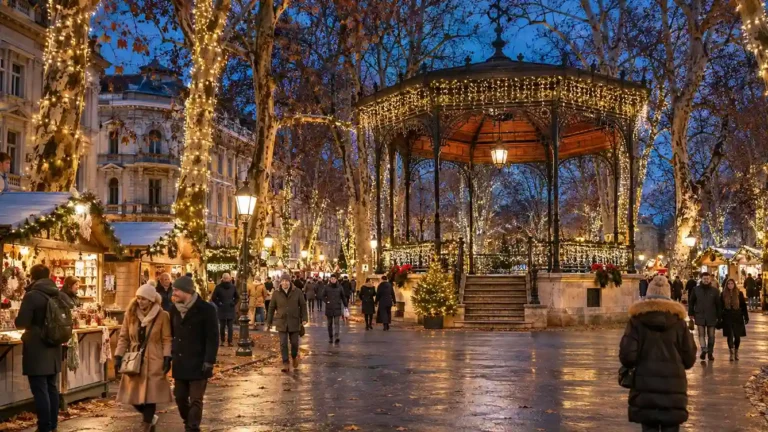
Zagreb is the strongest starting point for travelers experiencing Christmas in Croatia for the first time. The capital combines traditional Christmas markets with a varied cultural programme, illuminated parks, seasonal food, historic streets and winter entertainment.
The confirmed Advent Zagreb season runs from 28 November 2026 until 7 January 2027. Unlike destinations where Christmas festivities revolve around one main square, Zagreb offers several interconnected festive areas across its city center.
This makes Zagreb particularly attractive for visitors who prefer exploring on foot. Its public transportation network also allows travelers to stay outside the immediate market areas without needing a rental car.
Families can combine festive activities with museums and indoor attractions, while couples can enjoy atmospheric evening walks, cafés, restaurants and seasonal concerts. Zagreb is also a practical arrival point for a longer Croatian Christmas itinerary because of its international airport and mainland transport connections.
The main disadvantages are colder weather, potentially crowded Advent weekends, and increased accommodation demand in convenient central locations. Staying for two or three nights provides enough time to enjoy the festivities without rushing.
For confirmed market locations, individual opening hours, ice skating, accommodation areas, airport transportation and detailed walking itineraries, read our complete Zagreb Christmas Market 2026/2027 travel guide.
You can also consult the official Advent Zagreb website for the festival programme.
2. Dubrovnik — Best for Christmas in a Historic Coastal City
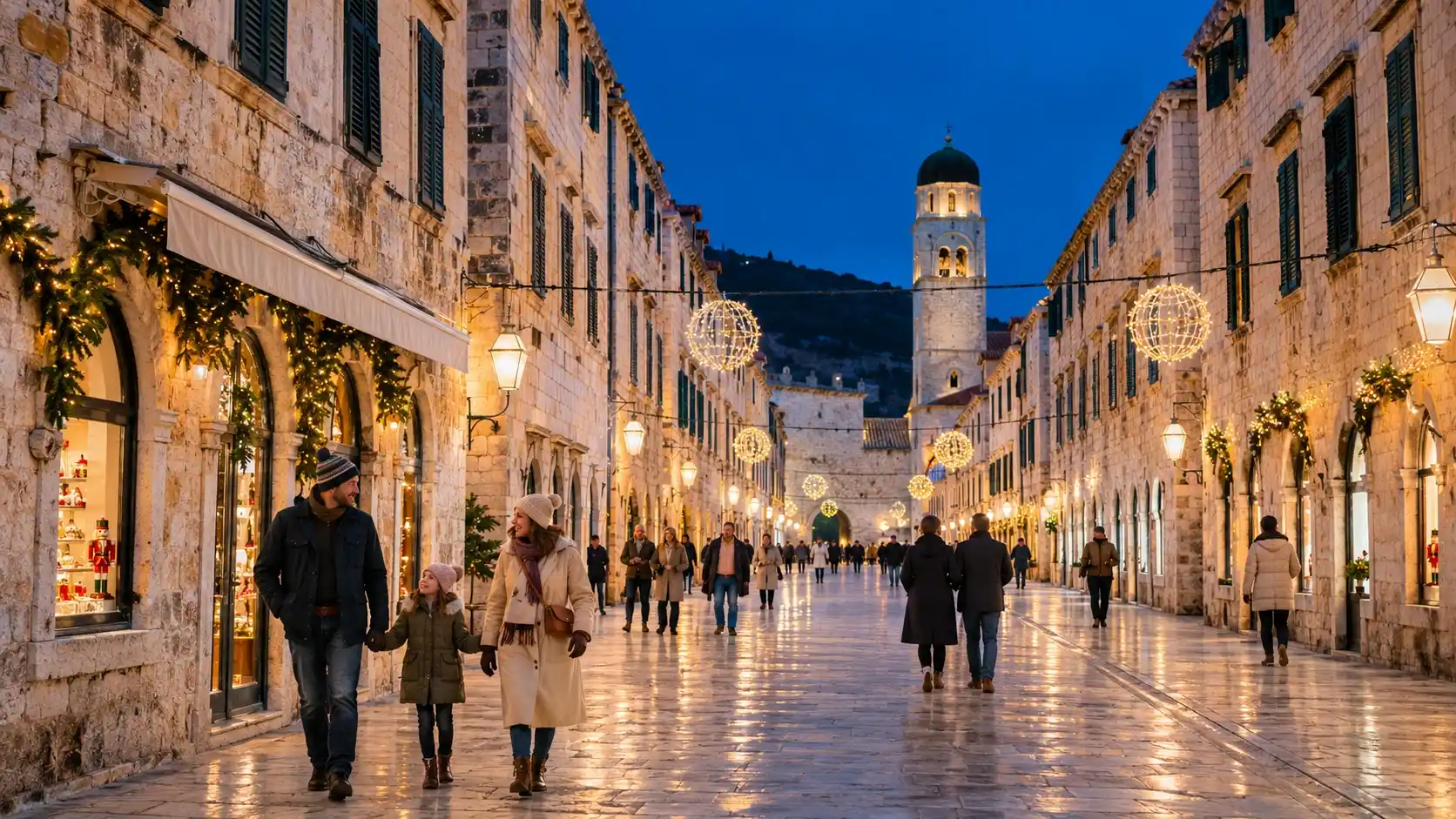
Dubrovnik offers a different Christmas experience, with festive decorations set against medieval limestone architecture and the Adriatic coastline.
The city’s 2026/2027 festival, known as Advent in Dubrovnik or Advent u Gradu, runs from 28 November 2026 to 3 January 2027. The programme includes concerts on Stradun, theatrical performances, creative workshops and events for children.
During daylight, visitors can explore the Old Town, historic churches and waterfront areas. In the evening, the illuminated streets provide an attractive setting for festive walks and cultural events.
The official Advent in Dubrovnik programme provides information about seasonal activities.
One important limitation is that many tourism businesses operate seasonally. Dubrovnik’s City Walls also close on Christmas Day, according to the official City Walls operator.
Best for: Couples, photography, architecture and cultural sightseeing.
Recommended stay: Two or three nights. Confirm winter flights and airport transportation before booking.
3. Split — Best for Christmas by the Adriatic
Split combines a functioning year-round coastal city with Roman heritage, waterfront cafés and Christmas entertainment.
According to the Split Tourist Board’s 2026 Advent announcement, the main programme runs from 27 November 2026 to 6 January 2027, with festivities centered around Riva and Prokurative Square.
The programme includes music, children’s entertainment, cultural activities and an ice rink at Strossmayer Park. Traditional Christmas Eve food distribution is also announced.
Split is well suited to travelers who want to combine Christmas celebrations with exploring Diocletian’s Palace and the surrounding historic streets.
Winter ferries and excursions are less convenient than in summer, so treat Split primarily as a Christmas city break rather than an island-hopping base.
Best for: Couples, families and independent travelers.
Recommended stay: Two nights, with an optional third night for a relaxed visit.
4. Opatija — Best for a Romantic Seaside Christmas
Opatija’s historic villas, elegant hotels, landscaped parks and seaside setting make it particularly suitable for a relaxed Christmas holiday.
The official Opatija Advent programme runs from 27 November 2026 until 10 January 2027.
Rather than spending every evening in busy market squares, visitors can combine seasonal celebrations with waterfront walks, hotel dining and indoor relaxation.
Opatija is especially appealing to couples and travelers who prefer a slower pace. However, rain and strong coastal winds can interrupt outdoor plans, making accommodation with comfortable indoor facilities particularly valuable.
Recommended stay: Two nights, or a day trip from Rijeka if transportation schedules are suitable.
5. Rijeka — Best for an Urban Coastal Christmas
Rijeka provides a less resort-oriented coastal experience, combining local city life with Christmas entertainment and historic neighborhoods.
The official Rijeka Advent season runs from 28 November 2026 until 10 January 2027.
Its programme includes activities in central public spaces and other locations around the city. Visitors can combine the Korzo pedestrian area with cultural attractions and local restaurants.
Rijeka is also a useful base for visiting nearby Opatija. Staying in one city and making a day trip to the other avoids an unnecessary hotel change.
Best for: Independent travelers interested in urban culture and coastal scenery.
Recommended stay: One or two nights, excluding additional time in Opatija.
6. Varaždin — Best for a Smaller Historic Christmas Destination
Varaždin offers an intimate Christmas atmosphere within a compact historic center known for its Baroque architecture.
The Varaždin Tourist Board’s Advent calendar confirms celebrations from 27 November 2026 to 6 January 2027.
The city’s decorated streets and seasonal attractions are suitable for families and visitors who prefer smaller destinations. Varaždin can be considered as an additional stop during a Zagreb-based Christmas trip.
Before planning a day trip, check both outbound and return transportation. Winter evening departures may be less convenient than daytime services.
Recommended stay: One day or one overnight stay.
7. Zadar — Best for a Quieter Dalmatian Christmas
Zadar combines historic streets, Roman heritage and Adriatic waterfront scenery with a seasonal Advent programme.
The official Zadar Christmas Market runs from 24 November 2026 until 2 January 2027.
Its historic peninsula offers a compact setting for festive sightseeing, while landmarks such as the Sea Organ provide additional reasons to explore during daylight.
Zadar is a good alternative for travelers who prefer a smaller coastal city. Nevertheless, popular concerts can attract substantial local crowds, and winter international flight options may be limited.
Recommended stay: One or two nights.
8. Osijek — Best for Exploring Slavonian Christmas Traditions
Osijek provides an opportunity to experience Christmas in eastern Croatia, away from the country’s better-known Adriatic destinations.
The 2026 Advent event is centered around Tvrđa, the city’s historic fortified district. The announced programme includes concerts, children’s activities and festive entertainment, with the main event period extending from 28 November 2026 to 1 January 2027.
Visitors interested in regional cuisine, continental architecture and Slavonian culture may find Osijek particularly rewarding. Consult the official Osijek Advent programme for individual activity dates.
Its distance from the principal coastal destinations makes it less practical for a short first-time Croatian holiday.
Recommended stay: One or two nights as part of an inland itinerary.
Croatia’s Christmas Destinations Compared
| Destination | Best For | Festive Experience | Weather | Stay |
|---|---|---|---|---|
| Zagreb | First-time visitors | Traditional markets and citywide festivities | Cold | 2–3 nights |
| Dubrovnik | Architecture and couples | Historic coastal celebrations | Milder, potentially wet | 2–3 nights |
| Split | Culture and families | Waterfront events | Milder, windy at times | 2 nights |
| Opatija | Romantic holidays | Seaside lights and hotel stays | Cool, potentially rainy | 2 nights |
| Rijeka | Local urban culture | Coastal city festivities | Cool and wet | 1–2 nights |
| Varaždin | Smaller markets and families | Historic inland Advent | Cold | 1 day/night |
| Zadar | Relaxed coastal visits | Historic peninsula celebrations | Cool and mild | 1–2 nights |
| Osijek | Regional food and culture | Slavonian Christmas | Cold | 1–2 nights |
If you can visit only one city, choose Zagreb for the widest range of traditional Advent experiences. Choose Dubrovnik or Split instead if coastal architecture and historic sightseeing are more important than a classic continental Christmas market.
If you are planning a longer trip beyond Christmas celebrations, our complete guide to Croatia in December explains regional weather differences, realistic travel costs, national park accessibility, winter transportation and the best destinations for a December holiday.
Christmas Markets in Croatia: Confirmed 2026/2027 Dates
| City | Festival | Opening | Closing |
|---|---|---|---|
| Zadar | Advent Zadar | 24 Nov 2026 | 2 Jan 2027 |
| Split | Advent in Split | 27 Nov 2026 | 6 Jan 2027 |
| Opatija | Opatija Advent | 27 Nov 2026 | 10 Jan 2027 |
| Varaždin | Advent Varaždin | 27 Nov 2026 | 6 Jan 2027 |
| Zagreb | Advent Zagreb | 28 Nov 2026 | 7 Jan 2027 |
| Dubrovnik | Advent in Dubrovnik | 28 Nov 2026 | 3 Jan 2027 |
| Rijeka | Rijeka Advent | 28 Nov 2026 | 10 Jan 2027 |
| Osijek | Advent Osijek | 28 Nov 2026 | 1 Jan 2027 |
Traditional Christmas Celebrations in Croatia
Croatian Christmas traditions reflect a combination of Christian religious observance, regional customs and family celebrations. Modern public Advent festivals complement these traditions rather than replace them.
The Advent Season
Advent traditionally represents the preparation period before Christmas. Families may display an Advent wreath containing four candles, lighting an additional candle on each successive Sunday.
Public Christmas markets, concerts and decorations provide a more contemporary expression of the festive season.
St. Nicholas Day — 6 December
Children traditionally prepare clean boots or shoes on the evening before St. Nicholas Day. Small gifts, sweets or fruit may be left for them overnight. In some traditions, the figure of Krampus accompanies St. Nicholas as a warning against misbehavior.
St. Lucy’s Day — 13 December
Planting Christmas wheat, known as božićna pšenica, is a distinctive Croatian festive custom. Wheat is grown indoors so that green shoots decorate the home around Christmas, symbolizing renewal and prosperity.
Some regions observe this tradition on St. Barbara’s Day instead. These variations reflect the diversity of Croatian customs documented by Croatian public broadcaster HRT.
Christmas Eve — Badnjak
Christmas Eve is commonly associated with family preparations, decorating the Christmas tree, meat-free meals and religious observances.
Fish, particularly dried cod, has an important place in many households. Some families attend midnight Mass, known as polnoćka.
For international visitors, Christmas Eve offers an opportunity to experience local traditions, but it is also a day when businesses may close earlier than usual.
Christmas Day — Božić
Christmas Day is primarily a family occasion for many Croatians, often involving religious services, a festive lunch and time spent with relatives.
Not every household follows the same practices. Visitors should understand that public Advent entertainment and private family celebrations are different aspects of the holiday.
Useful Croatian Christmas Greetings
| Croatian | English |
|---|---|
| Sretan Božić | Merry Christmas |
| Sretna Nova godina | Happy New Year |
| Badnjak | Christmas Eve |
| Božić | Christmas |
| Advent or Došašće | Advent |
| Polnoćka | Midnight Mass |
Traditional Croatian Christmas Food and Drinks
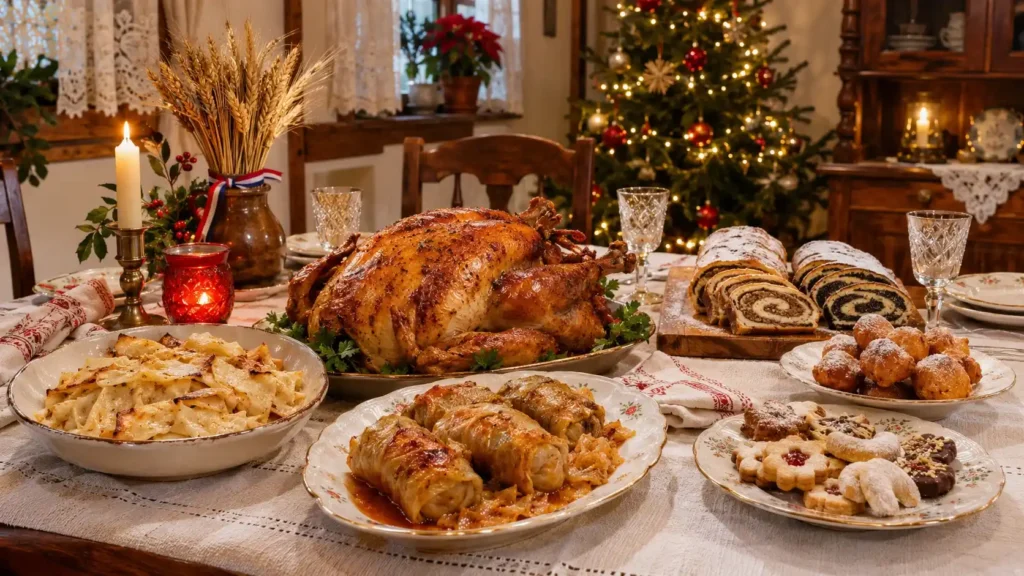
Food is an important part of Christmas in Croatia, with significant differences between continental and coastal regions. Christmas Eve dishes are frequently based on fish, while Christmas Day meals often feature roasted meats, cabbage dishes and homemade pastries.
| Dish | What It Is | Traditional Occasion or Region |
|---|---|---|
| Bakalar | Prepared dried or salted cod | Christmas Eve, particularly coastal Croatia |
| Fritule | Small fried sweet dough balls | Dalmatian festive tradition and Christmas markets |
| Sarma | Stuffed fermented cabbage rolls | Winter and festive family meals |
| Pečena purica | Roast turkey | Christmas meals in continental Croatia |
| Mlinci | Thin flatbread softened and served with roasting juices | Zagreb and northwestern Croatia |
| Orehnjača | Sweet walnut roll | Festive homemade baking |
| Makovnjača | Poppy seed roll | Traditional holiday pastries |
| Festive biscuits | Various homemade cookies and pastries | Family Christmas celebrations |
| Kuhano vino | Hot spiced wine | Modern Christmas markets |
Traditional turkey with mlinci is particularly associated with northwestern Croatia, including Zagreb, as explained by the Croatian National Tourist Board’s culinary guide.
Market food is not necessarily identical to what Croatian families serve at home. Visitors may encounter sausages, contemporary street food, desserts and international dishes alongside traditional specialties.
Vegetarians should ask whether vegetable dishes contain meat stock or animal fat. Travelers with allergies should check ingredients, especially nuts, dairy and wheat in festive pastries. Reserve Christmas meals in advance if a particular restaurant or traditional dish matters to your trip.
What Is Open in Croatia on Christmas Eve and Christmas Day?
Holiday opening arrangements are one of the most important considerations when visiting Croatia at Christmas.
Christmas Day and St. Stephen’s Day are official public holidays. Christmas Eve is not a nationwide public holiday, although many businesses operate shorter hours.
| Service | 24 December | 25–26 December |
|---|---|---|
| Restaurants | May close early | Selected restaurants open; reservations advisable |
| Supermarkets | Often reduced hours | Generally closed, subject to legal exceptions |
| Christmas markets | Venue-specific schedules | Selected venues may operate |
| Museums | Possible shortened hours | Many close or operate special schedules |
| Public transportation | Modified services possible | Holiday timetables may apply |
| Hotels | Operating properties normally serve guests | Restaurant arrangements vary |
| Churches | Christmas Eve services | Christmas religious services |
Consult the official Croatian public holiday information. Croatian retail legislation generally requires shops to close on public holidays, with specified exemptions for certain locations and types of businesses.
Christmas Weather in Croatia: Coast vs Inland
Christmas weather varies considerably across Croatia. Inland cities experience colder winter conditions, while the Adriatic coast generally remains milder but can receive significant rainfall and strong winds.
| Destination | Typical Daytime Conditions | Nighttime Conditions | Snow Potential |
|---|---|---|---|
| Zagreb | Around 5°C | Near or below freezing | Possible |
| Varaždin and Osijek | Cold | Frost possible | Possible |
| Split | Around 11°C | Cool | Rare in the city |
| Dubrovnik | Mild by Croatian winter standards | Cool | Very uncommon |
| Rijeka and Opatija | Cool and potentially wet | Cold to cool | Uncommon near sea level |
These are broad historical December conditions rather than forecasts for Christmas 2026. Consult the Croatian Meteorological and Hydrological Service climate information and check short-range forecasts before traveling.
A white Christmas is not guaranteed, even in Zagreb. Coastal winds can also make temperatures feel considerably colder than expected.
Pack a waterproof jacket, warm layers, comfortable water-resistant shoes, gloves, a scarf and clothing suitable for both outdoor markets and heated indoor spaces.
For broader seasonal comparisons, see our guide to the best time to visit the Balkans.
How Much Does Christmas in Croatia Cost?
Christmas travel costs depend primarily on accommodation, destination, dining preferences and transportation. Zagreb’s Advent popularity can increase central hotel prices, while coastal cities may offer lower off-season accommodation rates despite reduced hotel availability.
The following figures are suggested planning allowances, not confirmed Christmas 2026 prices or live booking quotations.
| Expense | Budget Traveler | Mid-Range Traveler | Notes |
|---|---|---|---|
| Accommodation | €25–€45 | €45–€85 | Per person, sharing a double room or using budget lodging |
| Breakfast | €4–€7 | €7–€12 | May be included with accommodation |
| Market food or lunch | €8–€15 | €15–€25 | Depends on portion and location |
| Evening meal | €12–€20 | €20–€35 | Special Christmas menus may cost more |
| Drinks and snacks | €4–€8 | €8–€15 | Optional spending |
| Local transportation | €2–€6 | €4–€10 | Walking reduces costs |
| Optional attractions | €0–€10 | €10–€25 | Not needed every day |
| Intercity transportation | €15–€35 | €25–€50 | Additional allowance per travel leg |
A reasonable starting budget is approximately €60–€100 per person per day for careful spending, or €100–€160 for a comfortable mid-range city break. Peak-date accommodation and special dinners can push spending higher.
International flights, airport transfers, intercity travel and premium Christmas dinners should be budgeted separately.
Christmas in Croatia Itinerary: 3, 5 or 7 Days
Three Days — Zagreb Christmas City Break
Spend two nights in Zagreb, using the arrival evening for festive markets, the second day for cultural sightseeing and Christmas activities, and the final morning for a relaxed city walk.
For detailed market routes and activity schedules, follow the Zagreb Christmas Market guide rather than attempting to fit another distant Croatian destination into this short trip.
Five Days — Zagreb, Rijeka and Opatija
| Day | Plan | Overnight |
|---|---|---|
| 1 | Arrive in Zagreb and enjoy Advent | Zagreb |
| 2 | Christmas markets and cultural sightseeing | Zagreb |
| 3 | Travel to Rijeka and explore the festive center | Rijeka |
| 4 | Opatija Christmas day trip | Rijeka |
| 5 | Return toward Zagreb or continue onward | Departure |
This route combines continental and coastal festivities without excessive hotel changes. Allow several hours for the Zagreb–Rijeka journey and confirm the local connection to Opatija.
If your return flight departs Zagreb early on Day 5, return to the capital the previous evening instead or add an extra night.
Seven Days — Zagreb, Split and Dubrovnik
| Day | Plan | Overnight |
|---|---|---|
| 1 | Arrive in Zagreb | Zagreb |
| 2 | Enjoy Zagreb’s Advent celebrations | Zagreb |
| 3 | Intercity journey to Split | Split |
| 4 | Explore historic Split and its festive programme | Split |
| 5 | Travel to Dubrovnik | Dubrovnik |
| 6 | Old Town sightseeing and Advent activities | Dubrovnik |
| 7 | Departure | — |
This itinerary works best with an open-jaw flight arrangement, arriving in Zagreb and departing from Dubrovnik, provided suitable winter flights exist. Reverse the route if flight availability makes that more practical.
Compare Split to Dubrovnik bus tickets for your exact travel date before reserving non-refundable accommodation.
If traveling during 24–26 December, arrange to spend Christmas Day in one destination rather than making a long intercity transfer.
Where to Stay in Croatia for Christmas
The most convenient accommodation is usually within walking distance of Christmas festivities, restaurants and indoor attractions.
| Destination | Best Area | Advantages | Considerations |
|---|---|---|---|
| Zagreb | Lower Town | Festive areas and public transit | Higher Advent demand |
| Dubrovnik | Old Town or Pile area | Historic sights and celebrations | Steps, luggage access and noise |
| Split | Historic center or near Riva | Walkability and dining | Possible event noise |
| Opatija | Central waterfront | Seaside walks and hotel facilities | Higher prices at premium properties |
| Rijeka | City center near Korzo | Restaurants and transport access | Street noise in busy areas |
For a traditional Christmas market holiday, compare accommodation in Zagreb, prioritizing central locations, heating and flexible cancellation conditions.
For a coastal festive break, explore available hotels and apartments in Dubrovnik. Confirm that nearby restaurants and hotel facilities operate throughout your stay.
Getting Around Croatia During Christmas
Most Croatian Christmas city breaks do not require a rental car. Central festive areas are often walkable, while intercity buses connect many of the country’s major destinations.
The Arriva Croatia route network includes connections between Zagreb, Rijeka, Opatija, Split and Dubrovnik. Check actual departure dates rather than assuming that every regular service operates on public holidays.
Railway travel can be useful on selected inland routes. Consult Croatian Railways’ official timetables, particularly because the existing 2025/2026 railway timetable ends on 12 December 2026.
For island journeys, use Jadrolinija’s official sailing schedules. Winter frequency and weather-related cancellations require particular attention.
Read our guide to exploring Croatia without a car for general transportation principles, but verify winter-specific connections separately.
Travelers without an appropriate roaming plan can compare Croatia eSIM options before departure. Check device compatibility and whether your existing mobile plan already includes Croatia.
Christmas in Croatia with Children
Zagreb, Split and Varaždin are attractive choices for family Christmas trips because they combine festive activities with relatively compact sightseeing areas.
Split’s announced 2026 programme includes children’s performances, workshops and ice skating. Dubrovnik also has family-oriented cultural activities, while Osijek’s programme includes interactive educational experiences.
Check age requirements, activity reservations and exact operating dates. For younger children, plan shorter outdoor visits with frequent indoor breaks.
Historic streets, cobblestones and steps can make stroller access more difficult in some destinations, particularly Dubrovnik’s Old Town.
Families spending Christmas Day in Croatia should prioritize confirmed meals and comfortable accommodation over ambitious travel plans.
Christmas in Croatia for Couples and Solo Travelers
Couples seeking traditional markets may prefer Zagreb, while Opatija offers a slower seaside holiday. Dubrovnik is particularly suitable for historic evening walks, and Split combines architecture with waterfront dining.
Solo travelers can benefit from Zagreb’s public transportation and broad range of activities or choose Split for a compact coastal city break.
Winter nightlife varies between cities and individual dates. Check evening transportation, stay in conveniently located accommodation and use normal personal safety precautions in busy festive areas.
Christmas and New Year’s Eve in Croatia
Travelers visiting Croatia between Christmas and early January can combine Advent celebrations with New Year’s Eve on 31 December 2026, welcoming 2027.
Several major Advent festivals continue into January. Split has confirmed an evening celebration on Riva, while Dubrovnik and Osijek have also announced public New Year entertainment.
New Year’s Eve can increase accommodation demand and create additional restaurant reservation requirements. Check individual city programmes, late-night transportation and any event-specific arrangements before choosing where to celebrate.
Common Mistakes When Visiting Croatia at Christmas
| Mistake | Why It Causes Problems | Better Approach |
|---|---|---|
| Expecting identical celebrations everywhere | Festivals vary considerably | Choose a city matching your interests |
| Planning summer-style island hopping | Reduced winter services | Focus on mainland cities |
| Assuming restaurants open on Christmas Day | Limited dining choices | Reserve meals before arrival |
| Expecting guaranteed snow | Weather is unpredictable | Enjoy festive activities regardless of snowfall |
| Using outdated Advent dates | Programmes change annually | Consult current official calendars |
| Ignoring accommodation heating | Uncomfortable winter stays | Confirm heating facilities |
| Underestimating coastal winds | Outdoor conditions may feel colder | Pack waterproof and wind-resistant clothing |
| Ignoring holiday transportation | Missed or unavailable connections | Check date-specific timetables |
| Visiting too many cities | Less time enjoying festivities | Choose two or three realistic bases |
| Assuming attractions remain open | Unexpected closures | Verify individual opening hours |
Practical Tips for Spending Christmas in Croatia
- Check official Advent programmes before finalizing travel dates.
- Arrange Christmas Day meals in advance.
- Carry a suitable payment card and some euros.
- Download offline maps.
- Reserve essential intercity connections and airport transfers.
- Check seasonal ferry schedules separately.
- Pack for rain, frost and coastal winds.
- Allow flexibility for winter transportation disruptions.
- Avoid unnecessary rental cars for city-based trips.
- Confirm accommodation heating and holiday services.
- Consider appropriate travel insurance.
- Check official weather forecasts before longer journeys.
Which Croatian City Should You Choose for Christmas?
The best Croatian Christmas destination depends on the kind of holiday you want.
- First-time Christmas visitors: Zagreb.
- Traditional Advent markets: Zagreb or Varaždin.
- Romantic seaside holidays: Opatija.
- Historic architecture: Dubrovnik or Split.
- Family activities: Zagreb, Split or Varaždin.
- Regional traditions: Osijek.
- Smaller coastal destinations: Zadar.
- Car-free multi-city trips: Zagreb, Rijeka and Opatija.
Budget-conscious travelers should compare actual accommodation and transportation prices rather than assuming smaller destinations are automatically cheaper. A well-connected city can reduce overall costs even when hotel rates are higher.
Final Thoughts — Christmas in Croatia 2026
Christmas in Croatia is a rewarding alternative to a conventional European winter holiday, offering traditional Advent markets, regional festive food, historic architecture and distinctive coastal celebrations.
Zagreb is an excellent choice for a first visit, while Dubrovnik, Split and Opatija provide appealing alternatives for travelers who prefer the Adriatic coast. Smaller inland and coastal cities offer additional opportunities to experience local culture.
Three days are sufficient for a focused city break, while five to seven days allow a realistic combination of destinations. The most important considerations are holiday restaurant arrangements, winter transportation, accommodation heating and confirmed festival schedules.
Choose your preferred Christmas atmosphere, compare accommodation and transportation for your exact dates, and leave enough flexibility to enjoy Croatia’s festive season without unnecessary rushing.