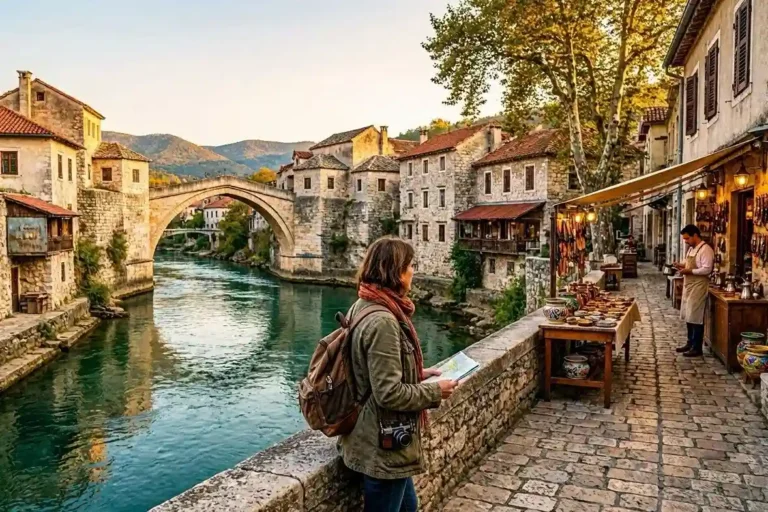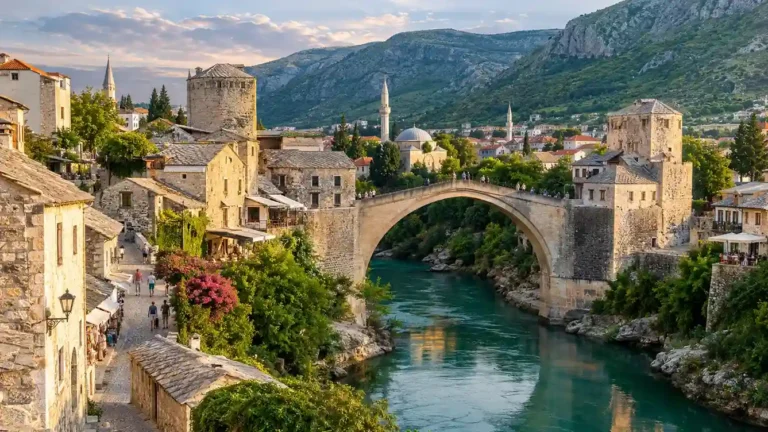

Split to Mostar Bus Guide: Tickets, Border Crossing & Travel Time

Taking the Split to Mostar Bus is a practical way to travel from Croatia’s Dalmatian coast into Bosnia and Herzegovina without renting a car. The route connects two popular Balkan stops, but it is not an ordinary domestic transfer: you will leave the Schengen Area, pass immigration controls and arrive at one of several possible stops in Mostar. This guide explains how to choose a direct bus, compare tickets and stations, prepare for the border and plan your arrival or return journey.
Affiliate disclosure: Some links in this guide may be affiliate links. If you book through them, we may earn a small commission at no additional cost to you. This helps support BalkanTripGuide.com.
Quick Answer: Split to Mostar Bus
- Direct bus? Yes. Direct services appear on Globtour’s published route information and major ticketing platforms; check the date you need.
- Journey: Commonly around 3.5–5 hours on published schedules, with additional delays possible.
- Fare: Recent listings generally put standard one-way tickets around €20–€35, with cheaper offers occasionally advertised; not a fixed tariff.
- Departure: Split’s main bus station, Autobusni kolodvor Split, by the ferry port.
- Arrival: Check for Mostar East, Mostar West or another explicitly named Mostar stop.
- Companies: Globtour/Croatia Bus and services sold through FlixBus; other departures may appear under different operating names.
- Booking: Operator websites and route searches on Omio or Busbud; booking ahead is sensible on fixed travel dates.
- Border: Croatia/Schengen exit and Bosnia and Herzegovina entry checks apply. Carry an accepted original travel document and any required visa.
- Seasons: Frequencies and departure times can change, particularly around holidays and quieter months.
- Alternative: A guided day tour is often easier than an independent same-day bus return; a private transfer adds flexibility at a higher cost.
- Most important tip: Verify the actual operator, exact Mostar stop and your re-entry eligibility before paying.
Table of Contents
Split to Mostar Bus: Quick Travel Overview
| Travel detail | What travelers should know |
|---|---|
| Start / finish | Split, Croatia → Mostar, Bosnia and Herzegovina |
| Road distance | Route-dependent; FlixBus advertises approximately 140 km / 87 miles |
| Direct route | Yes, on selected published departures; check for “0 transfers” |
| Scheduled travel time | Typically about 3.5–5 hours, depending on service and stop |
| Indicative one-way fare | Often around €20–€35 in recent listings; live fares vary |
| Split station | Obala kneza Domagoja 12, near the port and railway station |
| Mostar station | East, West or another stop as specified on your ticket |
| Immigration | International border; entry rules depend on nationality and documents |
| Currencies | Euro (EUR) in Croatia; convertible mark (BAM/KM) in Bosnia |
| Online tickets | Available for many services; check ticket format and luggage terms |
Is There a Direct Bus from Split to Mostar?
Yes. You can find direct buses from Split to Mostar without changing vehicles. Globtour publishes Split–Mostar connections, while FlixBus lists the route for online purchase. Availability is still date-specific: a provider may list fewer journeys on certain days, and a booking comparison may mix nonstop departures with itineraries requiring a change.
Split to Mostar Bus Companies
The operating carrier runs the coach; a ticket seller may only handle booking. Globtour publishes route information, while FlixBus sells departures and should identify the actual carrier. Croatia Bus and Globtour appear together on some ticket platforms. Omio and Busbud are comparison or sales channels, not evidence that they operate the vehicle.
| Operator / seller | Service shown | Listed time | Booking / important note |
|---|---|---|---|
| Globtour / Croatia Bus | Direct departures listed | Examples around 3h 30m–4h 40m | Globtour route notice; station booking and partner sellers |
| FlixBus | Route marketed; check transfer count | Advertised minimum 3h 30m; individual trips may take longer | Book on FlixBus; confirm the operating carrier and stop |
| Centrotrans | Direct service appears in ticket listings | Around 5 hours on listed examples | Verify the actual carrier on the selected ticket |
| Omio / Busbud | Ticket sellers, not single bus operators | Depends on departure | Useful for comparing price, stations and change requirements |
Split to Mostar Bus Timetable and Frequency
There is no single timetable that should be copied into an evergreen guide as though it applied every day. The published Globtour service notice names Split departures at 07:30 and 17:30, and booking marketplaces show additional departures on some dates, including a morning journey sold under Centrotrans and evening options sold via FlixBus. These are examples from published listings, not a guarantee for your travel day.
Search your travel date in the official Split Bus Station timetable and the carrier’s booking screen. Seasonal revisions, holidays and weekday differences can change the available departures; search your return date separately.
How Long Does the Bus from Split to Mostar Take?
Plan around four to five hours for many direct buses, though some advertised trips take closer to three and a half hours. FlixBus quotes about 140 km, but stops, roads and arrival stations differ.
Border queues, passenger checks, traffic, intermediate stops and roadworks can extend the scheduled journey. Do not book a tight onward connection after an international bus arrival; add a generous buffer.
How Much Does the Split to Mostar Bus Cost?
Recent booking listings show many one-way fares around €20–€35, sometimes with lower promotions or more expensive dates. This is an observed planning band, not a fixed tariff; check the final price for your specific departure.
| Ticket or expense | Indicative cost | Important notes |
|---|---|---|
| One-way bus seat | Often about €20–€35 | Observed offer range; varies by date, provider and availability |
| Return ticket | Price both directions | No universal round-trip discount; compare separately |
| Checked baggage | Included on some tickets; fee on others | Read your carrier’s exact allowance |
| Extra / oversized bag | Operator-specific | Request approval before travel where required |
| Platform / payment fee | Varies or may not apply | Check final checkout total and currency conversion |
Croatia uses the euro (EUR); Bosnia and Herzegovina uses the convertible mark (BAM/KM). Check conversion fees and carry some local cash for small purchases; do not assume cards or euros are accepted everywhere.
Where to Buy Split to Mostar Bus Tickets
Booking Bus Tickets Online
Compare available Split to Mostar bus tickets on Busbud with Omio’s Split–Mostar bus listings. Check the actual bus operator, departure and arrival stations, direct or connecting services, seat availability, luggage allowances, cancellation conditions and total ticket price before booking.
FlixBus states that its mobile tickets can be shown on a phone. Do not extend that policy to every regional carrier: check the confirmation to see whether a PDF, QR code or paper ticket is required. Save an offline copy, and read amendment, cancellation and refund terms before choosing a nonflexible fare.
Buying Tickets at Split Bus Station
Split station sells tickets at its counters and website. Buying in person can work for flexible trips, but busy departures may fill up. Ask about the Mostar arrival stop, baggage fees and accepted payment methods; do not assume the driver sells tickets.
Should You Book in Advance?
Where Does the Bus Leave from in Split?
Most listed coaches depart from Autobusni kolodvor Split at Obala kneza Domagoja 12. The official station website confirms the address beside the ferry port and railway station.
From Diocletian’s Palace or the Riva, follow the waterfront toward the port; allow approximately 10–20 minutes from central Old Town addresses. The ferry and railway terminals are nearby, though the walk depends on your specific pier or platform.
The station has ticket offices, waiting areas, toilets and luggage storage, some subject to fees. Aim to arrive 20–30 minutes early, or sooner when buying a ticket. Confirm your platform on station displays or with staff.
Where Does the Bus Arrive in Mostar?
Mostar has East station near the railway station and West station on Vukovarska. Booking sites sometimes show generic labels such as “Mostar Central,” so check the ticket address or map pin—not just the city name.
| Arrival station | Location | Access to Old Town | Practical advice |
|---|---|---|---|
| Mostar East | Trg Ivana Krndelja, next to the railway station | Typically about 20–25 minutes on foot to Stari Most | Good for rail connections and walking toward the historic center |
| Mostar West | Vukovarska, west of the central historic area | A longer cross-city walk for many Old Town hotels | Consider taxi or local transport with heavy luggage |
| Other named stop | Defined by the individual ticket | Varies | Check the exact street and pin before departure |
Croatia–Bosnia Border Crossing by Bus
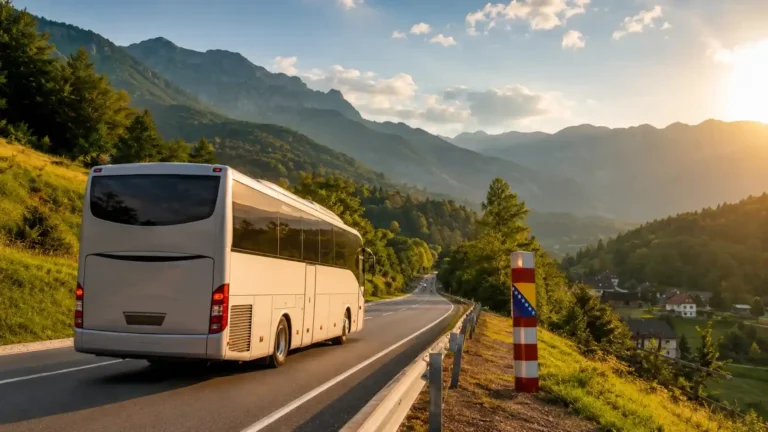
The Split to Mostar route leaves Croatia, an EU and Schengen member, and enters Bosnia and Herzegovina, which is outside Schengen. This makes the border a central part of your trip, not a minor roadside stop. Official guidance from the Croatian Ministry of the Interior explains external-border controls, while the Bosnia and Herzegovina Border Police explains entry-document and visa rules.
Leaving Croatia and the Schengen Area
At the external Schengen border, Croatian officials can examine travel documents and confirm eligibility to exit or subsequently re-enter. For many non-EU short-stay visitors, the European Entry/Exit System (EES) electronically records relevant border movements and may involve biometric procedures. The European Commission’s EES guide explains which travelers are covered and how the system works.
Entering Bosnia and Herzegovina
Bosnia applies its own immigration rules. Many travelers enter without a Bosnian visa, but visa-free status cannot be inferred from the fact that they were permitted into Croatia. Nationality, passport, residence status and relevant visas matter. EU citizens may generally use a valid national identity card for entry under Bosnian rules, while travelers from other countries must check their accepted documents individually.
What Happens During Passport Control?
Expect the coach to stop for checks on both sides of the border, although the physical layout and sequence depend on the crossing used. Officers may inspect or collect documents on the bus, ask passengers to get off, confirm identities or examine selected luggage. Follow instructions, keep documents accessible and wait until the whole coach has been cleared. Neither remaining in your seat nor leaving the bus is a universal rule.
How Long Does the Border Crossing Take?
There is no dependable guaranteed waiting time. A quiet crossing may proceed comparatively quickly, while peak holiday traffic, long vehicle queues, document issues or additional checks can extend the stop. Immigration officers determine the procedure; the bus company’s timetable is only an estimate for arrival planning.
Do You Need a Visa for Bosnia and Herzegovina?
That depends on your nationality and circumstances. Bosnia publishes certain exemptions for travelers holding qualifying valid multiple-entry Schengen, EU or US visas or residence permits, but precise document and stay conditions apply. A single-entry Schengen visa is not automatically equivalent. Consult the Bosnian Ministry of Security’s information for foreigners and the competent Bosnian embassy before departure.
Can You Return to Croatia After Visiting Mostar?
Only if you meet the applicable Schengen entry conditions when you come back. Leaving Croatia can be significant for travelers holding a single-entry Schengen visa, those whose permitted stay is running out, or those subject to other entry restrictions. A valid multi-entry visa or residence permit may help where applicable, but it is not an unconditional guarantee of admission. Check re-entry before you decide on a day trip or round-trip booking.
Documents to Carry for the Split to Mostar Bus
Prepare the following as a practical checklist, not a claim that every item is mandatory for every nationality:
- Original valid passport, or a national identity card accepted for your specific citizenship and journey.
- Bosnian visa if required, or supporting documents for a verified exemption.
- Any Schengen visa or residence permit relevant to your return trip.
- Bus ticket, booking reference and accessible offline copy.
- Accommodation address and contact information, if requested.
- Travel-insurance details, useful emergency contacts and payment card/cash.
- Copies of documents stored separately for reference; copies are not substitutes for originals at passport control.
Luggage Rules and Bus Comfort
Bus luggage allowances are carrier-specific. FlixBus currently advertises one small carry-on up to 7 kg and one checked bag up to 20 kg for this route, but that allowance must not be assumed for every Croatia Bus, Globtour or partner-operated service. Check the actual operating carrier on your booking and ask about second bags, bikes, sports equipment and other oversized items.
Vehicle amenities vary. Air conditioning is common, but do not count on functioning Wi-Fi, sockets, toilets or fixed rest stops across all operators. FlixBus advertises several amenities; check your service. Bring water, snacks and a charged power bank.
What the Split to Mostar Bus Journey Is Like
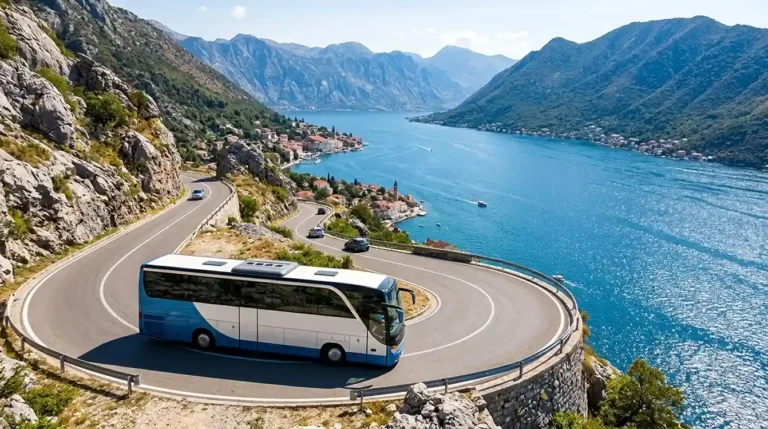
The coach leaves Split’s harbor district and travels through Dalmatian towns and limestone landscapes toward Herzegovina. Exact roads, intermediate stops and rest breaks depend on the carrier, so do not plan around an assumed scenic route or guaranteed rest stop.
How to Get from Mostar Bus Station to the Old Town
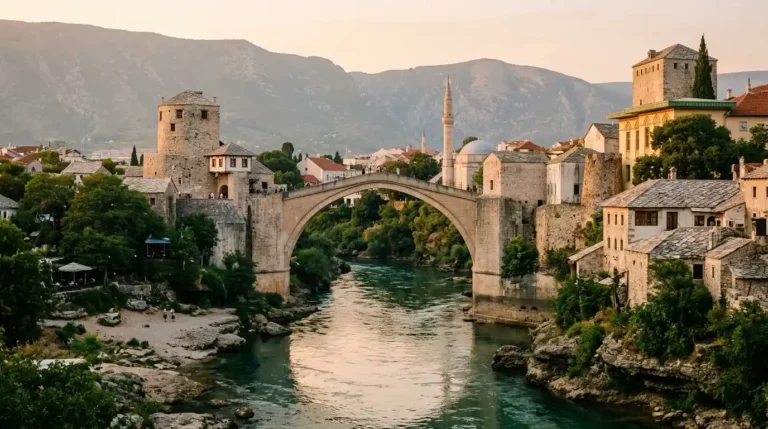
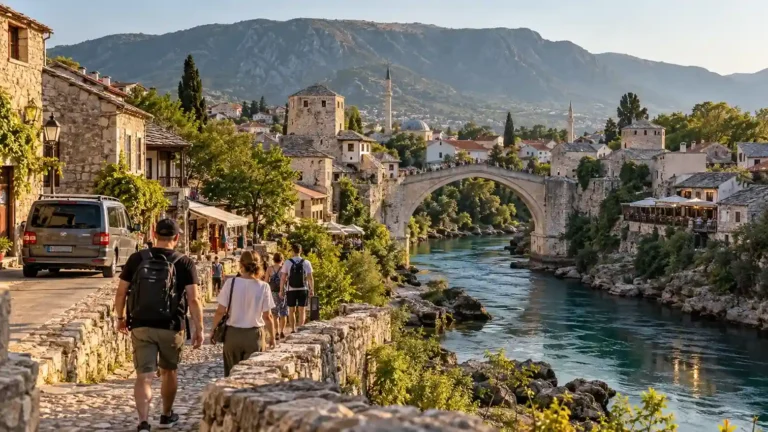
From Mostar East, walk south toward the city center and onward to the historic streets and Stari Most (Old Bridge). Allow roughly 20–25 minutes at a normal pace from the station area, longer with heavy luggage or a slower walking speed. Mostar’s cobbled Old Town and bridge approaches can be steep or slippery, so practical footwear matters.
Once you have dropped your luggage, the main Old Town sights are best explored on foot. For a self-guided route rather than more transport details, read our One Day in Mostar walking itinerary. Travelers interested in context from a local guide can also compare a Mostar private walking tour.
Can You Visit Mostar as a Day Trip from Split by Bus?
A same-day public-bus trip is possible only if both directions’ real timetables leave enough time in Mostar. With around four to five hours of travel each way, a return journey can use most of the day before you account for border queues. If your earliest usable outward bus arrives in the afternoon or the last return leaves early, the trip becomes impractical.
Check the earliest usable outward service, planned arrival stop and the last feasible return from the correct Mostar station. Aim for enough time to see Stari Most, the Kujundžiluk bazaar and the Neretva River without rushing.
For most travelers, an overnight stay offers a more relaxed independent trip. If you must return to Split on the same day, a guided Mostar and Kravice day tour departing Split can simplify the transportation plan. Check actual operating dates, pickup location, immigration requirements and how much time the tour gives you in Mostar; a guided tour does not eliminate border controls.
Split to Mostar Bus vs Private Transfer vs Organized Tour
| Transport option | Travel time | Cost | Flexibility | Best for | Main limitation |
|---|---|---|---|---|---|
| Intercity bus | Usually ~3.5–5 hours scheduled | Often ~€20–€35 one way | Low | Budget and car-free travelers | Fixed departures and border delays |
| Private transfer | Road time plus border | Quote required; generally higher | High | Groups or door-to-door arrival | Expense and cross-border provider approval |
| Organized day tour | Often a full 10–12-hour outing | Tour-specific; check inclusions | Medium | Same-day sightseeing from Split | Limited independent time |
| Rental car | Road time plus border | Rental, fuel, parking and possible cross-border fees | High | Multi-stop regional trips | Driving, paperwork and parking |
How to Travel from Mostar Back to Split
Return buses exist, but do not assume the departure times or stations are identical to the outward journey. Search your date on Mostar to Split bus ticket listings, then verify whether the coach boards at East or West. Globtour’s published service information includes a morning Mostar–Split connection, but the current timetable for your chosen day takes precedence.
Where to Stay in Mostar After Arriving by Bus
Mostar Old Town
Best for atmospheric streets, restaurants and easy sightseeing once your bags are dropped. The historic paving can be awkward for rolling suitcases, so check the walking approach to your exact accommodation.
Near Stari Most
A good choice for a short stay centered on the bridge and river views. Rooms can be close to busy pedestrian lanes; look for realistic access instructions and any steps.
Near the Bus Station
Convenient if you have an early departure, particularly from Mostar East beside the railway station. Before booking, check that the hotel is near the terminal your bus actually uses. Compare Mostar accommodation by neighborhood on Booking.com and map the walk from your arrival point.
Best Time of Year to Travel from Split to Mostar by Bus
Spring
Often a comfortable choice for sightseeing and walking, with potentially fewer crowds than midsummer. Check the route schedule rather than assuming all seasonal connections have begun.
Summer
Demand for Balkan city connections and organized tours tends to be higher. Reserve useful departures early and leave more breathing room for road and border congestion.
Autumn
A practical season for city travel, but departures can change as the peak season ends. The return service deserves as much attention as the outward journey.
Winter
The route can still be available, but never assume summer frequency, extended daylight or identical road conditions. Confirm the operating calendar, arrival time and accommodation check-in before committing.
Common Mistakes When Taking the Split to Mostar Bus
| Mistake | Why it causes problems | Better approach |
|---|---|---|
| Assuming every service is direct | A connection can add time and risk | Check “0 transfers” and journey details |
| Confusing East and West stations | You may arrive far from your hotel | Save the ticket’s exact stop on a map |
| Relying on an old timetable | Dates and frequency may differ | Search live schedules for your date |
| Ignoring Bosnian visa rules | Possible refusal to enter | Consult Bosnia’s official rules for your nationality |
| Assuming a Schengen visa guarantees Bosnia entry | Exemptions have precise conditions | Verify qualifying visa or permit type |
| Forgetting Croatia re-entry | A single-entry visa may not permit return | Check Schengen eligibility both ways |
| Tight onward connection | Border and road delays can cascade | Add a generous buffer or overnight stay |
| Wrong Split stop or platform | Risk of missing departure | Use ticket address and station displays |
| Ignoring baggage and ticket format | Unexpected fees or boarding issues | Check allowance and printing rules |
| Assuming cards work everywhere | Cash-only expenses may arise | Carry a little BAM and confirm payment methods |
| Unworkable same-day return | Too little time or no later bus | Price both legs before leaving Split |
Practical Tips for the Split to Mostar Bus Journey
- Compare the direct journeys and identify the real operating carrier.
- Read the actual departure stop, arrival terminal and baggage policy.
- Check Bosnia entry rules and your Schengen re-entry conditions independently.
- Keep your original documents and offline bus ticket within reach.
- Travel with water, snacks and a charged phone or power bank.
- Check whether your operator requires a printed ticket or separate baggage payment.
- Carry some Bosnian convertible marks for small purchases after arrival.
- Save an offline Mostar map with your station and accommodation marked.
- Allow for variable border processing and avoid tight onward bookings.
For a wider Croatian itinerary, see Croatia Without a Car: 7-Day Route; this article covers only the cross-border transfer.
Is the Split to Mostar Bus Worth Taking?
Yes, particularly if you are moving between cities and staying overnight. The bus avoids car-rental costs, and Split station is central. The trade-offs are fixed departures, variable border processing and the need to check which Mostar station is served.
Final Thoughts – Split to Mostar Bus
The Split to Mostar Bus is a sensible car-free connection when a suitable direct departure is available. Check current tickets, confirm the Split pickup point and Mostar arrival station, understand the Croatia–Bosnia border formalities, and verify your own visa and Schengen re-entry position. Treat advertised arrival times as estimates, not guarantees.