Croatia Without a Car: 7-Day Dubrovnik, Split & Plitvice Route

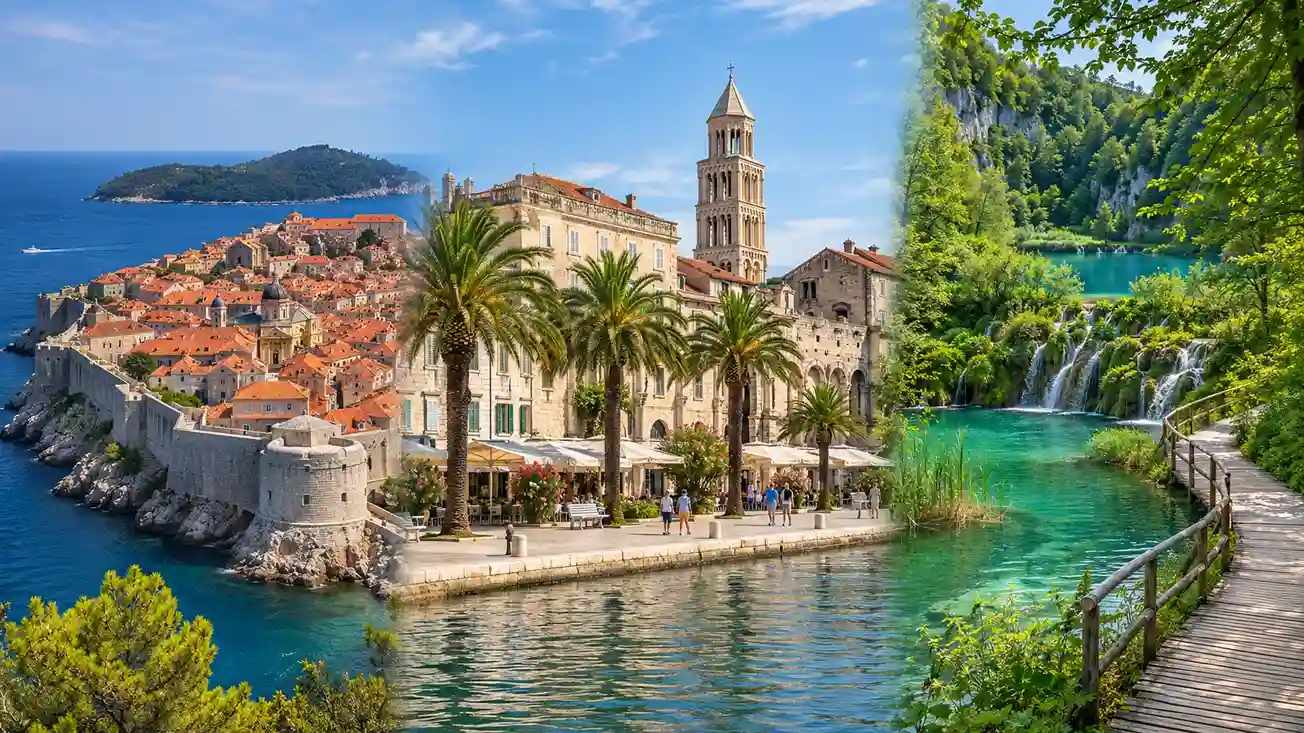
Exploring Croatia Without a Car is entirely realistic if you connect its cities in the right order. Dubrovnik and Split reward travelers who walk, coastal buses link the mainland, and ferries open up nearby islands. Plitvice Lakes is the complicated part: its bus stops, timed admission and onward connections need planning. This seven-day itinerary gives each transfer enough room and finishes in Zagreb, so you can see the Adriatic coast and Croatia’s famous lakes without hiring a vehicle or pretending every day is a full sightseeing day.
Affiliate disclosure: Some booking links may be affiliate links. If you book through them, BalkanTripGuide.com may earn a commission at no additional cost to you.
Quick Answer: Croatia Without a Car
- Possible? Yes. Use intercity buses, walking, airport shuttles and optional ferries.
- Seven days? Enough for Dubrovnik, Split and Plitvice, with a compact schedule.
- Route: Dubrovnik (2 nights) → Split (2 nights) → Plitvice area (1 night) → Zagreb (1 night); depart on Day 7.
- Airports: Arrive at Dubrovnik (DBV) and depart from Zagreb (ZAG), if flights and prices suit.
- Ferries necessary? No. They are optional, and many coastal services are seasonal.
- Plitvice by bus? Yes, but check the exact stop, departure and onward bus before paying for rooms.
- Park overnight? Recommended to protect sightseeing time and reduce luggage stress.
- Budget: Roughly €450–€850 per person for a careful budget trip, excluding flights, subject to season and room-sharing.
- Best period: May–June or September for a practical balance of conditions and crowd levels.
- Book ahead? Yes for timed Plitvice entry, popular intercity buses and high-season accommodation.
- Biggest challenge: Matching the Split–Plitvice and Plitvice–Zagreb buses to your park visit.
Croatia Without a Car: 7-Day Itinerary Overview
This is a seven-day, six-night trip, not seven sightseeing days followed by an unmentioned eighth travel day. It travels north once, avoids returning to the coast after Plitvice, and leaves the final morning for Zagreb Airport. It works best when you can book a suitable morning bus from Split to the Plitvice area on Day 5 and a suitable afternoon bus toward Zagreb on Day 6. Confirm both before finalizing the itinerary.
| Day | Destination | Main activities | Transport | Overnight |
|---|---|---|---|---|
| 1 | Dubrovnik | Arrival and Old Town orientation | Airport shuttle/local bus | Dubrovnik |
| 2 | Dubrovnik | City Walls, harbor, viewpoints | Walk/local bus | Dubrovnik |
| 3 | Dubrovnik → Split | Transfer, Riva, palace exterior | Intercity bus | Split |
| 4 | Split | Historic walk or optional short island visit | Walk/optional ferry | Split |
| 5 | Split → Plitvice | Bus, check-in, easy local afternoon | Intercity bus/prearranged local transfer | Plitvice area |
| 6 | Plitvice → Zagreb | Park circuit, onward journey | Walk/park boat and bus | Zagreb |
| 7 | Zagreb | Optional city stroll, depart | Airport shuttle | — |
Why northbound? Dubrovnik is a logical starting point, Split lies farther up the Dalmatian coast, and Zagreb is a useful departure hub after Plitvice. You can reverse the order if flight times are better, but recheck all bus legs. An open-jaw flight arrangement is efficient geographically, not automatically cheaper.
Can You Travel Around Croatia Without a Car?
Yes. You can reach the cities in this plan using scheduled coaches and explore their old centers on foot. Croatia’s mainland bus network is often more useful to visitors than trying to make the entire journey by rail. Local buses connect residential neighborhoods, airport shuttles simplify arrivals, and passenger ferries provide excursions to islands. For a broader overview of regional transport choices, see our guide to getting around the Balkans by bus, train and car.
The limitations matter. Some islands have fewer departures outside summer, buses can sell out at busy times, and accommodation in rural areas can be several kilometers from the advertised bus stop. A car-free trip suits solo travelers, couples and light packers particularly well. It is less effortless if you need door-to-door access, carry several large suitcases or want to visit numerous inland villages in one day.
Is Seven Days Enough for Dubrovnik, Split and Plitvice?
Seven calendar days are enough for a satisfying first visit, provided you accept that transfers replace some sightseeing. Two nights in Dubrovnik give you one relatively complete day; two in Split give you an arrival evening and one full day; the Plitvice overnight protects the park visit; Zagreb becomes a departure base rather than a major sightseeing stop. You are not also fitting in Zadar, Krka, Korčula and three islands.
For a more relaxed trip, add at least one day in Split and one in Zagreb, or give Plitvice an extra night. With just a week, prioritize the City Walls, Diocletian’s Palace and one carefully chosen lake circuit. Treat island-hopping as an optional trade-off, not a guaranteed extra.
Day 1 – Arrive in Dubrovnik and Explore the Old Town
Fly into Dubrovnik Airport (DBV). The Platanus airport shuttle serves the Ploče side of the Old Town and continues to the main bus station in Gruž; check the current departure arrangement against your arriving flight. Taxi or prebooked transfer can be more convenient for several travelers with heavy luggage, especially late at night. The Old Town itself has steps and restricted vehicle access, so confirm where your accommodation expects you to arrive.
After checking in, start with Stradun, Dubrovnik’s main stone-paved street. Wander the side lanes, find the Old Harbor, and pause at a square or waterfront viewpoint. Keep the first afternoon flexible: flights, baggage collection and airport transfers rarely follow a perfectly neat timetable. If you land late, make dinner and an evening walk your only commitments.
Old Town rooms are atmospheric but may involve stairs and higher rates. Pile or Ploče can shorten sightseeing walks; Gruž is practical for the Day 3 bus; Lapad is often a more residential alternative with local-bus connections. Compare the locations of accommodation in Dubrovnik against the specific bus stop and walking route, not just a map distance.
Day 1 tip: Save your hotel’s directions offline and ask whether the entrance is accessible with a wheeled suitcase. A 400-meter walk can still mean many stone steps.
Day 2 – Dubrovnik City Walls, Historic Sights and Adriatic Views
Use the morning for Dubrovnik’s City Walls if they fit your budget and mobility. The circuit is exposed to sun and involves stairs, so carry water and allow roughly two hours at a comfortable pace, plus extra time for photography. Check the official ticket seller and the attraction’s seasonal opening times before visiting; do not assume a city pass is automatically worthwhile without comparing what you will actually use.
Then explore around the Rector’s Palace, cathedral and nearby churches from the outside before deciding whether to pay for a museum. The historic streets, harbor and many viewpoints provide a strong low-cost day. A cable car viewpoint can be appealing in clear weather if the service is operating, but it is optional rather than essential. Likewise, a guided walking tour may add context, but you can enjoy the Old Town independently.
Break for lunch away from the most prominent waterfront tables if you want more control over spending. Reserve a quiet afternoon for lanes you missed, the harbor, or a short local-bus trip to a coastal viewpoint. Check the forecast before committing to wall tickets or an exposed viewpoint. Tomorrow’s travel day is easier if you pack, confirm the bus departure platform and locate Gruž station tonight.
Day 3 – Travel from Dubrovnik to Split
Take an intercity bus from Dubrovnik’s main station in Gruž to Split. A practical planning allowance is about four to five hours on the road, sometimes longer with summer traffic, intermediate stops or disruptions. Buy for your actual date and check both station addresses on the ticket. Split’s main bus station is beside the ferry port and within walking distance of the central waterfront, which is useful if your accommodation is nearby.
A passenger catamaran can make the coast itself part of the experience, but direct Dubrovnik–Split services vary with season, operator and weather. Consult the Krilo sailing calendar for your exact day; a route shown on a map is not proof that it operates in winter. Some vessels are passenger-only and set their own baggage terms. Bus services are the more reliable default for a seven-day itinerary.
Dubrovnik to Split Transport Tip: Prioritize a direct daytime bus that arrives before dinner. Check the operator’s route and baggage allowance. Do not buy a nonrefundable ferry ticket until its operating date and weather policy are clear.
After arrival, drop your bags and walk along the Riva Promenade, then into the passages of Diocletian’s Palace. You can see much of the Roman-era complex without booking an attraction. Have dinner nearby and leave museum visits for tomorrow. Do not schedule a distant beach, island crossing or tightly timed tour after a four-hour-plus transfer.
Day 4 – Explore Split on Foot, with an Optional Island Alternative
Start in the Peristyle, the historic center of Diocletian’s Palace, then follow the narrow lanes toward the Cathedral of Saint Domnius, People’s Square and the waterfront. The streets and squares are free to explore; certain towers, museums and interiors charge admission. Allow two to three hours for an unhurried core walk, more if you enter several sites. Stop for coffee or lunch around the center rather than trying to complete the entire circuit without a break.
In the afternoon, follow the edge of the Riva and walk toward Marjan’s lower paths or a manageable viewpoint, adjusting for heat and mobility. A traditional Dalmatian lunch might include seafood, grilled vegetables or a simple local pasta. Split is a living city, so leaving time to browse markets and neighborhoods adds more value than racing between paid attractions.
Option A – Stay in Split
This is the recommended choice for a first visit. Spend the afternoon near the waterfront, visit a museum if weather turns bad, or relax at a reachable beach when conditions suit. You already have a long inland transfer tomorrow, so a light day is sensible.
Option B – Take a Ferry to Brač
If the forecast and return departures align, replace much of the Split sightseeing with a simple trip to Supetar on Brač. Jadrolinija’s Split–Supetar ferry operates across the year under seasonal timetables and the crossing is approximately 50 minutes each way. Choose a return with generous margin and concentrate on Supetar rather than assuming you can also visit distant island beaches. Hvar is another popular excursion, but convenient direct catamarans and return times are more seasonal; confirm them before choosing Hvar over Brač.
If islands are your main reason to visit Croatia, the more enjoyable solution is to extend the trip. This seven-day version does not hide a separate Day 5 island outing between two major bus journeys.
Day 5 – Travel from Split to Plitvice Lakes
Today replaces the extra Split leisure day that appears in more optimistic one-week itineraries. Take a suitable bus from Split toward Plitvička Jezera. Published operator route pages show the connection exists, with faster journeys around three and a half hours, but some departures can take considerably longer. Availability and stop patterns differ by date. Verify an actual departure in the morning or early afternoon, then build the day around its arrival rather than a theoretical best-case travel time.
There is no railway station at the park entrances. Bus services stop along the road near Entrance 1, Entrance 2 or another signed Plitvice-area stop according to the service. The label “Plitvice Lakes” alone is not a precise hotel location. Compare the stop shown in your booking with the park’s official arrival guidance, then ask your accommodation whether you can walk safely with luggage or arrange a pickup. Do not rely on finding an on-demand taxi in a rural area.
Check in, buy supplies, have an early dinner and rest. A brief viewpoint walk may be possible if you arrive early, but save your main park ticket for tomorrow unless you have deliberately booked a separate valid entry slot. A “near Plitvice” guesthouse could still be kilometers away, beyond easy walking distance on roads without continuous sidewalks.
Plitvice Transportation Warning: Book the onward Plitvice-to-Zagreb bus and verify its exact boarding stop before paying for nonrefundable accommodation or a park time slot. An overnight near the lakes helps, but it does not guarantee a convenient departure the following afternoon.
Plitvice planning tip: Choose a room near your intended entrance or with a confirmed transfer arrangement. Do not use distance to the national-park boundary as a measure of access to the walking trails.
Day 6 – Explore Plitvice Lakes and Continue to Zagreb
Begin at the entrance named on your ticket. Plitvice uses date-, entrance- and time-specific admission, and the park encourages advance online purchases. Check its official ticket and seasonal price information, then select a route that finishes comfortably before the bus you have already reserved. The 2026 published adult daytime admission spans €10 in winter, €23 in spring and October, and €40 for the main June–September daytime period, with some lower-priced late entry periods. Prices for your future dates may differ, and a late discounted slot is unsuitable for a full lake visit.
The park’s official Program C from Entrance 1 takes approximately four to five hours and covers about eight kilometers when its full route is open. Program H from Entrance 2 takes approximately four to six hours. Both mix walking with park transportation, subject to seasonal and weather restrictions. A shorter lower-lakes circuit is safer when daylight or the onward bus is tight. Do not attempt a six-to-eight-hour walking circuit and expect to catch an early-afternoon coach.
Electric boats and panoramic vehicles are included in admission for applicable routes, but routes and availability can change with weather and season. The Upper Lakes commonly close in winter, while the Lower Lakes may remain visitable. Follow the day’s official information; boardwalks can be wet or slippery, swimming is prohibited, and some paths are unsuitable for visitors who need step-free access.
The park states that luggage storage is available free of charge in designated areas at Entrance 1, Entrance 2 and the Flora auxiliary entrance. Confirm the facility and collection arrangements on your day, and collect your bag with enough time to reach the correct bus stop. The park’s visitor guidance also confirms that buses stop near both principal entrances. However, one company’s ticket may refer to a different nearby boarding point, so compare it with the actual stop before you start hiking.
Travel onward to Zagreb in the afternoon or early evening. Allow roughly two to three hours for the road journey, depending on the chosen service and traffic. The final destination is usually Zagreb’s main bus station, not Zagreb Airport. Collect your luggage, reach your hotel and enjoy a modest dinner rather than scheduling additional distant sightseeing. This night in Zagreb is what makes a Day 7 flight realistic.
Critical check: If your travel date has no usable afternoon departure after a proper park visit, do not force the Day 6 connection. Either move the park visit to Day 5 after an unusually early verified bus, shorten sightseeing, arrange a suitable private transfer, or add a night and fly on Day 8. The seven-day plan is a model contingent on the actual services you book, not a promise of a connection on every date.
Day 7 – Depart from Zagreb
Today is deliberately a departure day. For a late flight, you may have time for coffee and a short walk around central Zagreb or Ban Jelačić Square. For an early flight, travel straight from the hotel to the airport. Zagreb Airport’s official transport page confirms a Pleso Prijevoz shuttle connection with Zagreb Central Bus Station; check its current timetable and allow the airline’s recommended check-in time plus a traffic buffer.
If an open-jaw ticket into Dubrovnik and out of Zagreb is expensive, compare the total costs of reversing the trip or adding one more night elsewhere. Do not compare airfares alone: extra buses, hotels and time spent backtracking count too. If you want a genuine Zagreb sightseeing day, add Day 8 instead of presenting departure morning as a full day in the city.
Dubrovnik to Split Without a Car: Bus or Ferry?
The Dubrovnik-to-Split leg is relatively straightforward by bus. The ferry can be memorable, but is more sensitive to operating season and weather. These are planning ranges, not quotes for a chosen date; fares can change substantially with demand and departure.
| Transport | Approximate time | Budget allowance | Advantages | Limitations |
|---|---|---|---|---|
| Intercity bus | 4–5+ hours | €15–€40 | Practical, multiple operators | Traffic, possible hold-luggage conditions |
| Passenger ferry | Often 4–6 hours, route-dependent | €40–€70+ | Coastal and island scenery | Seasonal service, weather, luggage restrictions |
| Private transfer | About 3–4+ hours by road | Several hundred euros per vehicle possible | Door-to-door convenience | Usually expensive for one or two travelers |
You can compare bookable Dubrovnik–Split buses on Omio, then check the named operating company, arrival station and baggage rules. Some road services use the Pelješac Bridge to remain within Croatia; others may follow different routes. Never assume a Bosnia and Herzegovina border crossing or no crossing without checking the service, particularly if your visa or passport situation makes that distinction important.
How to Reach Plitvice Lakes Without a Car
The two bus legs around Plitvice are this itinerary’s weakest links. Operators advertise Split–Plitvička Jezera and Plitvička Jezera–Zagreb services, but route pages are not guarantees of a workable connection on the exact weekday you need. Check the dated timetables independently and book the onward journey before deciding whether Entrance 1 or Entrance 2 makes more sense for your accommodation and visit.
Option A – Overnight near the park, then Zagreb
This is the recommended version. Travel from Split on Day 5, sleep near an accessible entrance, visit Plitvice on Day 6, then take a preselected coach to Zagreb. It gives the park your freshest hours and avoids rushing from Split after a long morning transfer. The cost is one rural accommodation night and, possibly, a local pickup.
Option B – Split to Plitvice to Zagreb in one day
Possible only on dates when an early arrival, a valid entry slot, an appropriately short park circuit, luggage collection and a later Zagreb bus line up. This is considerably more fragile and can become unpleasant in heavy summer crowds or poor weather. Do not reserve it from a generic journey-time estimate. A tour that returns to Split also does not solve your onward journey to Zagreb.
Option C – Organized return excursion from Split
A guided day trip may work for visitors who are returning to Split and want someone else to handle transfers. It typically consumes most of the day and takes you back toward the coast, so it is inefficient for the northbound route. Check whether admission is included, whether pickup and drop-off are at your address, and whether the walking portion suits your group.
A practical sequence is to choose the bus departure, identify its precise Plitvice stop, locate a reachable room, select the entrance, then reserve the park slot and onward Zagreb service. If you cannot secure safe access between your stop and accommodation, contact the property before booking. A rural transfer can erase the savings of a cheaper distant room.
Croatia Transportation Comparison
| Method | Best use | Advantage | Disadvantage | Booking advice |
|---|---|---|---|---|
| Intercity coach | Mainland cities and Plitvice | Wide route coverage | Traffic, limited rural frequencies | Confirm date, operator, stop and bags |
| Ferry/catamaran | Island visits and some coast legs | Scenery | Weather and season | Read sailing calendar and return trip |
| City bus | Urban neighborhoods | Budget access | May require a walk | Check route number and stop |
| Airport shuttle | Arrival/departure | Direct station connection | Fixed stop and timetable | Check first/last run |
| Guided day trip | Simple return excursions | Organized logistics | Less freedom, return to start | Confirm inclusions |
| Private transfer | Awkward luggage/late arrivals | Door-to-door | Higher cost | Agree full fare and pickup point |
Where to Stay During This 7-Day Croatia Itinerary
Dubrovnik: two nights
Old Town is best for atmosphere but often requires carrying bags over steps. Pile and Ploče balance historic access with road connections, while Gruž suits the main bus station and port. Lapad can offer more space and beach access but takes a local bus ride to the walled center. For two short nights, pay attention to check-in arrangements and whether a bus stop is reachable with luggage.
Split: two nights
A central room near the Riva, railway station, ferry port or main bus terminal works well for a no-car visit. The historic center is atmospheric, yet some pedestrian-only lanes and upstairs rooms are awkward with heavy suitcases. Staying a little outside the palace may mean easier vehicle access and a calmer night. Compare accommodation in Split using walking directions to Obala kneza Domagoja rather than assuming every “central” address is equally useful.
Plitvice Lakes: one night
Proximity here is a practical transport issue, not merely a comfort choice. Hotel Jezero is beside Entrance 2, while properties in Mukinje, Rastovača, Jezerce and nearby villages differ considerably in walking time and access. Some are suitable with a prearranged pickup; others are inconvenient for people without vehicles. Check accommodation around Plitvička Jezera, then confirm the actual entrance, bus stop, walking path and transfer arrangement directly with the property.
Zagreb: one night
Near the central bus station is convenient after arriving from Plitvice and before taking the airport shuttle. The Lower Town offers a broader restaurant and city-center experience but may involve an extra tram or taxi journey. For an early morning departure, simplicity wins: check the airport transfer route before choosing the room.
Accommodation Planning Tip: Book the hardest night first: Plitvice. Confirm the Split arrival bus, the exact park-area drop-off, the hotel pickup and the Zagreb departure before locking in the remaining rooms.
How Much Does Croatia Without a Car Cost for 7 Days?
Croatia uses the euro (€). The table is an illustrative per-person, six-night planning budget for this precise route, not a live package price. It assumes a hostel or basic room for the budget traveler, a shared double room for mid-range, and a shared higher-comfort room for the last column. Solo private-room travelers should allow more. International flights and travel insurance are excluded.
| Expense per person | Budget | Mid-range | Higher comfort |
|---|---|---|---|
| Six nights’ accommodation | €180–€300 | €330–€600 | €720–€1,260 |
| Three mainland intercity bus legs | €65–€110 | €65–€120 | €65–€140 |
| Optional island ferry | €0–€20 | €0–€35 | €0–€60 |
| Airport shuttles and local transport | €20–€45 | €30–€80 | €70–€180 |
| Meals, drinks and snacks | €140–€210 | €210–€350 | €350–€560 |
| Dubrovnik and Split attractions | €0–€50 | €45–€95 | €90–€160 |
| Plitvice entrance | €10–€40 | €10–€40 | €10–€40 |
| Optional activities or transfers | €0–€50 | €0–€80 | €0–€160 |
| Approximate total | €415–€825 | €690–€1,400 | €1,305–€2,560 |
For a simple headline estimate, allow about €450–€850 budget, €700–€1,400 mid-range, or €1,300–€2,600 higher comfort per person, with a margin for summer demand, unexpected transfers and personal spending. The summer coast, especially Dubrovnik, can push accommodation beyond these figures. A private hotel room quoted per night is a room price; divide by two only if two travelers actually share it.
Budget Tip: To reduce costs without compromising the route, choose central but simple lodging, eat a few picnic lunches, use the intercity bus, and select free Split and Dubrovnik walks. Never save €15 on a remote Plitvice room if it creates an expensive private transfer.
Cards are widely usable in cities and at major booking sites, but keep a modest amount of euro cash for small purchases or unexpected transport issues. Check card fees and payment terms rather than relying on an outdated kuna conversion.
Croatia Without a Car for Different Travelers
Solo travelers
Hostels and scheduled buses can keep costs predictable. Choose places within practical walking distance of transport, especially after dark; tell your Plitvice host when you expect to arrive.
Couples
A shared room often improves value. Compare a central room with a cheaper outer-neighborhood stay plus daily bus tickets. Divide any private transfer fare between you before deciding it is unaffordable.
Families
Select shorter park routes and keep snacks and rain layers accessible. Check family or child ticket categories and the suitability of boardwalks for younger children; do not assume pushchairs can complete every route.
Budget travelers
Buses, self-guided walks and inexpensive meals are the biggest levers. Use a realistic allowance for Plitvice admission, and compare full fares with baggage charges before buying.
Older travelers and limited mobility
Prioritize accommodation without stairs, accessible transport stops and a shorter Plitvice route. The national park specifically warns that its regular routes do not provide wheelchair access throughout; ask staff about the most suitable available itinerary.
Best Time of Year for a Car-Free Croatia Trip
Spring: April–June
May and June generally balance walking weather with increasing coastal services. Spring rain is possible and some Plitvice sections can remain affected by conditions. Verify the precise ferry timetable rather than assuming summer sailings have started.
Summer: July–August
The widest choice of tourism services comes with hot Old Town walks, crowded buses and more expensive coastal rooms. Reserve the Plitvice time slot and long-distance transport early, and explore Dubrovnik’s exposed walls near the beginning of the day.
Autumn: September–October
September can be excellent for this route, but some passenger ferries reduce service as the season winds down. October gives shorter days and more variable park access. If the island excursion matters, check its final operating date first.
Winter: November–March
Dubrovnik and Split still make pleasant city breaks in good weather, but daylight is short, ferries may not match a summer itinerary, and the Upper Lakes often close. A flexible city-led route may be better than committing to the exact seven-day plan. For broader regional context, compare our Balkans season-by-season guide.
What to Pack for 7 Days in Croatia Without a Car
- Comfortable shoes: Stone streets and Plitvice boardwalks call for good grip.
- Manageable luggage: A modest suitcase or backpack is easier on steps, buses and ferries.
- Small daypack: Keep water, snacks, valuables and a layer separate from stored luggage.
- Rain jacket and light layers: Weather differs between the coast and inland lakes.
- Sun protection: Hat, sunscreen and sunglasses for exposed coastal walks.
- Reusable bottle and swimwear: Useful for summer, though swimming in Plitvice’s lakes is forbidden.
- Phone power bank and offline maps: Save route stops, hotel directions and tickets before rural journeys.
- Passport/ID, payment card and some euros: Keep essential documents accessible, not in the coach hold.
Common Mistakes When Traveling Croatia Without a Car
| Mistake | Why it causes problems | Better approach |
|---|---|---|
| Assuming year-round ferries | Routes and return sailings change | Check the operator calendar and backup bus |
| Booking far from transport | Taxi costs and difficult walks | Verify door-to-stop access before paying |
| Underestimating Dubrovnik–Split | Arrival becomes rushed | Keep the arrival evening light |
| Booking Plitvice late | Timed entry or onward buses may not align | Pair both bus legs with the entry slot |
| Same-day park and early flight | Little buffer for delays | Sleep in Zagreb the night before |
| Ignoring luggage rules | Extra fees or difficult transfers | Check hold luggage, storage and collection |
| Nonrefundable rooms first | Travel options may not fit | Confirm transport before finalizing rooms |
| Too many island visits | Return ferries and traffic eat the day | Choose one optional excursion or add days |
| Ignoring seasonal closures | Some park routes cannot be used | Check live park conditions |
| Backtracking to an airport | Costs time and extra fares | Compare open-jaw flights against total costs |
Practical Tips for Traveling Croatia by Bus and Ferry
- Check the actual travel date on the operator’s timetable, not a generic route page.
- Book popular intercity departures and Plitvice admission in advance when demand is high.
- Confirm each departure and arrival stop: a city may have several stops or terminals.
- Allow generous buffers after flights and before any expensive fixed-time activity.
- Read each operator’s baggage allowance, including the conditions for a suitcase in the hold.
- Save tickets, accommodation addresses and offline maps where you can reach them without data service.
- For ferries, check both the outward and return sailing plus possible weather interruptions.
- At Plitvice, match the entry gate, walking program, baggage storage and onward bus stop.
- Carry a working bank card and some cash, and keep a power bank close at hand.
- Leave extra airport time, especially when changing between intercity and shuttle buses.
Booking Tip: The most important order is bus times → Plitvice entrance and accommodation access → timed park ticket → remaining rooms → optional activities. A small saving on the wrong date can create a major rerouting cost.
Is Croatia Worth Visiting Without a Car?
Absolutely, particularly if historic cities, coastal walks and a national-park visit are your priorities. Walking removes the need to find parking in old-town areas, scheduled buses connect the important mainland stops, and ferries can add an island without a rental vehicle. Sharing buses rather than driving a separate car can also reduce road traffic, although the environmental impact depends on the whole trip.
The trade-off is less spontaneity in rural places. Plitvice needs more detailed coordination than Split’s palace streets or Dubrovnik’s harbor. If your dream trip involves remote beaches, several inland villages and last-minute detours, a different, longer itinerary may suit you better. For an independent coast-and-lakes holiday, no car is necessary.
Final Thoughts – Croatia Without a Car
Croatia Without a Car works when the route is simple: arrive in Dubrovnik, travel north to Split, give Plitvice a nearby overnight, and sleep in Zagreb before the flight home. Use buses for the essential mainland journeys, ferries only when they improve your actual plan, and centrally located rooms to minimize luggage transfers. Seven days are enough for a memorable introduction, not every highlight in Croatia.
Compare the dated transport services and accommodation carefully, reserve the correct park entry, and keep Day 7 for departure. If the Plitvice buses do not line up on your dates, adjust a night rather than forcing a risky connection. For travelers considering a longer cross-border variation, our Croatia, Bosnia and Montenegro itinerary explains a different travel rhythm. The best trip is the one whose connections really work.