Kopaonik Ski Trip Guide for Beginners (2026/27)

Kopaonik Ski Trip Guide for Beginners is designed for the part of a ski holiday that is easy to underestimate: choosing the right lift ticket, reserving the right ski lesson, finding a room close enough to the teaching area, and reaching the mountain safely in winter. Kopaonik is Serbia’s largest ski resort, and it has dedicated training terrain where a complete novice can learn before trying a chairlift-served run. But paying for a full mountain pass when you only need a moving carpet—or staying far from the lesson meeting point—can make the first two days needlessly expensive.
For the 2026/27 winter season, newly published Kopaonik pass prices mean you no longer need to rely on last winter’s figures as the only estimate. This guide compares actual ticket options, separates confirmed prices from operator-specific lesson and rental charges, and builds an achievable schedule for three, five, or seven days. It also explains where to stay in Kopaonik Center, Vikend Naselje or Brzeće; how to get here from Belgrade and Niš; and what to check when travelling with children.
Editorial check: 21 October 2026. Lift openings, snow conditions, transport services, ski-school availability and discounts are changeable. Confirm the details for your travel dates with the resort and your chosen supplier before paying for non-refundable services.
Table of Contents
Kopaonik Ski Trip Guide for Beginners: Quick Facts
| First-time question | Practical answer |
|---|---|
| Can I learn from zero? | Yes: dedicated beginner training areas with moving carpets allow supervised first lessons |
| Where is the simplest base? | Kopaonik Center, near your school and rental shop |
| How much is a 2026/27 adult day pass? | The reported standard/mid-season rate is 5,900 RSD; different seasonal bands apply |
| What is a training-area ticket? | A separate ticket for the beginner polygon and moving carpet, reported at 1,200 RSD for adults |
| How much is a six-day adult pass? | 24,900–27,100 RSD, depending on the price band |
| Do I need a lesson? | Strongly recommended, particularly before using regular lifts |
| When is the main ski period? | Usually January and February; December and spring conditions are less predictable |
| Do I need a car at the resort? | Not if staying centrally and spending most days skiing |
| Where should families focus? | Lesson meeting points, instructor availability, childcare logistics and helmet fit—not just room price |
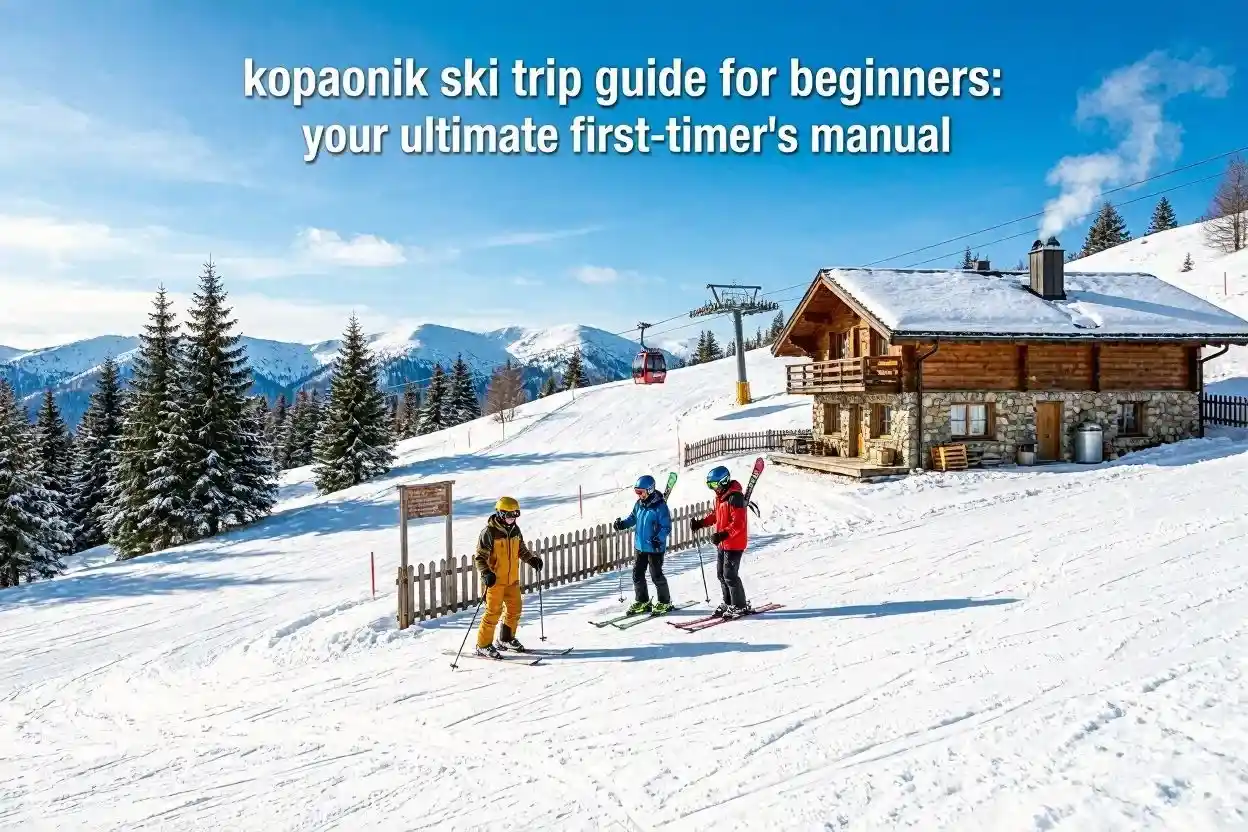
Before booking anything: decide whether your first lesson will use only a beginner polygon or a normal ski lift. That single answer affects your lift-ticket cost, where you should stay and which equipment shop is most convenient.
Is Kopaonik a Good Resort for First-Time Skiers?
Yes, provided you approach the resort in the correct order. The attraction is not that every piste is easy—many are not—but that the mountain combines gentle training grounds, moving carpets, short easier pistes and longer blue routes for later progression. Ski Resorts of Serbia describes more than 64 km of prepared runs and ski roads, with extensive artificial snowmaking. The official resort overview and live lift-and-slope report are the best starting points.
A realistic first-ski progression is simple. On the first morning, learn to stand, glide, stop and turn inside a controlled training area. Once you can control your speed, practise a short easy piste and learn the appropriate lift. Only then consider a longer descent on Karaman Greben or another suitable blue piste. Being able to slide down a hill once is not the same as being able to steer around other people and stop every time.
Why snowmaking helps, but doesn’t guarantee snow
Kopaonik’s reported snowmaking coverage is extensive—roughly 97% of the developed ski area according to resort descriptions. That improves the chances of usable slopes during colder winter spells, but snowmaking requires suitable temperatures and does not cancel storms, wind closures or poor visibility. A sunny resort forecast also does not guarantee that your preferred learner slope will be open.
Check three things separately before booking or setting off each morning: the weather, which beginner lift or polygon is operating, and whether the connecting route from your accommodation is usable. A resort-wide statistic is less useful to a novice than the condition of the first 100 metres they plan to ski.
Where to Ski: Beginner Slopes and the Correct Progression
Do not choose your first run only by looking for a blue line on the trail map. Piste color refers to the route’s general difficulty, while the snow, slope width, crowds and your ability to stop all affect whether it is appropriate for you. The official Kopaonik ski-status listing names each installation and identifies easy, medium and difficult pistes.
| Area or slope | Best stage of learning | Important limitation |
|---|---|---|
| Dolina Sportova / beginner polygons | First session; stopping and turning | Confirm the exact training-ground entrance and ticket required |
| Malo Jezero (piste 2) | Short easy runs after mastering basic control | Lift and night operations are not guaranteed |
| Mašinac (piste 22) | Gentle practice after training | Follow your instructor’s chosen approach and exit |
| Krst (piste 3) | Further easy-run repetition | Do not use the chairlift until comfortable with loading and unloading |
| Karaman Greben (piste 7 and easy variants) | Longer blue-run progression | The six-seat lift and length can overwhelm a first-day novice |
| Pančićev Vrh | Not a universal beginner zone | Several marked variants are medium difficulty; only certain routes are easy |
Stage 1: Training polygons and moving carpets
The moving carpet is a conveyor-belt lift designed to carry learners up short gentle terrain. That allows repeated practice without the challenge of loading a chairlift. You’ll practise the snowplough stop, basic turns and how to recover after a fall. A good lesson also covers looking uphill before starting, giving others space and stopping to the side rather than at a narrow crossing.
Kopaonik has multiple beginner facilities, but do not assume they all serve the same ski schools. The training area used by your instructor may determine the correct nearby equipment rental and whether a polygon-only pass is enough. Ask for the exact name and map location before arrival.
Stage 2: Malo Jezero, Mašinac and Krst
These are names worth recognizing for easier progression around the central ski infrastructure. As confidence grows, an instructor may take you to one of these slopes for short, manageable repetitions. You should be able to stop on command and link turns before trying longer sections. If the snow is hard or queues are crowded, staying in the learning area for another session is sensible.
Lift mechanics vary: a surface tow is not the same as a chairlift, and a mistake when unloading can create hazards for other people. Ask the instructor to teach the lift procedure rather than copying someone nearby. If you are travelling as a family, choose terrain suitable for the least confident person instead of splitting up impulsively.
Stage 3: Karaman Greben
Karaman Greben is a helpful next step because its marked routes are officially classed as easy and it is accessible from the resort’s central zone. But it is still a real mountain descent, not a children’s conveyor belt. Aim to ski it only after your instructor confirms you can link turns, manage changes in gradient and stop reliably.
Some learners reach an easy chairlift slope on Day 2; others need more time. Progress is not a competition. Your goal is repeatable control, not the name of the highest lift you’ve ridden.
Why Pančićev Vrh is not a beginner shortcut
Some Pančićev Vrh variants are marked easy, but multiple other marked runs in the same sector are medium difficulty. A beginner who knows only the lift name can accidentally select the wrong descent. Read the piste number and color at each junction, follow open-route signs and be willing to take another option or return with an instructor.
Kopaonik Ski Pass Prices for Winter 2026/27
Important update: an InfoKOP report updated on 20 October 2026 says Ski Resorts of Serbia has released the 2026/27 tariff and kept most headline ski-pass prices unchanged from 2025/26. The resort operator’s English price-list page was still displaying the 2025/26 PDF at this editorial check. Therefore the table below uses the newly reported 2026/27 pricing, not a falsely labeled official PDF. Cross-check the final tariff and your date-specific price at the operator’s ski-pass page and official webshop before payment. You can also consult InfoKOP’s detailed 2026/27 report.
| Adult lift ticket | Standard/mid-season 2026/27 reported price | What it buys |
|---|---|---|
| Beginner polygon with moving carpet | 1,200 RSD | The specific practice area, not general mountain access |
| Half-day ski pass | 4,200 RSD | Time-limited access according to ticket rules |
| One day | 5,900 RSD | General eligible daytime lifts for that tariff period |
| Three days | 15,700 RSD | Consecutive multiday skiing |
| Five days | 22,700 RSD | Consecutive multiday skiing |
| Six days | 26,200 RSD | Six-day general pass; low/peak bands differ |
| Seven days | 29,000 RSD | Seven-day general pass; low/peak bands differ |
| RFID ski card media | 500 RSD | Card cost; confirm any applicable refund policy |
For planning, the reported adult one-day rate ranges from 5,600 to 6,500 RSD, and the six-day rate from 24,900 to 27,100 RSD, across the seasonal pricing bands. This means the calendar matters: a six-day trip during school holidays can cost more than the same length of visit later in the season. The numbers here are ticket prices, not combined ski-holiday costs.
Beginner training ticket versus a full ski pass
This is the highest-value distinction for a first-timer. The 1,200 RSD adult beginner ticket covers the specified ski-kindergarten polygon and moving carpet. It is not a cheap ticket that unlocks all named beginner runs, Krst, Karaman Greben or the entire lift network. If you spend your first session only inside the polygon, your school may recommend this ticket. The moment lessons use regular lifts, ask which standard pass you need.
A practical question to send your ski school is: “For my very first lesson, are we using only the ski kindergarten, or will I need a full ski pass?” Ask this before purchasing a multi-day product. The ski-school lesson fee, rented equipment and lift access are commonly separate items.
2026/27 advance-purchase discounts
The 20 October announcement reports a 15% webshop presale from 1–15 November 2026. A further 10% period in December was described as likely, with exact dates not yet finalized; a later 5% discount is expected for eligible online purchases. These promotions apply only to qualifying products and dates, and the published discounts do not necessarily cover every ticket type—particularly a one-day pass or the kindergarten entry.
Do not build your budget around an unconfirmed promotion. Check the ticket type, holiday price band, first-valid day, refund rules and pickup instructions in the webshop. On-site ticket booths may not offer the same discount as advance online sales.
The RFID card, child rates and product terms
The reported price for an RFID plastic ticket card is 500 RSD. Do not describe it as universally refundable: confirm the relevant terms for your product. Young children have separate rules, and very young skiers may require a symbolic-price baby ticket for specific installations rather than unrestricted free use. Bring evidence of a child’s age where needed and check the current product definitions.
Also check whether your pass includes night skiing, whether a multiday product must run on consecutive days, and how closures or illness are handled. Never assume passes are transferable between family members. Policies can be stricter than a casual tour-company summary suggests.
How Much Do Ski Lessons Cost at Kopaonik?
Instruction is not an optional luxury for many absolute beginners: it is how you learn safely and avoid making dangerous mistakes. It also makes your skiing progress more efficient than repeating the same uncontrolled descent. The resort lists ski schools, but teaching availability, languages and winter schedules should be confirmed directly with each provider.
One published 2025/26 school price list, from Ski Škola Kopaonik / Ljubinko Raković, gives a concrete indication of costs: a group half-day was quoted at 4,700 RSD for one day and a private lesson for one person at 5,300 RSD per approximately 55-minute lesson. These are one school’s older reference prices, not confirmed resort-wide prices for 2026/27. Request a written quote for your trip dates.
| Lesson choice | Why choose it | Check before paying |
|---|---|---|
| Small-group beginner class | More economical and social | Ability level, group size, teaching language |
| Private first lesson | Individual feedback and less pressure | Price per person or group; lesson duration |
| Family group | Shared scheduling when abilities match | Whether children and adults can actually learn together |
| Multi-day package | Consistent progression and habit-building | Refund/reshuffle rules if weather interrupts |
Nine questions to send your ski school
- Are your instructors approved or contracted to teach at the ski center?
- Can my instructor teach in English or another language I understand?
- Which exact training area will we use?
- How long is one lesson, and how many lessons are included?
- How many students will be in the group, and are all absolute beginners?
- Does the price include the ski pass or kindergarten ticket?
- Are skis, boots, poles and a helmet included?
- What are the age restrictions and supervision rules for children?
- What happens if lifts close, the child becomes tired, or the weather is unsuitable?
Book your first lesson for a time when you will be rested and not rushing from a long airport transfer. If you are anxious or have reduced mobility, explain that when reserving. An instructor can discuss what modifications are possible; there is no universal pace that every learner must follow.
Ski Equipment Rental: What to Get and What to Check
For a first holiday, renting is usually more sensible than buying ski equipment. A standard ski package typically includes skis, boots and poles. A helmet may be extra, and jackets, waterproof trousers and gloves are often not included. Ask what the rental package contains instead of assuming “full equipment” means clothing as well.
The boots matter most. A poor fit can make you miserable even on a beautiful day. Boots should hold the heel securely without intense pressure, numbness or crushed toes. Wear a single appropriate ski sock. If your toes become numb or one area hurts sharply, return for an adjustment. Do not treat significant pain as normal beginner discomfort.
Rental-shop checklist
- Ask whether the skis are set up for an absolute beginner, not merely for your height.
- Have a staff member check boot size, closures and binding settings.
- Reserve a properly fitted helmet, especially for children.
- Confirm pickup time, closing time and whether the kit can be kept overnight.
- Ask whether storage near the slopes is available; carrying skis daily is tiring.
- Photograph or document existing visible equipment damage where relevant.
- Check lost-equipment and accidental-damage terms before signing.
Location is a hidden cost. A rental that saves a few hundred dinars but requires a long uphill walk in boots may be a worse deal than a convenient shop beside your ski school. Match three pins on your map before booking: accommodation, lesson meeting point and rental collection desk.
Where to Stay in Kopaonik: Center, Vikend Naselje or Brzeće?
There is no universally cheapest place once you factor in transport, storage and lost lesson time. For first-time skiers, convenience is an important part of the trip’s value. Choose the location by how you will get to the actual teaching area, not just by the resort name on an accommodation listing.
| Base | Best for | Main drawback |
|---|---|---|
| Kopaonik Center | First-time skiers and families prioritizing simplicity | Accommodation is usually more expensive |
| Vikend Naselje | Groups and apartment travelers who can use a dependable shuttle | Daily transport is an extra logistical step |
| Brzeće | More independent travelers willing to use the gondola | Gondola operation and transfer to the lesson point must align |
Kopaonik Center: the simplest first holiday
Stay close to the central ski infrastructure if your budget allows. You can usually walk to classes, rent equipment nearby and return to your room if the weather deteriorates or a child needs a break. Being near food and shops also makes a ski day with several short sessions much easier.
The trade-off is the nightly price, particularly during New Year, holidays and peak school-break weeks. A room advertised as “central” may still involve stairs or a significant walk in snow. Ask the property for a realistic walking time in winter, not an estimated summer driving distance.
Vikend Naselje: worthwhile only with reliable transport
Vikend Naselje’s apartments may offer kitchens and additional space. This can lower meal costs for families or groups. But before paying, ask for the timetable of any advertised shuttle, whether it stops at the right lift, and whether it returns after late lessons. A private car may solve the distance problem but adds parking and winter-driving issues.
A “free shuttle” that runs too late for ski-school check-in is not a working solution. If the property has no useful shuttle, get a written transport quote rather than assuming taxis will always be cheap and readily available in a snowstorm.
Brzeće: gondola access isn’t identical to direct class access
The Brzeće–Mali Karaman gondola connects the lower settlement with Kopaonik’s mountain system. It offers a useful alternative for some travelers, especially those comfortable managing a daily gondola journey. However, it does not guarantee a direct, simple connection to the central beginner-school meeting point at every time or in every weather condition.
Ask the instructor whether the lesson meeting point is accessible to you without skiing an unsuitable connecting slope. Also confirm whether the gondola is operating on the dates and at the hours you need. One benefit of staying in the center is that it removes those uncertainties from your first days.
Choose accommodation using a four-part calculation
Compare room cost, cost of daily transport, rental equipment storage, and the total time you lose reaching lessons. For a five-night ski break, a slightly higher room rate can be reasonable if it saves two transfers every ski day. Conversely, an apartment farther away can be good value for experienced drivers who have checked parking, snow access and gondola schedules.
How to Get to Kopaonik from Belgrade or Niš
Most international visitors enter Serbia through Belgrade Nikola Tesla Airport, then travel south by road. Niš Constantine the Great Airport is geographically closer to Kopaonik, but fewer direct flight options and less straightforward onward transport can cancel that distance advantage. Compare your entire journey, not the cheapest flight alone.
From Belgrade Airport: private transfer, car or bus
A car or pre-booked transfer from the airport is often the simplest choice, especially with children or heavy winter luggage. Expect a journey of several hours; commonly advertised transfers take around four hours in normal road conditions, but this is not a promise during snowfall, traffic jams or road closures. Give the driver your exact hotel or apartment address, because “Kopaonik” can mean quite different places and road approaches.
Public buses can be considerably cheaper but may require a transfer within Belgrade and a schedule that matches your flight. Some services have limited departures rather than hourly frequency. Confirm the departure bus station, destination stop, baggage policy and final connection to your accommodation. A bus terminating near the resort is not necessarily dropping you at your hotel’s door.
If you arrive in Belgrade late, a night in the capital can be a better choice than attempting an uncertain mountain connection. Our essential Serbia travel tips explain the official airport taxi voucher system, the city’s current public transport and other arrival tasks. For an extra city day, see the three-day Belgrade itinerary.
From Niš Airport: closer does not always mean simpler
Niš has a shorter road journey to the Kopaonik region than Belgrade. It is an attractive option for visitors who can reserve a reliable door-to-door transfer. Without private transport, however, connecting buses and the last section to the mountain may be less convenient. Do not rely on a map distance to predict public-transport journey time.
Ask the supplier which access road will be used in winter, what happens if your aircraft is delayed, and how they communicate a change of pickup location. If travelling with a child, arrange any required child seat in advance. Always consider the journey back to the airport, particularly for a morning flight.
Bus, private transfer or rental car?
| Transport | Best for | Trade-off |
|---|---|---|
| Intercity bus | Budget travelers with flexible arrival times | Limited departures, onward local transport and luggage |
| Private transfer | Families, groups, late flights and ski luggage | Higher price, especially for solo travelers |
| Rental car | Multi-stop Serbian road trips | Winter equipment, parking, snow-driving confidence |
| Flight to Niš + transfer | Travelers with a convenient flight to Niš | Fewer flight choices and specialized onward logistics |
If this is your only destination, you may not need a rental car at all. For a broader Serbia itinerary, the seven-day Serbia road-trip guide helps explain what fits after Kopaonik and what creates excessive driving. For general cross-country bus and rail planning, see how to get around the Balkans.
Winter Driving in Serbia: Safety and Road Equipment
Driving into a ski resort is different from driving between Belgrade and Novi Sad. Roads can be steep, icy or temporarily restricted, while weather at mountain elevation may differ substantially from conditions in the city. A vehicle that handles wet motorway pavement comfortably may be unsuitable without correct tires and other winter equipment.
According to the Automobile and Motorcycle Association of Serbia (AMSS), passenger vehicles need specified winter equipment when roads have snow, ice or black ice during the period 1 November–1 April. The guidance describes winter tires with at least 4 mm of tread when used as winter equipment, alongside rules concerning chains or traction devices. The precise obligation depends on conditions, road type and signs; read the full current guidance rather than treating dates alone as proof a particular vehicle is compliant.
Checklist before collecting a winter rental car
- Confirm winter tires are fitted, not just available for an extra fee.
- Ask which chains or traction devices are supplied and whether you know how to use them.
- Verify your licence and any International Driving Permit requirements with the rental supplier.
- Check the deposit, excess, snow-related insurance exclusions and roadside assistance.
- Ask whether the vehicle may use your planned mountain access route in winter.
- Check the weather and road authority updates before departure and each morning.
- Plan to arrive before darkness when possible, particularly on an unfamiliar mountain road.
Four-wheel drive is not a substitute for appropriate tires or careful driving. If road conditions worry you, take a transfer. It is a reasonable decision even if you are otherwise an experienced driver. A few hundred euros saved on rental arrangements is not a good bargain if it leaves you stranded or driving on unsuitable equipment.
Your First Three Days on Skis: What a Realistic Schedule Looks Like
The point of a beginner plan is to build control while preserving enough energy to enjoy the trip. Beginners often underestimate how tiring ski boots, repeated falls and unfamiliar movements can be. Two well-run hours may be more productive than an entire day spent exhausted on inappropriate terrain.
Day 1: Equipment fitting and a first supervised lesson
Arrive at the rental shop early, leaving time to change boot sizes if necessary. Check where your school meets. In the training polygon, learn stance, stopping and basic turns, plus how to recover safely after a fall. Finish the session when technique begins to deteriorate rather than pushing through fatigue. Keep the afternoon for lunch, a gentle walk and reviewing the next day’s meeting point.
A successful first day means you have learned to stop intentionally. It does not require a chairlift ride, a photograph at a summit or a certain distance of skiing. If your school recommends only the beginner-polygon ticket, do not buy a larger pass just because friends are heading up the mountain.
Day 2: Repeat, refine and introduce an easy piste if ready
Spend the first part of the lesson repeating the same basic movements. Ask for feedback on controlling speed and linking turns. If both you and the instructor are confident, try short lift-served terrain with clear signage and a manageable exit. If not, remain in the training polygon. Progress is individual, and visibility or icy conditions may justify a slower day even after a strong first lesson.
Day 3: Consistency before distance
A third lesson can build confidence with longer linked turns and safe lift routines. Some visitors are ready for an easy Karaman Greben route; others still need short runs. Plan breaks so you can practise with good technique rather than becoming exhausted. End the day with one clear improvement you can explain: smoother stopping, better turns or safer lift use.
Five-Day and Seven-Day Kopaonik Ski Itineraries
A common planning error is counting arrival and departure days as full ski days. Winter road transfers and equipment collection occupy time, so protect at least two proper learning days rather than assuming you can ski immediately after your flight.
Sample five-day introduction
| Day | Main plan | Why it works |
|---|---|---|
| 1 | Travel, check in, locate ski school and rental | No pressure to rush from the airport |
| 2 | Lesson in beginner polygon | Build stopping and turning control |
| 3 | Second lesson; short easy piste if ready | Repeat skills and learn safe lift use |
| 4 | Instructor-guided progression and breaks | Improve consistency without forcing difficult runs |
| 5 | Return gear and depart | Protect the long winter journey |
This is a five-day trip, not five complete days of skiing. If you want five full ski days, add travel nights. Travelers who want to ski both before and after a broader Serbian trip should consider whether keeping the same accommodation and rental kit is practical; multiple check-ins may consume more time than expected.
Sample seven-day week
A full week gives you time to recover from soreness or a weather-disrupted day. Use Day 1 to arrive and collect information, Days 2 and 3 for structured lessons, Day 4 for gentle progression, Day 5 as a lighter day or rest afternoon, Day 6 for a final controlled ski day, and Day 7 for gear return and the airport transfer.
You do not need to buy the most expensive seven-day pass simply because your accommodation reservation is seven nights. Check how many full days of lift access you actually need and whether a rest day changes the value of a consecutive-day ticket. For some beginners, shorter passes plus an additional lesson are more useful than unlimited access to terrain they cannot safely use.
Skiing With Children: Passes, Lessons and Helmets
Kopaonik has dedicated beginner facilities and child-focused instruction options, but family planning requires more than buying smaller skis. Different children’s ages affect pass categories, instructor supervision, lesson length and the correct equipment size. Bring age documentation if a discount or eligibility rule requires it.
The 2026/27 price report describes baby tickets for ages 1–5, with symbolic pricing for selected learner and easy installations, and different pass rates for older children. Such a ticket does not grant unrestricted access to the mountain, nor does it mean a preschool child should ski every listed easy route. Check the ski school’s age minimum and the resort’s current pass terms.
Helmet safety and supervision
Helmets are strongly recommended for all skiers, whatever their age. Kopaonik’s official 2026 safety notice describes helmets as mandatory for children under 12, while another resort webshop safety text uses an under-14 threshold. Because operator pages show different age wording, fit a helmet for every child and confirm the current binding rule directly with the resort; do not rely on an older website summary as a definitive legal interpretation.
Children should never be left unsupervised near operating lifts or at busy piste intersections. Check whether lessons are actually delivered in a protected children’s area, the child-to-instructor ratio, and who handles pickup if a child becomes tired or upset. Families may find two shorter lesson sessions preferable to one long, exhausting day.
If parents have different skiing abilities, do not make the children’s schedule depend on the fastest adult. Arrange a predictable meeting point and backup contact method. A missed mobile message should not be the only way to locate a child at a large mountain resort.
Night Skiing: Should Beginners Try It?
Selected slopes at Kopaonik have night-skiing infrastructure, including Malo Jezero, Karaman Greben and Pančićev Vrh. That does not mean all operate every night, or that a nighttime variant is appropriate for every learner. The official lift-and-slope status separates normal and night installations.
For most absolute beginners, the best first experience is in daylight. Artificial light changes your perception of bumps, shadows and slope texture. The air is colder, your muscles may already be tired, and night operation may require an additional ticket. Treat night skiing as a later option only if your instructor agrees and you have already skied the exact suitable slope confidently in daylight.
If your pass does not explicitly include night access, check the separate charge before entering. Ask about the last lift time and return route; an open café is not proof that lifts are still running.
What to Do at Kopaonik If You Do Not Ski
A mixed group does not need to spend every day separately. The wider resort offers mountain restaurants, cafés, spa facilities, winter walks near developed areas and seasonal attractions such as tubing or the rail bobsleigh. Some scenic chairlift or gondola experiences may be available depending on the day’s operating program and ticket rules.
However, do not assume that a summer adventure-park activity automatically runs in winter, or that a panoramic lift is operating whenever the weather looks clear. Check the operator’s current activity list. For a non-skier, a resort-center hotel with a pleasant lounge, spa or access to restaurants may be worth paying more for than a remote apartment.
If you add extra days to a Serbian trip rather than remaining entirely at Kopaonik, consider a separate trip to western Serbia. The Uvac Canyon guide and our western Serbia nature guide can help with wider trip ideas, but winter access and outdoor routes require their own safety checks. They are not casual half-day side trips from the ski slopes.
Best Time to Ski at Kopaonik
The best month is the one when beginner areas are operating, your budget fits the dates and travel conditions allow a safe arrival. Winter resort operation is weather-dependent, so no specific week guarantees powder snow or a fully open network.
December: exciting start, variable terrain availability
Early December may bring seasonal opening events and promotional ticket offers, but the number of open lifts depends on the weather and snowmaking conditions. It is a reasonable time for travelers who can be flexible. If you are flying specifically to learn to ski and cannot reschedule, verify that the beginner polygon and intended teaching area are open before choosing the cheapest non-refundable deal.
January and February: core winter weeks
These are usually the strongest months for broad winter-sports operation. They are also associated with school holidays, heavier demand for accommodation and ski schools, and higher pass price bands on certain dates. Reserve instructors early and avoid planning every day around the busiest midday beginner area.
March: longer daylight and changing snow texture
March can be an attractive compromise for beginners: longer days and, on some dates, milder temperatures. However, snow may become softer in the afternoon, and operating schedules can narrow. Take your lessons earlier in the day if the afternoon surface becomes more difficult. Be particularly cautious about March itineraries that depend on one low-elevation connection.
April: possible extension, not a promise
In 2026, Kopaonik extended selected ski facilities into April because of specific snowfall and demand. That was a seasonal exception, not a fixed annual closing calendar. Never buy an April ski holiday on the assumption that the same lifts, discounted passes and teaching polygons will be available every year.
Packing List: What Beginners Actually Need
Technical skiing equipment is usually rentable; personal winter clothing generally is not. Pack as if you will spend a few hours standing outdoors in wind and snow, followed by warmer periods indoors. Avoid cotton underlayers because they stay damp when you sweat.
| On the slopes | Away from the slopes |
|---|---|
| Waterproof ski jacket and trousers | Waterproof winter boots with grip |
| Moisture-wicking base layers | Warm casual clothing |
| Warm mid-layer | Spare socks and gloves |
| Ski socks, one pair at a time | Medication and blister care |
| Helmet, goggles, gloves | Phone charger and power bank |
| Neck gaiter, sunscreen, lip balm | Offline hotel and transfer details |
| Water and an approved small backpack | Swimsuit if your accommodation has a spa |
Protect your phone from cold and moisture. Don’t carry unsecured objects that might fall onto the slope. Save your school’s phone number and meeting point offline; connectivity can be unreliable in poor weather or crowded resort conditions.
Safety Rules Every First-Time Skier Should Know
Skiing is a sport with real injury risks even on easy-looking terrain. The operator’s ski-run code of conduct provides the essential behavioral rules: adjust speed to your ability and conditions, avoid endangering others, give way to people below, look uphill before entering and stop only where you are visible.
- Stay in control: if you cannot stop on demand, the slope is too difficult for independent skiing.
- Give way downhill: the person above generally has to choose a safe route around the person below.
- Leave room when overtaking: avoid passing close to a learner who may make sudden turns.
- Do not stop on a blind crest: move to a visible edge when taking a break.
- Follow closures and signage: piste or lift closure signs are safety information, not suggestions.
- Do not ski impaired: alcohol and sedating medicines are incompatible with controlled skiing.
- Know whom to call: ski patrol or the resort emergency contact is more useful than searching the internet after an accident.
A helmet protects against some head injuries but cannot make an unsuitable run safe. Do not ski off-piste as an inexperienced visitor, even if tracks in fresh snow look inviting. Cold temperatures, fatigue and lack of visibility can turn small decisions into serious problems.
Insurance: Confirm That Recreational Skiing Is Actually Covered
Ordinary travel medical insurance is not automatically a ski policy. Before buying, check whether recreational on-piste skiing, lessons, accident care, evacuation or rescue, and rented-equipment loss are included. Some insurers impose altitude, off-piste, helmet, guided-activity or age-related conditions.
Also distinguish medical treatment from trip cancellation or interruption. A policy that covers medical bills may not reimburse an unusable ski pass when several lifts close due to weather. Likewise, your ski-school refund policy and your accommodation cancellation policy are separate contracts. Read each one rather than relying on “winter holiday protection” marketing language.
If travelling with a child or someone with a medical concern, consult the relevant medical professional before booking demanding activities and tell the instructor about limitations that affect safety. A suitable beginner session should be adapted to the actual participant, not to a generic brochure.
Budgeting for a First Kopaonik Ski Trip
A realistic total budget includes six separate areas: accommodation, getting to the resort, ski tickets, lessons, equipment and food. Families may also need childcare or children-specific gear. You can plan the components without inventing a single universal “week in Kopaonik costs €X” number.
| Cost | Budget choice | Convenience choice |
|---|---|---|
| Accommodation | Apartment farther from center with confirmed transfer | Central hotel near lessons |
| Journey | Bus compatible with your flight schedule | Direct airport transfer |
| Ski pass | Polygon ticket first if the school confirms that’s enough | Appropriate multiday access once progressing |
| Lessons | Beginner group | Private first lessons |
| Equipment | Standard beginner rental | Nearby shop with storage and fitting help |
| Meals | Breakfast and some meals in apartment | Restaurants and on-mountain cafés |
Sample pass-only calculation: a six-day adult ticket in the standard/mid-season 2026/27 price band is reported at 26,200 RSD. That does not include ski school, equipment, food, accommodation, transport or the RFID media cost. A two-person party should not multiply that number and call it the complete holiday price.
The lowest hotel price can be misleading if you need a paid transfer every morning. Similarly, a full ski pass can be wasteful if you spend Day 1 entirely in the beginner polygon. Compare total cost and travel time before deciding which option is good value.
Common Kopaonik Ski Trip Mistakes to Avoid
- Buying a full week of lift tickets before asking your instructor whether Day 1 needs only a training-ground ticket.
- Treating the 2025/26 tariff as the latest even after the October 2026 announcement.
- Assuming all the Pančićev Vrh sector is easy or that a recognized lift name guarantees a beginner descent.
- Booking a cheap apartment without checking the actual morning shuttle schedule.
- Underestimating the time needed to fit rental boots before the first lesson.
- Choosing a coach that arrives too late to reach the booked accommodation.
- Driving in winter without the right tires, traction equipment and current road information.
- Assuming a group lesson includes equipment or an all-mountain lift pass.
- Starting night skiing before mastering turns and stops in daylight.
- Planning a skiing morning immediately before a long journey to an international flight.
- Confusing the resort’s children’s pass categories with children’s lesson eligibility.
- Using generic travel insurance without confirming ski coverage.
A strong first trip is deliberately simple: travel safely, arrive with a confirmed lesson plan, practise in a dedicated beginner space, progress at your own pace and make room for rest.
Frequently Asked Questions About Kopaonik for Beginners
Can someone who has never skied learn at Kopaonik?
Yes. There are protected beginner facilities and moving carpets, plus easy runs for later progression. Take professional lessons and choose terrain that you can control rather than trying to catch up with more experienced friends.
Are 2026/27 Kopaonik ski-pass prices available?
A specialist resort report updated on 20 October 2026 says the new 2026/27 tariff was published and headline prices remained unchanged. It lists a 5,900 RSD standard/mid-season adult day pass, a 26,200 RSD standard six-day pass and a 1,200 RSD adult beginner-polygon ticket. Confirm the date-specific tariff through Ski Resorts of Serbia, especially while an older PDF remains on the operator’s English page.
Do I need a full ski pass for my first lesson?
Not necessarily. If your school uses only the kindergarten polygon and moving carpet, a dedicated ticket may be sufficient. If it uses a regular lift, you may need a general ski pass. Ask your instructor before paying.
Is Brzeće suitable for a complete beginner?
It can be, but the gondola and onward journey to the lesson meeting point must work for your group. Kopaonik Center is typically the simplest base for a first-time skier because it removes more of that daily uncertainty.
How many days should I book for a first ski holiday?
A five-day trip can provide three useful ski days when arrival and departure occupy the other two. A seven-day trip offers more flexibility for weather, rest and additional lessons. Match your lift-ticket length to actual skiing days.
Should I choose Belgrade or Niš Airport?
Niš is closer geographically, while Belgrade usually offers more international flight options. The better choice is the one with a workable door-to-door transfer for your dates and an acceptable winter travel buffer.
Can I ski at night at Kopaonik?
Selected illuminated pistes have night operations when the resort publishes them as open. A first-time visitor should master the relevant run in daylight before considering nighttime skiing, and check whether an additional ticket is needed.
Is Kopaonik suitable for a family with young children?
Yes, with the right training area, child-sized gear and age-appropriate instructor. Verify baby-ticket and children’s pass eligibility, age requirements for lessons, and helmet rules rather than assuming one policy covers all ages and all lifts.
Final Verdict: Is Kopaonik Worth It for Your First Ski Holiday?
Yes—if you plan the lessons and logistics rather than buying a package based solely on the number of pistes. Kopaonik has the infrastructure to take a novice from their first controlled slide to easy marked runs over several days. The new 2026/27 pass announcement also makes lift-ticket budgeting more transparent, provided you confirm the final date-specific price with the operator before payment.
For the smoothest trip, book a central base if possible, choose an instructor whose meeting point you can reach easily, rent gear that fits, and check whether your initial lesson requires only the beginner training ticket. If you have a full week, leave room for weather delays and recovery rather than trying to ski every available hour.
Leaving Kopaonik able to stop confidently, link a few turns and enjoy the mountain is a far better result than rushing to the longest run before you are ready. For additional travel around the country, consult our Serbia first-time travel guide and plan the next destination according to transport realities, not a crowded map of sightseeing pins.