Kotor or Budva: Best Areas, Beaches & Where to Stay (2026)

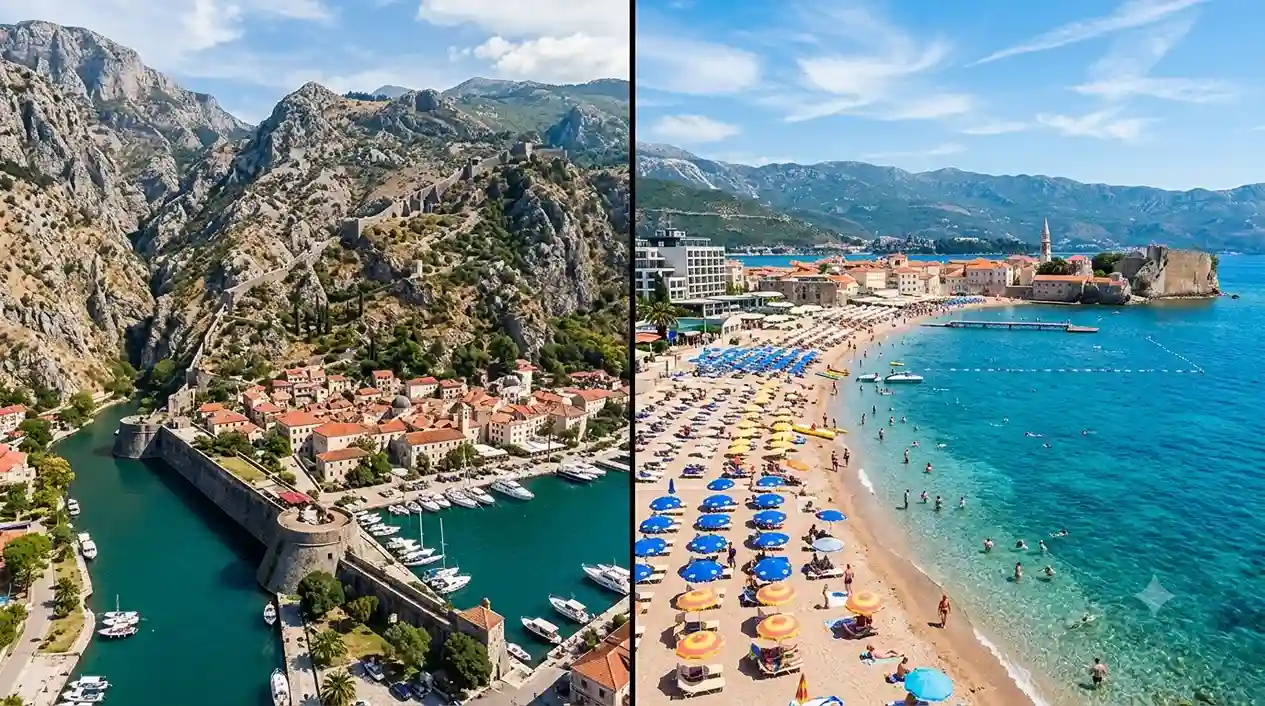
Kotor or Budva? Choose Kotor if your first Montenegro trip revolves around a UNESCO-listed historic town, mountain-framed bay scenery, boat trips and walking. Choose Budva if you want to spend most days swimming at Adriatic beaches, exploring a lively waterfront and enjoying summer nightlife. Both are good places to stay, but the neighborhood—and not simply the town name—will often determine whether the accommodation works for you.
This is a where-to-stay comparison, not another generic list of Montenegro attractions. It explains which neighborhoods are convenient without a car, which apparently inexpensive apartments create transport headaches, how the bus between the two towns works, what changes in July and August, and when splitting your nights is worthwhile. Prices and seasonal services change, so the guide separates verifiable transport examples from accommodation costs that should be checked for your own dates.
Table of Contents
Kotor vs Budva: The Quick Decision
| Your main priority | Better starting point | Important qualification |
|---|---|---|
| Medieval streets and mountain-and-bay views | Kotor | Cruise-ship arrivals can crowd the Old Town at midday. |
| A beach holiday with several swim options | Budva | Beaches vary in access, facilities, crowding and water conditions. |
| Calm accommodation with bay scenery | Dobrota or selected villages around Kotor | Check road access, walking distance and the exact waterfront entry point. |
| Family beach time | Bečići or quieter parts of the Budva Riviera | A beachfront hotel is not necessarily within walking distance of Budva Old Town. |
| Summer nightlife | Central Budva | Check recent noise reviews before booking. |
| Walking-focused cultural weekend | Kotor | The fortress climb is optional and strenuous in heat. |
| Traveling by public bus | Either town | Stay near the actual bus station or practical local-bus stop. |
| Three nights with one hotel | Choose by the main activity | Day-tripping across the coast costs time in peak season. |
| Five to seven nights with varied interests | Split Kotor and Budva | Two bases are worthwhile only if moving hotels suits your schedule. |
A useful rule: Do not book a room for its view until you have checked how you will reach the old town, the beach, the bus station and the airport with your luggage. This matters especially in hillside apartments around both towns.
Where Kotor and Budva Are—and Why the Difference Matters
Kotor sits at the inner end of the Bay of Kotor, backed by steep mountains. The old center belongs to the UNESCO-listed Natural and Culturo-Historical Region of Kotor, recognized for the connection between its architecture, fortified settlements and surrounding landscape. The town’s greatest attraction is the historic setting itself. Even a simple morning walk is a worthwhile part of the trip.
Budva lies on Montenegro’s open Adriatic coast, southeast of Kotor. It has a historic walled Old Town too, but its wider urban area contains beach resorts, a marina, hotels, restaurants and summer entertainment. The Budva Riviera also includes places such as Bečići, Rafailovići and Petrovac. Those are not all within an easy stroll of Budva’s walls, so treating the entire Riviera as one walkable neighborhood causes planning mistakes.
The towns are around 27 km apart by road according to the Kotor–Budva bus route listing. A published coach journey averages about 44 minutes on the timetable, but traffic, the chosen route, stops and boarding times can extend a real journey—sometimes substantially in peak summer. Use the scheduled time as a reference, not a guarantee for an airport transfer.
Kotor’s bay-water swimming spots also differ from Budva’s open-coast beaches. Around the bay, a waterfront may mean stone steps or a bathing platform rather than a broad sand-and-pebble beach. Budva provides easier access to beach days, but that does not make every beach quiet, free of equipment concessions or suitable for small children.
Best Places to Stay in Kotor
For most first-time visitors, the useful Kotor choices are the Old Town, the area around the intercity bus station, the closer parts of Dobrota, and quieter bay settlements such as Muo and Prčanj. Each solves a different problem. Rather than assuming the most photogenic accommodation is the best one, compare the practical return journey from the places you intend to visit.
Kotor Old Town: Maximum Atmosphere, Less Convenience with a Car
Stay inside the fortified Old Town when you want to step directly into its squares, churches and narrow stone lanes. You can explore before the daytime tour groups arrive, return to your room between activities and enjoy the streets in the evening. This makes it an appealing choice for a short first visit, especially if sightseeing and photography outweigh beach days.
There are trade-offs. The lanes are pedestrianized; do not expect to drive to your apartment door. Some historic buildings have stairs, limited luggage access or little sound insulation. Ground-floor rooms can experience restaurant noise, while upper-floor rooms may mean carrying bags up several flights. Ask about air conditioning, late check-in, luggage storage and the route from the nearest vehicle drop-off.
Kotor Old Town also receives cruise passengers. Overnight visitors can often take advantage of quieter mornings, but it would be misleading to promise an empty town every evening or throughout the off-season. For a realistic walking plan, see our one-day Kotor itinerary, which separates the old streets from longer fortress activities.
Who should book here: first-timers staying one to three nights, couples prioritizing historical atmosphere, and car-free visitors comfortable with stairs. Who should think twice: travelers needing private parking beside the room, guaranteed silence or doorstep beach facilities.
Near Kotor Bus Station: Practical for Buses and Short Stays
Kotor’s main intercity bus station sits in the Škaljari area south of the Old Town. Accommodation between the station and the historic center can be a useful compromise for a traveler arriving by bus or continuing toward Budva, Tivat or another destination. A practical walking approach with a suitcase may be worth more than a balcony view.
Compare your exact address with both the bus station and the Sea Gate. Some apartments described as “near Kotor” are up a steep hillside rather than on a comfortable flat route. Check whether a late coach arrival leaves you facing poorly lit steps, a long detour or an additional taxi. Street conditions matter as much as map distance.
Who should book here: solo travelers, short-stay visitors, budget-conscious travelers and anyone with an early onward bus. Trade-off: the location can be less atmospheric than sleeping inside the walls.
Dobrota: Waterfront Calm, with Distances That Vary
Dobrota stretches along the northern edge of inner Kotor Bay. Selected waterfront accommodations offer the bay setting people imagine when they picture Montenegro: mountain reflections, small jetties, promenades and quieter evenings than the busiest streets inside the Old Town.
But Dobrota is not one tiny neighborhood. An apartment at its nearer end can work well for walking into Kotor; one much farther along the coast may need local transport, taxis or a bicycle. A “sea view” can also mean the room is across a traffic-bearing road from the water. Check whether the accommodation has usable public swimming access nearby rather than assuming every stone waterfront is a beach.
Dobrota is especially useful for longer stays and couples who value peaceful mornings. If swimming matters, compare access carefully using our guide to beaches and bathing spots near Kotor, which distinguishes pebble beaches from platforms and remote coves.
Muo and Prčanj: Quiet Bay Bases, Less Walkable Than They Look
Muo, on the opposite side of the inner bay from Kotor’s Old Town, offers attractive views back toward town and its mountain backdrop. Prčanj extends farther along the western shore and can appeal to travelers who prefer a slower, less central stay. Both can provide an alternative to a room inside crowded Kotor.
Their limitation is daily mobility. Waterfront roads may have limited pedestrian space; an address that looks close across the water is not necessarily a short walk. For each booking, calculate the actual road route to Kotor, the nearest shop and restaurant, and the return journey at night. Ask where a taxi can stop and whether there is dedicated parking.
These are good places for travelers with a car, taxi budget, or a deliberate slow-travel plan. They are usually less appropriate when you intend to catch several intercity buses and want to return to your room repeatedly throughout the day.
Kotor Accommodation Comparison
| Area | Main advantage | Biggest caution | Suitable trip style |
|---|---|---|---|
| Inside Old Town | Atmosphere, major sights on foot | Stairs, noise, pedestrian access, parking | Culture-focused short break |
| Near intercity station / Škaljari | Simple arrivals and departures | Check hills and route to the Old Town | Car-free itinerary |
| Nearer Dobrota | Waterfront views and calmer surroundings | Exact distance to Old Town varies | Couples and longer stays |
| Farther Dobrota | Bay scenery and roomier stays | Often more dependent on transport | Relaxed holiday |
| Muo | Views toward Kotor and quieter setting | Road walking and return logistics | Car or planned taxis |
| Prčanj | Village waterfront atmosphere | Farther from Kotor’s daily sightseeing | Slow travel and longer stays |
Best Places to Stay in Budva
Budva requires the same address-level care. The Old Town, Slovenska Beach zone, neighborhoods closer to the bus station, Bečići and Rafailovići suit different visitors. A hotel advertisement may label all of them “Budva,” yet the daily walk to the beach or nightlife can be very different.
Budva Old Town and Its Immediate Surroundings
Budva’s walled Old Town is pleasant for historic streets, cafés and waterfront restaurants. It suits people who want a compact evening area and access to the coast without spending all their time in modern resort blocks. Mogren Beach lies along the coastal walking route from this part of town, though access and beach conditions should still be checked locally.
The downsides resemble Kotor’s but with a stronger summer entertainment element: noise, limited vehicle access, crowded streets and accommodation that can cost more on sought-after dates. Check whether your room faces a music venue or busy lane, and whether the property’s listed parking is truly available to guests.
Who should book here: couples or first-timers who want a historic center plus seaside restaurants. Who should reconsider: light sleepers traveling in July or August who expect a quiet old-town retreat.
Around Slovenska Beach: Convenient for Everyday Summer Needs
The Slovenska Beach area puts visitors close to a long developed stretch of shore, shops, cafés and parts of Budva’s entertainment scene. It can be extremely practical for travelers whose routine is to walk to the water, have lunch nearby and return to their apartment without arranging transport.
Convenience is not the same as peace. The exact property may face a busy road, music venue or promenade. During the busiest weeks, the beach and surrounding services can feel crowded. Check recent guest comments about soundproofing, late-night music, lift availability, parking and whether beach equipment is included or charged separately.
For friends, couples interested in nightlife and travelers who value central facilities, this can be the right area. Families may prefer a quieter address farther from the main entertainment streets.
Around the Bus Station and Central Residential Streets
If you plan to use intercity buses and take local day trips rather than spend every hour on the beach, an address within practical walking distance of Budva’s bus station can reduce costs and stress. Shops and apartment-style stays may offer different price-to-space trade-offs from the old-town or seafront properties.
The catch is that some streets involve hills, large road crossings or longer walks in summer heat. Check the actual walking time to your preferred beach—not merely to “the sea”—and verify the return route after dark. A cheaper apartment becomes expensive when you need taxis both ways each day.
Bečići: Beach-Oriented and Often Easier for Families
Bečići sits east of Budva and has a longer, developed beach with resort accommodation. The national tourism organization includes Bečići among the notable beaches of the Budva Riviera in its official popular-beaches overview.
For families, its advantage is that you can design days around swimming, meals and hotel facilities without constantly traveling to another beach. That said, it is not Budva Old Town. If you want to explore Budva in the evenings, plan the actual walk or local bus ride and check whether the path suits your group. Some hotels are on the coast; other properties are across roads or up slopes.
The choice between Bečići and central Budva is often about quiet versus nightlife, not quality. A seafront property in Bečići can still be busy during peak season, so do not assume all accommodations are silent.
Rafailovići, Kamenovo and Quieter Riviera Options
Rafailovići adjoins the Bečići coastline and offers an alternative beachfront setting with restaurants and accommodation. Kamenovo is another beach to consider farther east. Both can suit travelers who mainly want coastal relaxation and are happy to use a local bus or taxi for trips into central Budva.
Petrovac is a separate coastal town farther along the Riviera and should not be sold as a walkable Budva neighborhood. It can make sense for a dedicated quieter stay, but choosing it changes your transport plan. Similarly, a hotel described as being near Sveti Stefan may provide a wonderful viewpoint without granting public access to the iconic islet itself. Do not confuse the viewpoint, nearby accessible beach sections and restricted island premises.
For specific directions and realistic beach-bus corridors, our Budva beaches without a car guide distinguishes the eastbound Petrovac/Sveti Stefan area from the westbound Jaz/Trsteno route.
Budva Accommodation Comparison
| Area | Main advantage | Biggest caution | Suitable trip style |
|---|---|---|---|
| Old Town / nearby | Historic center, restaurants, coast | Noise and expensive central rooms in peak season | Short stays, couples |
| Slovenska Beach | Walkable beach services and nightlife | Crowding and late-night sound | Summer resort stay |
| Near the main bus station | Easy onward travel and everyday shops | Beach may be farther; check slopes | Budget and car-free travel |
| Bečići | Long beach and hotel facilities | Travel into Budva center takes planning | Families and swim-focused trips |
| Rafailovići | Beachfront restaurants and coastal atmosphere | Not central Budva | Longer beach stays |
| Petrovac | Separate small-town feel | Additional journey from Budva | Deliberate quiet-coast base |
Kotor or Budva for Beaches and Swimming?
Budva is the more straightforward beach-holiday base. Its strength is not merely one beach beside town but access to several distinct stretches of coast. Slovenska is convenient for central stays, Mogren is popular near the Old Town, Jaz is reached on the western side, and Bečići and Kamenovo offer eastern alternatives. The experience changes by beach: some have long service areas, some are smaller and more crowded, and some require separate transport.
Kotor is better described as a bay-and-waterfront destination. You can swim at appropriate marked or public spots around Dobrota and nearby bay villages, but many shores consist of stone, concrete platforms or small pebbly stretches. The landscape makes a swim with mountain views attractive; it does not guarantee a sandy family beach near your hotel. If swimming every day is a deciding factor, ask your accommodation for the nearest legal, practical entry point, whether footwear is helpful, and whether there is shallow water suitable for your group.
Neither town is a guarantee of clean water at every beach on every day. Montenegro’s coastal authority conducts seasonal bathing-water testing; its September 2026 update reported site-specific results and directs visitors to the official bathing-water monitoring map. Check the latest location-specific result and observe local warning flags, rather than treating a whole bay or town as uniformly safe or unsafe. This is especially important after unusual weather or local advisories.
Beach Planning Checklist
- Check whether your hotel has public beach access, a private concession area, or only sea views from a balcony.
- Confirm the walking route: a short straight-line distance may hide a steep road or a major crossing.
- Ask whether sun loungers and umbrellas cost extra and whether there is space for towels in a public section.
- In Budva, identify the specific beach you want before choosing a hotel; the Riviera is not a single beachfront.
- In Kotor, do not treat a boat-tour pier as a safe swimming area unless explicitly designated for bathing.
- Consult the latest bathing-water monitoring results and on-site safety information.
Kotor vs Budva for Nightlife, Couples and Families
Nightlife and Social Atmosphere
Budva is more oriented toward clubs, beach bars and summer evening entertainment, especially around the busier center and waterfront. The atmosphere can be fun for groups and sociable solo travelers, but it is precisely why selecting a room by price alone can be a mistake. For a light sleeper, a quiet-looking listing with no recent reviews about nighttime noise is not enough evidence.
Kotor has bars and restaurants and can be lively, particularly inside the Old Town, but its principal draw is a historic bay setting rather than resort nightlife. Do not overstate the contrast: both towns can be noisy in season; simply choose the quieter street and accommodation based on reviews rather than relying on a town-wide label.
Couples
Kotor often works well for couples interested in boat trips, early old-town strolls and dramatic scenery. A room in Dobrota or Muo may provide a calmer waterfront alternative to staying inside the walls. If the goal is instead to spend the day at a beach and dine beside the open Adriatic, Budva or Bečići may be a more comfortable match.
A romantic room is not automatically a useful room. Verify privacy, balcony exposure, whether the water view faces a main road, room access with luggage and actual public swimming facilities before paying extra for the location.
Families with Children
Budva’s broader beach-resort region, especially Bečići, is frequently more convenient for families seeking easy swimming and hotel facilities. Kotor can be excellent with older children who enjoy old towns, museums and short excursions, but narrow stone streets, hillside steps and a lack of broad beaches may make it less ideal for a week devoted to swimming.
For either town, check cot availability, lifts, shade, beach entry and pedestrian routes. If using a rental car, insist on child restraints appropriate for each child and verify where the accommodation’s parking actually is. Coastal traffic and narrow waterfront roads can make an apparently small distance awkward with a stroller.
Solo Travelers and Budget Travelers
For travelers who enjoy photography, historical exploration and day trips around the bay, Kotor is a natural fit. For solo travelers who expect frequent beach days and late-evening socializing, Budva is useful. Hostel culture and opportunities to meet people exist in both, but the type of accommodation matters more than broad assumptions about the town.
Neither destination has a permanent budget advantage. A remote apartment that saves a few euros per night can erase that saving through transport. Conversely, a modest room near Kotor’s coach station or a central residential street in Budva can make public transport practical and keep incidental costs under control.
Which Town Is Better Without a Car?
Both work without a rental car if you stay close to the attractions you will use. Kotor favors old-town exploring, short bay excursions, local buses to selected villages and organized boat trips. Budva favors centrally located beaches and local services along the Riviera. What does not work well is booking a secluded hillside apartment and assuming buses will reach the door.
There are several different transport systems. Kotor and Budva’s intercity coach stations handle the town-to-town route. Kotor’s local bay buses are separate services with their own roadside stops. Budva’s local coastal-bus routes serve different corridors, so a bus toward Sveti Stefan/Petrovac is not interchangeable with a trip toward Jaz. A sightseeing boat is an activity, not a dependable public ferry linking all settlements.
If you are creating a coastal itinerary without a car, see the fuller Montenegro without a car planning guide. Here the main decision is simpler: sleep where you can reach the bus and your main daily activity on foot without constantly paying for last-mile transfers.
Kotor–Budva Bus: Realistic 2026 Reference
Published Kotor-to-Budva departures cover different operators and run at multiple times during the day. In the bus operator listings reviewed for 2026, some example one-way fares appear in the €4–€6 range, with listed journey times often roughly 30–60 minutes. These figures are examples from published schedules, not a live price or a promise of an available seat for your date. The BusTicket4.me Kotor–Budva route page is a useful starting point for checking your departure.
| Transport detail | What to do before traveling |
|---|---|
| Departure | Check the exact station and operator; do not assume a roadside stop is served. |
| Fare | Look up your date; sample online prices are not a fixed official tariff. |
| Luggage | Ask whether larger bags require an additional payment. |
| Travel time | Build a traffic buffer in summer and before timed activities. |
| Return | Check the last practical departure for your day rather than guessing. |
| Accommodation | Allow a separate walk or taxi from the arrival station to your room. |
A traveler staying in Kotor can visit Budva’s Old Town for a day, and someone based in Budva can visit Kotor’s historic center. However, if your plan involves daily returns to another town for beaches or sightseeing, splitting accommodation is often more efficient than spending the same road journey every day.
Arriving by Air: Tivat, Podgorica and Dubrovnik
The most convenient arrival airport depends on your flight, final accommodation and onward itinerary. Tivat Airport is the obvious airport to investigate for Kotor and parts of the Bay of Kotor; it can also work for Budva. Podgorica Airport provides another arrival option for either town, but you must arrange the onward land transfer. Dubrovnik Airport across the Croatian border may be an option on a broader journey; that adds border-crossing requirements and a buffer for possible delays.
Do not confuse a city bus station with an airport terminal. A ticket to Tivat town, for example, is not necessarily a door-to-door airport transfer. Check the terminal pickup point and luggage policy, particularly with late flights. Taxi and transfer quotes should specify the exact drop-off address, vehicle size, currency, inclusions and whether a border wait is covered where relevant.
If you are planning a complex multi-country route, the Albania and Montenegro itinerary explains how these coastal bases fit into a wider journey without unnecessary backtracking.
Driving and Parking: What Changes When You Have a Car?
With a rental car, the decision becomes less about access to intercity buses and more about parking and the kind of trips you want to make. Kotor is excellent for the bay, but the old center is pedestrianized and parking can be challenging near popular gates. Some properties include a nearby space; others merely suggest a paid public lot. Treat “parking available” as a question to verify, not a guarantee that your room has reserved parking.
Budva gives drivers access to different stretches of the Riviera, but parking by beaches and within the busy center can take time in summer. A room far from the waterfront may be cheaper but require a car for each swim. If most days are local beach days, walking convenience can be worth more than a rental car that stays parked.
Montenegro’s coastal roads include winding sections and busy junctions. If driving during July or August, do not schedule several different seaside towns into a single afternoon. Choose a practical loop and return before fatigue or darkness becomes an issue. For an itinerary in which the car itself adds real value, see our Montenegro road trip over seven days.
Car-rental checks: confirm the permitted driving area, insurance exclusions, deposit, fuel policy, parking at the property and any international border permissions before signing. Do not assume a vehicle permits every mountain track or cross-border trip just because the main coast road is paved.
What Do Kotor and Budva Really Cost in 2026?
Publishing a single average nightly hotel price for each town would be misleading. Prices change with date, property type, cancellation terms, views, festivals, beach proximity and booking lead time. Budgeting works better when you compare the total cost for the same travel dates, not a headline room price.
A sensible comparison uses the same arrival and departure dates, the same number of guests, similar cancellation conditions and comparable room features. Then add everything that changes the real total: parking, local transport, beach equipment, breakfast, baggage, optional boat excursions and any locally collected visitor charge. Ask the accommodation which charges are included in the online total rather than guessing a tax rate.
| Cost item | Kotor: typical decision | Budva: typical decision |
|---|---|---|
| Accommodation | Pay for Old Town atmosphere or move toward a quieter bay address | Pay for beach convenience or move to a residential address |
| Transport | Add taxi/local-bus costs for outer bay villages | Add local-bus/taxi costs for beaches away from the center |
| Swimming | Check if waterfront access is genuinely usable | Check beach concessions, equipment and access |
| Parking | Particularly important for Old Town bookings | Important near seafront and central properties |
| Activities | Budget for sightseeing, fortress climb or bay boats | Budget for beach equipment, coastal activities or nightlife |
| Crowding | Cruise arrivals can affect daytime comfort | High-season beaches and nightlife can affect comfort |
Three Sample Budget Scenarios—Without Inventing Hotel Prices
Solo traveler with no car, three nights: compare a Kotor room near the coach station against a Budva room within an easy walk of the central beaches and intercity station. Count one paid outing and your total taxis. The cheaper headline rate may lose once transfers are included.
Couple with a rental car, five nights: compare a Kotor bay-view apartment with parking against a Budva or Bečići apartment near the beach. If you plan Perast and bay activities, Kotor may limit unnecessary return trips. If swimming dominates the holiday, living close to Budva’s shoreline reduces driving and parking time.
Family spending a week at the beach: compare Bečići and Rafailovići stays with child-friendly facilities, practical shore access and dining within walking distance. Kotor can still be visited for a day if desired. Do not pay for a Kotor Old Town room for an entire week solely because the photographs look romantic when your children expect daily beach time.
Best Time to Stay in Kotor or Budva
May and June
Late spring and early summer are strong months for town walks, coastal scenery and excursions. Kotor offers extensive sightseeing even if the sea is too cool for your preferences. Budva begins to make more sense as swimming weather develops; however, individual beach services and nightlife venues may be seasonal. Check current operating arrangements instead of assuming everything runs like August.
July and August
This is the period when the difference in travel style is most pronounced. Budva is at its most active for beach holidays and nightlife; some areas will be lively late into the night. Kotor’s Old Town can be crowded with tourists and cruise passengers, making an overnight stay valuable for early and late visits. Accommodation and parking should be arranged ahead where possible, and every intercity day trip needs road-traffic time.
September and October
September often gives a useful balance for travelers who want some beach time without peak summer intensity. October is better treated primarily as sightseeing season, with swimming dependent on the weather and personal comfort. Kotor’s cultural setting remains appealing outside summer, while parts of Budva’s seasonal resort scene become quieter. Check tour operators and restaurant opening days before building a detailed off-season plan.
Winter and Early Spring
Kotor has more year-round appeal for visitors primarily interested in heritage, views and photography. Budva still has an Old Town and waterfront, but many people visit it principally for warm-weather activities that are absent or reduced in winter. In either location, rain, shorter daylight and reduced boat activity affect plans. Check heating as well as air conditioning when comparing apartments.
Kotor or Budva for Day Trips?
The base should match the direction of the places you want to visit. From Kotor, Perast and Our Lady of the Rocks are sensible bay-oriented outings, while Tivat is another nearby option. The island church at Our Lady of the Rocks is reached by boat; being able to ride a bus to Perast does not mean the island is accessible on foot. A longer Blue Cave excursion is a booked boat activity and depends on weather and the operator’s route.
From Budva, Bečići and Rafailovići are straightforward beach-oriented choices; farther east, the Sveti Stefan viewpoint and Petrovac make sense for a coastal day. A viewpoint of the Sveti Stefan islet does not confer access to restricted premises. West of Budva, Jaz is another excursion but requires a different transport direction from the eastern Riviera.
It is better to choose two meaningful outings than attempt Perast, Budva beaches, Sveti Stefan, Lovćen and a sunset boat trip in one day. If you base yourself in Kotor, our day trips from Kotor without a car guide gives stop-level transport advice rather than repeating it all here.
| Day-trip objective | Easier base | Main practical issue |
|---|---|---|
| Perast + Our Lady of the Rocks | Kotor | Local stop and separate boat to the islet |
| Inner-bay boat trip or kayak | Kotor | Departure pier, weather and tour details |
| Kotor Old Town and fortress views | Kotor | Hillside climb, heat and ticket conditions |
| Bečići and Rafailovići beach day | Budva | Hotel location and local connection |
| Sveti Stefan viewpoint / Petrovac | Budva | Access restrictions and return service |
| Jaz Beach | Budva | Western route, parking or correct coastal bus |
| Lovćen National Park | Depends on planned transport | Book a tour or driver; do not assume direct public bus to viewpoints |
Should You Split Your Nights Between Kotor and Budva?
With only two or three nights, moving hotels may consume too much time. Choose your main priority, then visit the other town for a day if it fits naturally. A short history-and-bay visit usually works well from Kotor; a summer swimming weekend is often easier from Budva or Bečići.
With four or five nights, splitting is an option rather than a rule. Consider two nights in Kotor and the remaining nights in Budva if you genuinely want separate cultural and beach experiences. Alternatively, stay in one town if you dislike repacking, are traveling with children, or have a rental car and already selected well-connected accommodation.
With six or seven nights, a split can noticeably improve the trip: for example, three nights around Kotor for the Old Town, Perast and the bay, followed by three or four nights near Budva’s beaches. Choose the final base partly by the airport from which you depart. If adding inland Montenegro, reduce the coast days rather than inventing impossible day trips to distant mountains.
Three-Night Plan: Kotor-Led Sightseeing
- Day 1: arrive, check in and explore Kotor Old Town after a comfortable break.
- Day 2: choose one of Perast with Our Lady of the Rocks, a boat excursion, or the fortress and waterfront. Do not force all three if the day is hot or your boat has a fixed departure.
- Day 3: take a day trip to Budva Old Town and one nearby beach if schedules allow, then return to Kotor.
- Departure: reserve enough transfer time for your airport; skip additional attractions on travel day.
This plan is particularly good for people who have never been to Montenegro and want to prioritize distinctive scenery without changing accommodation.
Five-Night Plan: Two Bases Without Rushing
| Day | Stay | Focus |
|---|---|---|
| 1 | Kotor | Arrival, Old Town and relaxed evening |
| 2 | Kotor | Perast or a Bay of Kotor excursion |
| 3 | Budva | Coach or drive to Budva; waterfront and Old Town |
| 4 | Budva | Beach day at Budva, Bečići or Kamenovo |
| 5 | Budva | Choose another Riviera beach or relaxed rest day |
| 6 | — | Airport transfer, with traffic buffer |
The day of transfer should be treated as a partial sightseeing day, particularly if you have luggage and must wait for check-in. Confirm whether your accommodation will store luggage rather than carrying it to a beach.
What to Check Before Booking a Room
A well-located room should make your intended trip easier. Use this checklist in both towns; it is particularly important during the summer when availability gets tighter and photographs can hide logistical drawbacks.
- Exact address and entrance: is the accommodation inside a pedestrianized Old Town, up steps or on a hill?
- Actual walk to your priority: time the route to your chosen beach, attraction or bus station, not just the nearest water.
- Noise: review recent reports of bars, music venues, construction and early deliveries.
- Parking: is there a reserved space, paid public lot, or only an informal suggestion?
- Luggage: are there stairs or a long uphill walk from the taxi drop-off?
- Room conditions: air conditioning for summer, heating for colder months, and clear details of the bathroom and bedding.
- Beach access: public sand/pebble shore, a resort concession, a platform or simply a sea view?
- Fees: check taxes, cancellation, cleaning costs and any payment due directly at the property.
- Transport on departure day: calculate the trip from the accommodation to the correct airport terminal or onward bus.
- Seasonal services: verify restaurants, local buses and activity operators for your travel month.
Accommodation decision in one sentence: For Kotor, choose walkability to the Old Town and bay activities; for Budva, choose walkability to the particular beach and services you actually intend to use.
Frequently Asked Questions
Is Kotor better than Budva for a first Montenegro trip?
Kotor is often a better fit for a culture-and-scenery trip because of its dramatic bay setting and walkable historic center. Budva is usually a better fit for travelers whose main aim is a beach holiday. Neither is universally better; pick the base that matches how you intend to spend most days.
Can I swim in Kotor, or do I need to stay in Budva?
You can swim at appropriate publicly accessible places around the Bay of Kotor, including selected areas near Dobrota and neighboring villages. They are generally different from the longer beach settings along the Budva Riviera. Check the exact access point, local warnings and current bathing-water conditions.
Are Kotor and Budva close enough for a day trip?
Yes. The road is about 27 km, and multiple intercity buses serve the route. Published travel times may be under an hour, but busy coastal traffic can delay trips. Check the specific operator’s timetable and return service rather than assuming every departure runs unchanged year-round.
Is Kotor or Budva better without a car?
Both can work. Choose Kotor when your trip is built around the Old Town, Perast and boat excursions; choose Budva when it is mainly beaches and coastal buses. In either case, accommodation location and last-mile walking conditions determine convenience.
Where should families stay?
If daily swimming, easy meals and resort facilities are your priorities, compare Bečići and nearby parts of the Budva Riviera. Families interested in history and sightseeing can enjoy Kotor too, provided they plan for cobbles, stairs, crowds and limited broad-beach options.
Which town has the better nightlife?
Budva generally provides more nightlife and beach-entertainment choices during the summer season. Kotor is more closely associated with its historic setting and bay atmosphere, although both can be lively and noisy in central streets.
Should I spend every night in Kotor and visit Budva, or split my stay?
For a short two- or three-night trip, using one base is simpler. With five nights or more, dividing time can make sense if you genuinely plan separate bay-sightseeing and beach days. If you are traveling slowly, with children or on a tight transfer schedule, one well-chosen base may still be the better choice.
Final Verdict: Kotor or Budva for Your Montenegro Stay?
Choose Kotor for an Old Town-centered first visit, dramatic bay scenery, cultural walks and Perast or boat excursions. Consider Old Town or the area near the bus station for convenient sightseeing, and Dobrota or another bay village when you prefer waterfront calm and have checked the last-mile transport.
Choose Budva for beaches and summer resort activity. Stay close to the relevant shore if daily swimming is your priority; consider Bečići or Rafailovići for a more beach-oriented alternative to the busiest center. Budva Old Town is an attractive option when you want restaurants and historic streets as well as access to the sea.
For a longer trip, combine the two areas only when the change of base genuinely reduces repeated journeys. The correct choice is not whichever town seems to win the most comparison categories; it is the one that gives you more time doing what you came to Montenegro to do.