Berat or Gjirokaster: Which UNESCO Town to Visit? (2026)

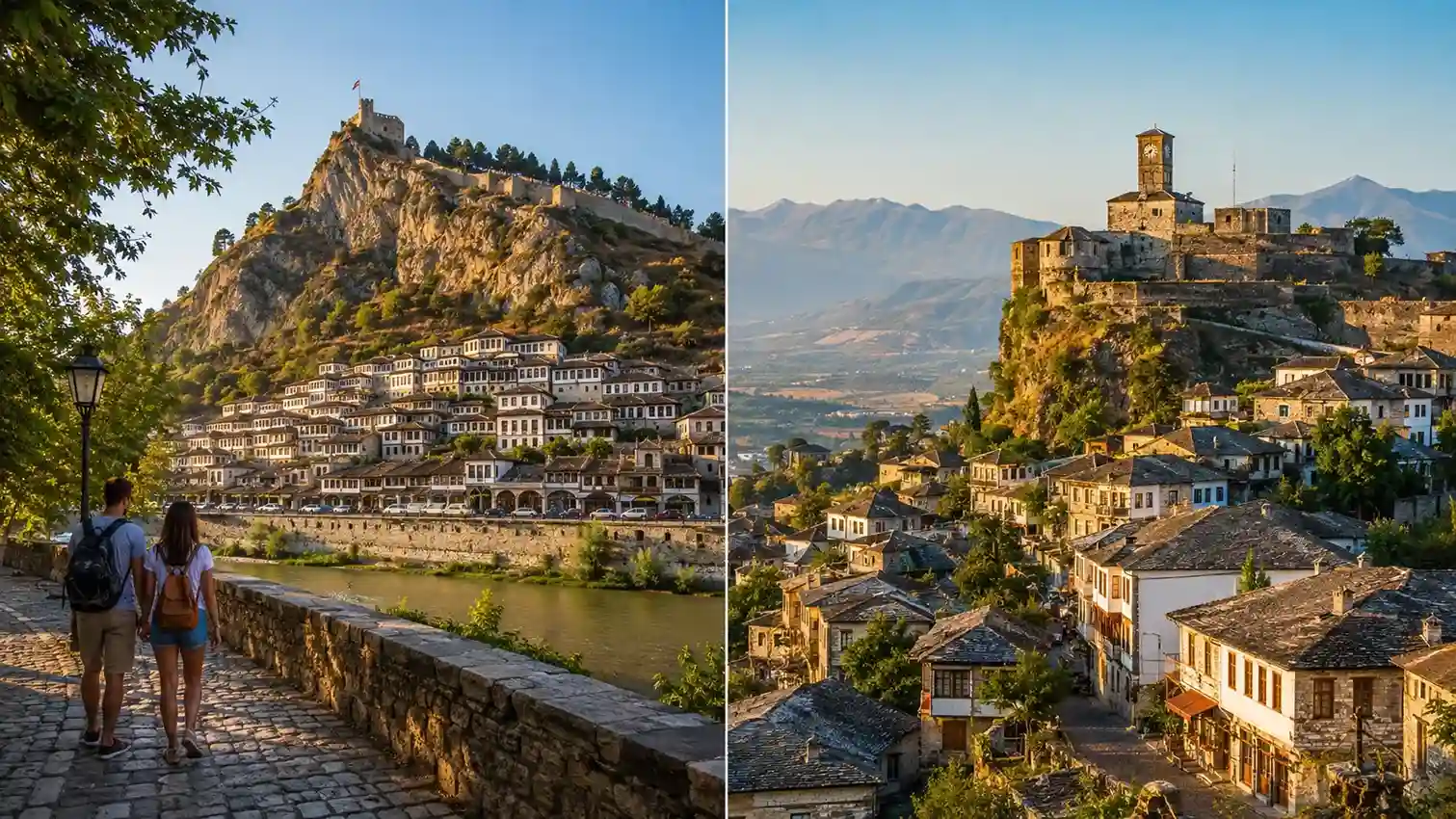
Berat or Gjirokaster is one of the most useful questions to answer before booking a first trip to Albania. These two historic towns share UNESCO recognition and an exceptional collection of Ottoman-era buildings, yet they feel different on the ground. Berat is a riverside town of white houses and inhabited castle walls. Gjirokastër is a steep, stone-built hill town with a formidable fortress and grand tower houses. Neither is automatically the better destination: the best choice depends on where you start, whether you have a car, how comfortable you are with hills, and where you are going next.
For most travelers staying in Tirana with just one spare day, Berat is the more practical choice. If you are traveling toward Sarandë, the Albanian Riviera, or southern Albania, Gjirokastër fits the route more naturally. If you have three or more days available for the southern part of your trip, visiting both makes sense—but only if you plan the bus connection or driving day rather than assuming they are next door.
This 2026 comparison looks beyond Instagram photographs. It compares walkability, castle visits, museum access, transport prices and terminals, family considerations, realistic itineraries, and what to do when you only have a single day. Prices and departures below are dated planning references, not promises that a particular fare or attraction will be available on your travel day.
Table of Contents
Quick Answer: Berat or Gjirokaster?
| Your situation | Better fit | Why |
|---|---|---|
| You are based in Tirana with one free day | Berat | Significantly shorter journey and a practical same-day return |
| Your route continues to Sarandë or the southern coast | Gjirokastër | It sits more naturally on the route through southern Albania |
| You love riverside views and white hillside houses | Berat | Mangalem and Gorica create the signature panorama |
| You love monumental fortresses and historic tower houses | Gjirokastër | Castle, bazaar and preserved stone houses anchor the visit |
| You prefer flatter, accessible sightseeing | Neither is flat | Berat’s riverfront is easier; both castle districts involve serious climbs |
| You are traveling by public transport with an overnight stop | Either, with a plan | Check terminal transfers and exact onward departures |
| You have two nights in central and southern Albania | Visit both | One night in each creates a rewarding cultural route |
| You are traveling with young children or limited stamina | Depends on the route | Choose manageable lower-town walks, taxis uphill and rest breaks |
Simple decision: choose based on geography first. Berat is the easier day trip from Tirana, not necessarily the easier castle walk. Gjirokastër is the natural southern stop, not necessarily a quieter town in every season. Both places have steep cobbled sections, changeable museum schedules and worthwhile reasons to stay the night.
Are Berat and Gjirokaster Two Separate UNESCO Sites?
No. The official UNESCO property is called Historic Centres of Berat and Gjirokastra and is listed as a single World Heritage property. Gjirokastra was inscribed in 2005; the property was extended to include Berat in 2008. This distinction matters because both towns tell related, but not identical, stories about urban life and architectural traditions in the Balkans. See the UNESCO World Heritage listing for the authoritative designation and descriptions.
UNESCO highlights the remarkable survival of vernacular Ottoman-period housing alongside older medieval traditions. Berat’s historical development reflects craft, trade and diverse religious communities; Gjirokastër is associated with its citadel townscape and elaborate houses built by notable families. A visitor does not need to memorize heritage criteria to appreciate those differences: you can see them in the scale of buildings, their construction materials and how each town fits into its landscape.
Neither old town is a static museum. Homes, cafés, businesses and religious buildings are woven into the historic areas. Some streets are residential and some entrances are private. Treat this as a living community: avoid photographing people or private interiors without permission, and take care when navigating steps near homes and monuments.
For cultural context, the Albanian National Tourism Agency’s comparison of traditional houses explains how Gjirokastër’s stone tower houses differ from Berat’s white-fronted houses with balconies and densely arranged windows.
Berat vs Gjirokaster: The Old Town Experience
Berat: Mangalem, Gorica and the River
Berat is defined by the Osum River and the layers of houses above it. Mangalem rises below the castle on one side, while Gorica lies across the river. Connecting them in one walk reveals the arrangement of houses, windows, bridges and hillside lanes that earned Berat the nickname City of a Thousand Windows. The effect is particularly striking when you look back toward Mangalem from the Gorica side.
The lower historic quarters give you a satisfying introduction even without entering a museum. You can walk through sections of Mangalem, cross the Gorica Bridge, pause beside the river, and choose a café with a view. These are the relatively manageable parts of town, although the side streets themselves may still be uneven. The steep ascent to Berat Castle is a separate physical challenge and should not be dismissed as an easy extension of the riverside walk.
Berat suits travelers who enjoy architectural photography, riverside restaurants and a rhythm of short neighborhood walks followed by a larger uphill heritage visit. It is also a convenient first heritage stop on a route south from Tirana. The Albanian tourism guide to Berat describes the preserved neighborhoods of Mangalem, Gorica and the Castle District as parts of the wider historic ensemble.
Gjirokastër: Stone Streets and the Bazaar
Gjirokastër is built onto a hillside above the Drino Valley. Its old bazaar is a hub of converging cobbled lanes, traditional storefronts and restaurants. Above it, the castle occupies a commanding ridge. Instead of Berat’s bands of white houses overlooking a river, you get grey stone roofs, fortified-looking residences and views of mountains and the valley.
The town’s famous tower houses show why the architectural heritage is more than a beautiful façade. Historic homes such as Skënduli House and Zekate House contain spaces shaped by family life, hospitality and social status. Visiting one open house can make the town’s history more tangible than trying to photograph every lane. Check access locally, because private-house visits and guided tours may not follow the same hours as public museums.
Gjirokastër can feel dramatic and enclosed, especially within the narrow cobbled streets; but it is not guaranteed to be empty or peaceful. The bazaar can become busy with tour groups and coach visitors. Quieter moments often come early and late in the day, as in Berat. The official destination overview provides more detail on the castle, bazaar and traditional houses.
Which Old Town Is Easier to Explore?
If you plan to stay around the lower riverfront and historic quarters, Berat offers more scope for relatively gentle walks. The castle is still high above town, so seeing the entire Berat heritage area can be tiring. Gjirokastër’s bazaar, castle and historic houses sit along steep stone streets, which can become slippery in rain.
For visitors with mobility needs, neither town should be described as reliably step-free. Call accommodation ahead to confirm vehicle access, distance from taxi drop-off, stairs inside the property and whether a room can be reached without carrying luggage uphill. If the castle is important and walking uphill is difficult, ask a local licensed taxi for a suitable drop-off point rather than counting on a pedestrian shortcut.
Castles Compared: Living Citadel or Monumental Fortress?
Berat Castle: A Historic Neighborhood Inside the Walls
Berat Castle (Kalaja) is an inhabited hilltop citadel. Behind its walls you will encounter narrow streets, houses, churches and traces of mosques rather than only an open fortress interior. In that sense it feels like another neighborhood of Berat, with the unusual added perspective of looking out over Mangalem, Gorica, the river and surrounding hills.
Allow approximately two to three hours for the wider castle visit if you want to explore lanes, visit a museum and pause at viewpoints. That is a planning allowance, not an official visit duration. If you start on foot from the lower town, add time and energy for a substantial ascent. The stone paving and slopes make grippy footwear worthwhile even on a sunny day.
Inside the castle, the Onufri National Iconographic Museum occupies a former church and presents Albanian religious iconography. The national tourism agency describes its collection of icons and liturgical objects spanning several centuries. For an indoor visit, check the museum’s official calendar; do not assume the entire castle and every church or museum share one opening schedule. The official Berat museums visit page currently publishes 400 ALL as the standard Onufri adult ticket, with its own seasonal opening hours and concessions. Recheck for your date.
Berat Castle wins if your idea of a memorable fortress is a living historic settlement. It is less about a single gigantic exhibition route and more about the combination of inhabited streets, surviving monuments and viewpoints.
Gjirokastër Castle: Bigger Presence, Military History and Valley Views
Gjirokastër Castle dominates the skyline and delivers a different type of experience. It has enormous defensive structures, open areas and sweeping views across the Drino Valley. Its history includes military and later uses, so there are exhibits and stories beyond Ottoman architecture alone. Parts of the castle have contained historical weapons displays and prison-related material; access to individual exhibits may depend on the current museum arrangement.
Allow roughly two hours or more for a thoughtful castle visit and its immediate viewpoints, plus the walk to and from the old bazaar. The castle’s scale makes it attractive to those who enjoy military history and broad panoramas. Check the current admission and gallery access before you travel rather than relying on a blog’s old price or an assumption that every exhibition is included in the entry ticket.
The Albanian tourism agency’s Gjirokastër Castle page is a useful starting point for its history and features. Families should know that historic fortress paths, drops and open edges demand close supervision. The castle is a real monument, not a modern theme-park facility.
Verdict: Which Castle Is Better?
| If you value… | Better match | Reason |
|---|---|---|
| Inhabited lanes and several layers of religious architecture | Berat Castle | A citadel with residences, churches and Onufri Museum |
| A large imposing fortress and military history | Gjirokastër Castle | More dramatic fortress experience and historic exhibits |
| Wide mountain and valley views | Gjirokastër | The Drino Valley setting is especially impressive |
| Looking down over white houses and the Osum River | Berat | Its castle overlooks the town’s best-known panorama |
| The easiest possible climb | Neither | Consider a taxi uphill and check the final walking section |
| A compact museum-oriented visit | Depends | Choose Onufri in Berat or the open exhibits in Gjirokastër |
The best castle for you is the one whose content fits your interests. Calling either an automatic winner conceals what visitors will actually do there.
Museums, Historic Houses and Cultural Depth
What to Prioritize in Berat
Onufri Museum is the standout specialist museum for visitors interested in icon painting, Byzantine and post-Byzantine artistic traditions. It is inside the castle precinct, so plan museum hours before the climb. The official museum system provides admission prices, seasonal schedules and information about its collection.
Berat’s Ethnographic Museum is another important choice when open. Rather than schedule it automatically, check its operating status and ticket information through the same official Berat museums portal. If one museum is closed, you can still enjoy Mangalem, Gorica, the castle district and an unhurried meal; the town does not depend on a single attraction.
Visitors who love religious heritage should give the citadel extra time because its churches and traces of religious architecture reflect Berat’s long history. Not every historic church is open for regular interior visits. Respect the difference between a surviving exterior monument and an accessible museum display.
What to Prioritize in Gjirokastër
The town’s Ethnographic Museum presents domestic architecture, furniture and customary life. The official Albanian tourism site places it in the old quarter, in the house associated with Enver Hoxha’s birthplace. That makes its story different from Gjirokastër Castle’s military and defensive history. See the official Ethnographic Museum overview.
For interiors of wealthy historic households, consider Skënduli House or Zekate House, subject to access on your visit date. The tourism agency describes Zekate House as a notable early-19th-century tower house with decorated reception rooms and carved interiors. It is the sort of place that reveals what makes Gjirokastër architecture distinctive beyond the stone streets.
Do not attempt to cram the castle, two large houses, the ethnographic displays and every street into a rushed afternoon after a long bus journey. Choose one substantial historic interior plus the castle and the bazaar, then add another house if you stay overnight.
History Lovers: Who Wins?
Gjirokastër has an advantage for visitors specifically fascinated by stone tower-house interiors and a large fortress. Berat offers a different depth of experience through religious art, the inhabited citadel and its connected historic neighborhoods. Neither is a substitute for the other, and UNESCO recognizes the combined importance of their traditions.
If you can visit only one museum, think about what you genuinely want to understand. Icons and historic religious painting suggest Berat; household architecture and defensive history suggest Gjirokastër. If indoor access is crucial, verify opening hours first and make your decision accordingly.
Getting to Berat or Gjirokaster from Tirana
This is where the choice often becomes decisive. The towns are not equally convenient from the capital. The following are published online bus listings checked in October 2026, so they are snapshots rather than guaranteed service for any future date.
| Trip from Tirana | Berat | Gjirokastër |
|---|---|---|
| Indicative bus journey | About 2 h 15 min | About 3 h 50 min average |
| Indicative online one-way fare | About €6 | About €13.50 |
| Main intercity departure point | Tirana South and North Terminal | Tirana South and North Terminal |
| Day trip from Tirana | Normally practical with early start | Long and usually not worth a same-day return |
| Overnight strategy | Optional but rewarding | Strongly advisable from Tirana |
| Important extra time | Travel to Tirana terminal and onward from Berat station | Travel to Tirana terminal and onward from Gjirokastër bus drop-off |
For current bus searches, check Gjirafa Travel’s Tirana–Berat listing and its Tirana–Gjirokastër listing. Not every bus or cash fare appears identically across all booking services, so validate the specific departure with the operator or terminal before a tight connection.
Berat by Bus: Remember the Terminal Transfers
A two-hour-and-a-quarter intercity bus does not mean your hotel-to-hotel journey is only two hours and fifteen minutes. Tirana’s regional terminal sits outside the most walkable sightseeing core, and Berat’s intercity bus station is not in the heart of Mangalem. You need to allow time to get to the terminal, board, reach Berat, and take a local bus, taxi or other transfer into the town’s historic area.
This does not undermine Berat as a day trip. It simply means a good day trip has an early departure, an arrival plan and a checked return service. You can avoid the most common mistake—arriving in Berat at lunchtime and expecting to see both castle and museums before rushing for an afternoon return.
Travelers taking a rental car from the airport can consult our Tirana Airport to Berat car-rental tips for additional planning considerations, including pickup timing and whether keeping a car is worthwhile.
Gjirokastër by Bus: Allow Most of a Day to Get There and Visit
Gjirokastër is well connected to Tirana in the sense that scheduled intercity buses exist, but it is a poor spontaneous half-day excursion. A journey averaging close to four hours each way leaves limited sightseeing time after terminal travel and city transfers. If you are based in Tirana, an overnight visit will usually feel far less rushed.
Once you arrive, your accommodation and the old bazaar may lie uphill from the main bus drop-off. Ask the driver where the bus ends, check your hotel’s access instructions and decide whether a short taxi ride is sensible with luggage. Do not plan a steep walk carrying heavy cases simply because two points look close on a flat map.
For a broader first-time Tirana stay before the heritage towns, see our Tirana in 2 Days itinerary, which groups the capital’s sights without forcing cross-city journeys.
Can You Go Directly from Berat to Gjirokastër?
A direct connection may be available, but it should never be assumed to run every hour. Gjirafa Travel’s Berat–Gjirokastër listing, checked in October 2026, displays a 14:00 direct departure, an approximately three-hour journey and a reference ticket price around €12. This is a limited published service, not a promise that it runs unchanged every day or throughout the year.
If you want to travel between both towns without a car, plan the accommodation night and attraction order around the confirmed date-specific departure. If the direct bus is unavailable, investigate another verified connection, a transfer or an extra travel day; do not assume a quick, straightforward same-day alternative through a neighboring city.
Public-transport rule: book accommodation only after you have established how you will arrive and leave. A beautiful heritage guesthouse is less helpful if your onward journey turns out to require an unplanned taxi or an overnight connection.
Cost Comparison: Which Town Is Cheaper in 2026?
It is tempting to pick one town because a hotel or tour looks cheaper on a search result. In practice, transport costs and the number of hotel nights are usually more decisive than small differences between café prices. A traveler visiting Berat from Tirana for the day pays for a shorter round-trip journey. A traveler planning to see the Riviera after Gjirokastër may spend less on detours because the town is already on the route.
The comparison below separates published reference fares from costs that genuinely depend on your chosen room, restaurant or activity. It should not be interpreted as a fixed-price package.
| Expense | Berat | Gjirokastër | Planning takeaway |
|---|---|---|---|
| Bus from Tirana, one way | About €6 online | About €13.50 online | Published sample fares, not guaranteed for your date |
| Key heritage attraction | Onufri Museum: 400 ALL standard ticket published | Castle and house-museum fees vary; verify current tariffs | Check attraction-specific official prices |
| Old Town walking | Free to walk public streets | Free to walk public streets | Some interiors and monuments charge entry |
| Accommodation | Guesthouses to boutique rooms | Guesthouses to boutique rooms | Compare exact dates, breakfast and taxi access |
| Meals and coffee | Wide range of casual choices | Wide range of casual choices | Similar broad price category; menus vary |
| Car costs | Parking and possible taxi to castle | Parking and possible taxi uphill | Do not ignore restricted streets or slopes |
A published ticket reference is more valuable than an invented citywide average. The Onufri Museum’s official visit page, for example, provides the standard adult admission in lek as well as special rates for eligible visitors. The museum may have different seasonal hours, making its schedule at least as important as its ticket price. By contrast, a hotel rate without travel dates does not establish a useful comparison of the towns.
For an affordable visit, base your spending on local meals, a comfortable but not necessarily central room, and only the museums you genuinely want to enter. Both towns reward time in their public streets and viewpoints without requiring a paid activity every hour. Tipping is optional, not a mandatory percentage to add to every bill.
Where Are the Best-Value Guesthouses?
In Berat, search around the accessible parts of Mangalem, Gorica and the lower center. A room above a steep staircase may look attractive in photographs, but think about the climb after dinner and carrying luggage. A quieter room in Gorica can still be close to the old bridge and main views.
In Gjirokastër, proximity to the Old Bazaar is valuable if you want to explore in the evening without arranging multiple taxis. However, a property described as “five minutes from the bazaar” could involve a strenuous hill. Ask about the actual access route, parking, pickup and the number of stairs. A reasonably priced room that requires a taxi each time may not be as economical as it appears.
Neither town should be judged by one accommodation screenshot or a claim that a boutique guesthouse is automatically better. Compare the total trip cost: lodging, transport to the historic center, breakfast arrangements and any parking fee.
Food and Evening Atmosphere
Eating in Berat
Berat’s river setting makes a leisurely lunch or dinner particularly appealing. You can spend time around the old quarters, find dishes such as byrek, grilled meats or seasonal vegetables, and return to the riverfront for evening views. The town’s appeal is not a single restaurant that every visitor must book; it is the opportunity to dine between several contrasting historic neighborhoods.
If you plan to climb to the castle, keep lunch timing sensible. A long, heavy meal followed immediately by a steep summer ascent may not be enjoyable. Instead, allow time for water, shade and a slower climb. Travelers with dietary needs should check menus or call ahead—traditional regional dishes often contain meat or dairy, though plant-based alternatives are possible.
Eating in Gjirokastër
Gjirokastër’s bazaar concentrates many cafés and dining options within the old-town experience. The dining area works naturally after a castle visit: descend, rest and enjoy an evening in the streets you explored earlier. The official tourism agency also mentions local culinary specialties including dishes associated with the wider southern Albanian region.
Because the old bazaar is a popular visitor zone, do not assume that every restaurant is inexpensive or equally local. Look at displayed menus and current opening hours. A smaller establishment slightly away from the main intersection can make a pleasant alternative, but do not send yourself across town simply to save a small amount on one meal.
Does One Have Better Nightlife?
Neither should be chosen primarily for nightlife if your goal is clubbing or a very late urban evening; Tirana and the main coastal resorts have different entertainment scenes. Both historic towns offer evening cafés, bars and restaurants, with the atmosphere changing markedly between quiet weekday evenings and peak-season weekends. There is no reliable basis for promising Gjirokastër will always be quieter or that Berat will always be busier. Choose the setting you prefer and check event dates when booking.
One-Day Itinerary: How to Visit Berat Without Rushing
A day in Berat should not mean trying to walk every alley, climb to every viewpoint and enter every museum. The following itinerary assumes one full day in town. If you are traveling from Tirana and returning by bus the same evening, reduce the number of interior visits and confirm your return departure beforehand.
| Approximate phase | Stop | Why it works |
|---|---|---|
| Morning | Mangalem neighborhood and riverside | Begin with the signature white-house views |
| Late morning | Gorica Bridge and Gorica lanes | Look back toward Mangalem from across the Osum |
| Midday | Lunch and rest | Avoid rushing uphill in the hottest hours |
| Afternoon | Berat Castle / Kalaja | Explore the living citadel, churches and viewpoints |
| If museum hours allow | Onufri Museum | Add specialist cultural context |
| Evening | Lower old town and riverfront | Enjoy the historic setting at an unhurried pace |
What to Cut If You Have Only Five Hours
Focus on one riverfront and old-quarter walk followed by one castle visit, provided your stamina and transport arrangements allow it. Alternatively, if the climb is too demanding, spend more time around Mangalem, Gorica and the bridge rather than insisting that a castle visit is essential for everybody. The view from across the river tells much of Berat’s story on its own.
If you are traveling by bus, ask locally how to reach the bus station from the historic center and leave a margin for unexpected traffic. A tightly scheduled museum visit near your planned departure is easy to regret. If there is one interior you most want to see, confirm its hours before setting off in the morning.
Best Time of Day for Photos
A view of the white houses from the Gorica side works well in changing daylight, while castle viewpoints offer broader compositions. Early and late light may be softer, but weather, hill shadows and seasonal sunset times change the result. A relaxed visit that allows you to revisit one viewpoint generally produces better photos than a single fixed time demanded by a generic itinerary.
One-Day Itinerary: How to Visit Gjirokastër Properly
Gjirokastër deserves a route that takes its hills seriously. You can spend a satisfying day here, particularly if you have slept locally, but travelers arriving after a four-hour bus journey from Tirana should not pretend they have the same free time as overnight guests.
| Approximate phase | Stop | Why it works |
|---|---|---|
| Morning | Old Bazaar and surrounding streets | Get oriented before making the castle climb |
| Late morning | Gjirokastër Castle | Allow time for major views and exhibits |
| Midday | Lunch in or near the bazaar | Rest after the hilltop sightseeing |
| Early afternoon | Skënduli or Zekate House | Choose one historic domestic interior |
| Later afternoon | Optional Ethnographic Museum or slower old-town walk | Adapt to open hours and energy |
| Evening | Bazaar cafés and dinner | Enjoy the atmosphere without further long transfers |
What to Cut If You Arrive After Lunch
Choose castle plus bazaar, or bazaar plus one historic house if you prefer domestic architecture and want to avoid a demanding climb. Trying to see all the interiors after 14:00 may fail because of individual opening hours and the time it takes to move between uphill locations.
If your hotel is in the historic center, leave your bags there before the longer walk. If it is lower in town, confirm how to return after dinner. Public streets are generally easy to find with an offline map, but a map does not show every staircase or the steepness of cobbles. Allow extra time in wet weather.
Is a Guided Tour Worth It?
For a visitor deeply interested in vernacular architecture, a knowledgeable local guide can make the details of the tower houses clearer. However, you do not need a tour to enjoy the Old Bazaar or exterior streets. Ask a potential guide which interiors are actually available, how strenuous the route is, what admission is included and whether the tour begins at a reachable meeting point.
Visiting Both Towns: A Realistic Two- or Three-Day Route
If you have the time, doing Berat then Gjirokastër is a natural southbound journey. Reversing the order works just as well when you are returning north from Sarandë. The important factor is not the sightseeing sequence but your hotel bookings and the actual bus or driving connection.
Option A: Two Calendar Days — A Brief Taste, Not Two Full Visits
Day 1: travel from Tirana to Berat early, explore Mangalem and Gorica, visit the castle if time allows, and sleep in Berat. Do not schedule every museum if you reach the town late.
Day 2: use the morning for any remaining Berat sightseeing, then board a confirmed onward connection to Gjirokastër. With the currently listed direct bus around 14:00 and a three-hour journey, the remaining afternoon is best used for a bazaar walk and dinner. If you must leave Gjirokastër that evening, you will not have seen its major sights properly. To visit its castle and historic houses, you need to stay overnight and use at least part of a third calendar day. A car can make the transfer earlier and create more sightseeing time, but two full heritage visits are still ambitious.
Option B: Three Days with Less Pressure
Day 1: Tirana to Berat; full lower-town exploration and overnight in Berat.
Day 2: Berat Castle or Onufri Museum, then the confirmed afternoon transfer to Gjirokastër. Have dinner and stay in the old town.
Day 3: Gjirokastër Castle, one historic house, the old bazaar and onward transport later in the day or another night in southern Albania. This is a more realistic balance if culture—not speed—is the purpose of your trip.
If you need a longer national plan, our 7 Days in Albania itinerary places both towns in a southbound route and accounts for the final return to Tirana. For travelers with more flexibility, the Albania 2 Week Itinerary allows additional mountain or coastal experiences without making each day a frantic transfer.
What If You Are Driving?
Driving offers more control over departure times and can eliminate dependence on a limited direct bus. But it does not make heritage streets easy to navigate or park in. Both towns have hillside roads and areas where walking is still the best way to explore. Ask accommodation about parking and whether your route includes restricted or narrow historic lanes. Do not enter pedestrian streets merely because your navigation app suggests the shortest path.
If you are continuing toward the coast, Gjirokastër is well placed on a southern itinerary, while the return to Tirana can still be a substantial driving day. If you are considering a cross-country journey, see the Albania and Montenegro itinerary for a wider route that explains why adding distant destinations can strain a short holiday.
Which Town Is Better for Your Travel Style?
Families With Children
Berat can be an easier introduction if you choose the river and lower historic quarters. However, its castle requires a steep ascent and is not effortlessly stroller-friendly. Gjirokastër has fascinating houses and a dramatic castle, but old stone staircases and hill walking can tire younger visitors. Consider spending less time inside museums and more time taking regular rests. There is no sensible universal minimum age for enjoying either town.
Older Travelers or Visitors Who Need Easier Walking
Do not select Berat solely because a comparison says it is flat. Choose the specific parts of either city that you can comfortably navigate. In Berat, a riverside walk and lower-quarter viewpoints may be manageable; in Gjirokastër, taxis can reduce some hill walking but will not eliminate stairs inside historic houses. Speak with accommodation and museum staff about accessible entrances and available facilities instead of relying on a claim that either heritage center is universally accessible.
Couples and Slow Travelers
Both are rewarding overnight destinations. In Berat, a river-view evening and a slow crossing between Mangalem and Gorica can be the highlight. In Gjirokastër, the combination of old bazaar cafés and evening walks among stone houses feels distinctive. For a romantic or unhurried visit, the best upgrade may simply be a second night in one town rather than a more expensive organized activity.
Photography and Architecture Enthusiasts
Choose Berat for layered white façades, river compositions and the inhabited fortress. Choose Gjirokastër for slate roofs, grand tower houses, steep streets and mountain-backed panoramas. If your interest is interiors rather than skyline photographs, check the house museums and Onufri Museum before making the decision. The perfect light is less useful if the only interior you hoped to photograph is closed or prohibits photography.
Travelers Using Public Transport
Berat is the straightforward choice for a return day trip from Tirana because the bus journey is shorter. Gjirokastër suits a multi-day route with at least one night in town. Visiting both by bus is possible when the direct connection operates, but the timetable can determine the order of your museum visits. If you cannot confirm the transfer, do not make a non-refundable booking that depends on it.
Travelers Heading to Sarandë or Greece
Gjirokastër normally makes more geographical sense. It is a southern stop rather than a central-Albania detour, and many travelers can incorporate it on a route toward Sarandë or the Greek border. The exact coach service and drop-off require checking for your specific date. If you are traveling from Tirana straight to the coast, consult our Tirana to Saranda bus guide rather than assuming every service calls at the Old Bazaar or even stops in central Gjirokastër.
Best Time to Visit Berat and Gjirokastër
Late spring and early autumn often offer a comfortable balance of daylight and walking conditions for both towns, although weather is never guaranteed. Summer can bring substantial heat, and exposed stone streets can become uncomfortable around midday. Prioritize early or later castle walks, carry water and use shaded breaks rather than trying to cover every historic neighborhood at once.
Winter can be atmospheric, but shorter days and wet or slippery stonework demand more caution. Museum and historic-house opening hours may differ from summer schedules. A winter itinerary should have a backup indoor activity or allow for a shorter, slower day instead of promising a full lineup of monuments.
Neither town wins the weather comparison across the whole year. Their geography affects the views and how exposed you feel on a climb, but your actual travel date and ability to adjust activity times matter much more than a blanket recommendation to visit one town in a particular month.
Common Planning Mistakes to Avoid
- Treating them as two completely separate UNESCO listings. They form one serial World Heritage property, although each town has its own historic identity.
- Calling Berat flat. Its lower river sections are comparatively manageable, but the castle ascent is steep.
- Assuming Gjirokastër is always quiet. The bazaar can be crowded at popular hours; visit at quieter times if atmosphere matters.
- Using bus-ride time as the full journey. Add travel to terminals, boarding, luggage and the trip into each historic quarter.
- Assuming unlimited direct buses between the two towns. Check the date-specific Berat–Gjirokastër service before committing to the route.
- Booking a heritage room without checking access. A beautiful staircase becomes less charming with heavy luggage, tired children or mobility limitations.
- Scheduling museums on an assumed daily timetable. Verify opening days, seasonal changes, ticket categories and separate gallery arrangements.
- Doing both as day trips from Tirana. The repeated travel is inefficient, particularly for Gjirokastër. An overnight southbound route is usually much better.
- Choosing only by hotel price. The total price depends on transport, taxis, transfers and nights spent on the road.
- Treating a comparison as a contest with a universal winner. The right destination is the one that fits your actual journey.
Final Verdict: Berat or Gjirokaster in 2026?
Choose Berat if you are starting in Tirana, have only one extra day, want to photograph Mangalem and Gorica, or prefer a riverside town where some of the central sights can be visited on a less demanding walk. Stay overnight if possible to explore the castle and museum without rushing, and remember that getting up to the castle is the strenuous part.
Choose Gjirokastër if you are already traveling through southern Albania, enjoy the distinctive architecture of tower houses, want an imposing hilltop castle, or are continuing toward the coast. Allow at least a night rather than treating a lengthy return trip from Tirana as a comfortable day excursion, and be prepared for steep cobbled streets.
Visit both if you have enough days to connect them sensibly. The combined UNESCO designation is appropriate: Berat and Gjirokastër preserve complementary examples of Albania’s heritage. They are different enough to make two visits worthwhile, but only when your schedule leaves time for more than transport and hotel check-ins.
The most useful question is not which town is prettier. It is which town fits your route, your interests and your walking pace. Answer those three questions first, then arrange the museums and bus tickets around the choice. That is how a short trip to Albania’s historic heart becomes a rewarding journey rather than a rushed collection of landmarks.