Sarajevo in 3 Days: 15 Best Things to Do for First-Time Visitors

Sarajevo, the capital of Bosnia and Herzegovina, is compact enough for a focused city break but layered enough to reward careful planning. A well-organized Sarajevo in 3 days itinerary gives first-time visitors time to explore the Ottoman-era Old Town, understand the city’s Austro-Hungarian and modern history, experience Bosnian food and coffee culture, and reserve a full day for the mountain setting around Trebević. The key is to group sights geographically instead of crossing the city repeatedly. The official Destination Sarajevo tourism guide is useful for checking attractions and visitor information before your trip.
This guide provides a realistic three-day route built around exactly 15 carefully selected things to do. Day 1 stays almost entirely within the historic center, Day 2 adds Sarajevo’s religious heritage, museums and modern-history sites, and Day 3 moves toward Trebević and the city’s Olympic landscape. Meal breaks, coffee stops and slower periods are deliberately included rather than treating Sarajevo as a checklist of landmarks.
Quick Answer: How to Spend 3 Days in Sarajevo
Is 3 days enough? Yes. Three full days work well for a first visit without forcing major sights into an unrealistic schedule.
Best area for first-time visitors: Baščaršija or the central Ferhadija area, especially if sightseeing on foot is your priority.
How much can you explore on foot? Most central sights can be combined on foot, but hills and attractions outside the center change the calculation.
Best Old Town day: Day 1, when the route remains concentrated around Baščaršija and the Miljacka river.
Best historical experience: Combine the historic center with one carefully chosen museum and the Tunnel Museum on Day 2.
Best viewpoint: The Yellow Fortress is particularly practical because it can be added to the end of Day 2.
Best half-day experience within Sarajevo: Trebević and its Olympic heritage.
Traditional food to try: Start with ćevapi or one of Bosnia’s filled pita varieties, then leave room for a slower traditional meal later in the trip.
Is public transport necessary? Not for most Day 1 sightseeing, but transport becomes useful for places outside the historic center.
Recommended pace: Moderate. Plan around two or three substantial sightseeing blocks rather than filling every hour.
Important Opening Hours Note: Museum schedules, admission fees, religious-site access, public transport information and attraction opening hours can change. Check official sources shortly before visiting, especially when an attraction is essential to that day’s route.
To make the most of a short Sarajevo visit, many travelers choose guided tours to learn more about the city’s history and culture. You can find walking tours, food experiences, and local activities through GetYourGuide Sarajevo.
Sarajevo in 3 Days: Quick Itinerary Overview
The most efficient Sarajevo itinerary follows the city’s geography. Begin with the compact Ottoman and Austro-Hungarian center, use the second day for central cultural sights before making a separate trip to an outlying historical site, then keep Trebević together on the final day.
| Day | Area / Theme | Main Highlights | Walking Level | Transport Needed | Best For |
|---|---|---|---|---|---|
| Day 1 | Old Town and historic center | Baščaršija, Sebilj, Gazi Husrev-beg Mosque, Latin Bridge, Vijećnica | Moderate | Usually no | Ottoman and Austro-Hungarian Sarajevo |
| Day 2 | Culture, religion and modern history | Ferhadija, religious heritage, museum, Tunnel Museum, Yellow Fortress | Moderate to high | Yes, for part of the day | Historical context and museums |
| Day 3 | Trebević and local experiences | Cable car, mountain scenery, Olympic track, Bosnian food and coffee | Flexible | Cable car or alternative transport | Views, Olympic history and a slower final day |
Is 3 Days Enough in Sarajevo?
Three full days are enough for many first-time visitors to Sarajevo. The central historic district contains several major attractions within a relatively compact area, allowing the first day to remain almost entirely pedestrian. The additional two days provide enough space for museums, an attraction outside the central walking zone and Trebević without compressing everything into one long sightseeing marathon. Sarajevo’s official tourism resources similarly group many of the best-known historic attractions around Baščaršija and the central city.
What three days do not provide is unlimited museum time or room for several major Bosnia day trips. Travelers particularly interested in the 1990s, Yugoslav history, religious heritage or hiking may prefer four or five days. Adding Mostar, Jajce or another distant destination also changes the trip significantly because a day outside Sarajevo should not simply be squeezed into an already full city itinerary.
| Trip Length | What It Allows | Best For |
|---|---|---|
| 1 day | Historic center and a few essential landmarks | Transit stops or very short visits |
| 2 days | Old Town plus selected museums or modern-history sights | Fast-paced weekend trips |
| 3 days | Historic center, cultural and modern-history context, Trebević and local food | Most first-time visitors |
| 4–5 days | More museums, neighborhoods, slower sightseeing or one carefully planned excursion | Slow travelers and deeper cultural trips |
First-Time Visitor Tip: Staying near Baščaršija or central Sarajevo can make a three-day trip considerably easier. You can begin Day 1 on foot and avoid using valuable sightseeing time commuting into the historic center.
Day 1 — Baščaršija, Ottoman Sarajevo and the Historic Center
Day 1 follows a compact route through Sarajevo’s historical core: begin in Baščaršija, move through the bazaar around Sebilj and Gazi Husrev-beg Mosque, continue toward Latin Bridge, and finish near Sarajevo City Hall. These locations are clustered closely enough that using transport between them would usually add more complication than it saves.
Day 1 Walking Tip: Allow roughly half a day for the five main sightseeing stops, but do not calculate the route only from map distances. Baščaršija is best explored slowly, and time disappears quickly when you stop for coffee, food, crafts or photographs.
1. Explore Baščaršija
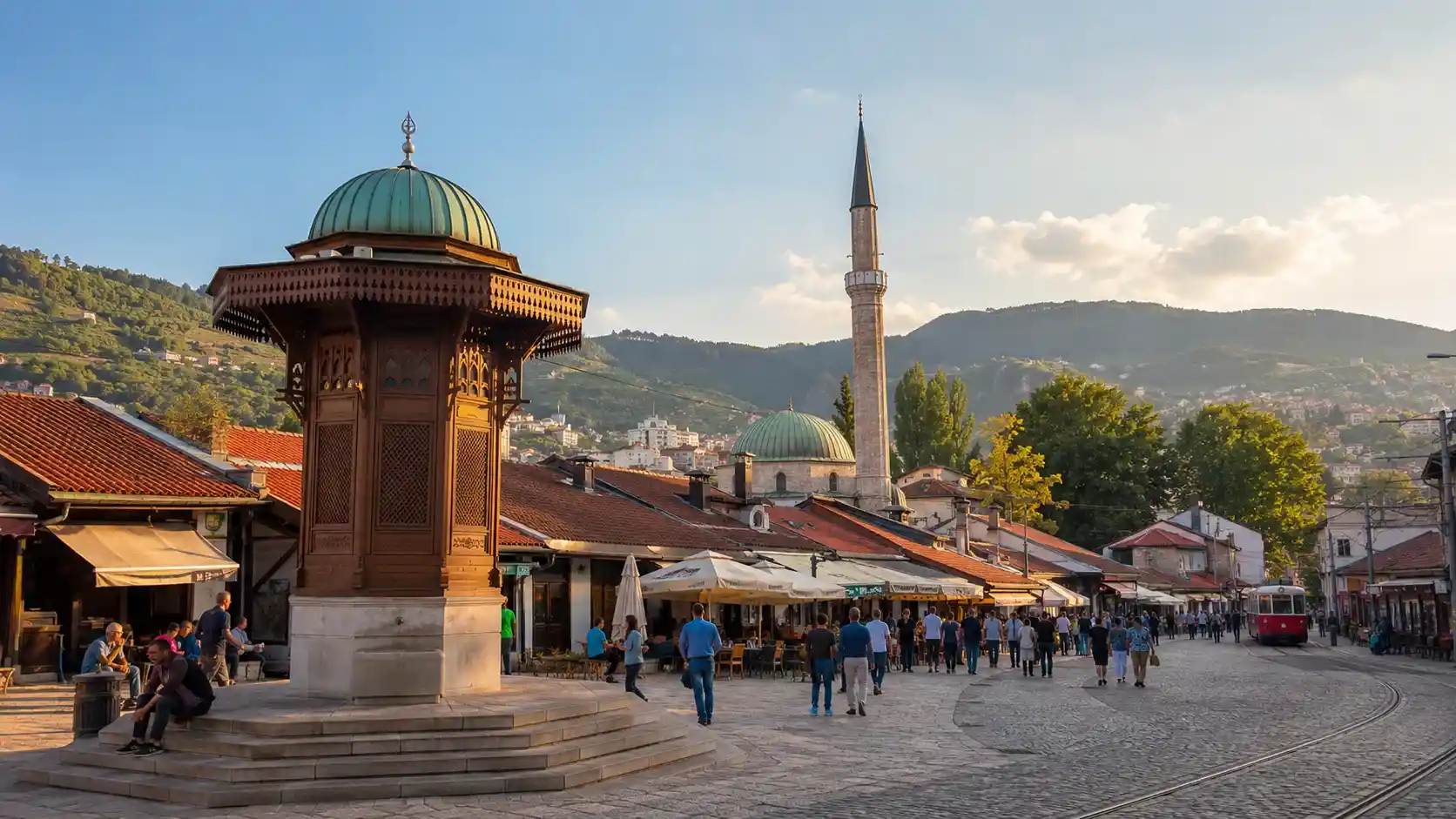
Baščaršija is the logical starting point because it forms Sarajevo’s historic commercial core and brings together streets, courtyards, religious buildings and traditional trades associated with the city’s Ottoman development. Destination Sarajevo describes it as the historical heart of the city and highlights its long role as an important trading center. Rather than walking randomly through every lane, begin around Baščaršija Square and follow the principal pedestrian streets toward Sarači and the Gazi Husrev-beg complex.
Allow around an hour for an introductory walk, more if you plan to browse metalwork, textiles or other traditional crafts. The value of Baščaršija is not simply shopping; its street layout helps explain how Sarajevo developed around commerce, religious institutions and community life. Exploring it first also gives useful geographical context for almost every other stop on Day 1.
2. See Sebilj and the Old Bazaar
Sebilj stands in the middle of Baščaršija Square and is one of Sarajevo’s most recognizable landmarks. The official Destination Sarajevo listing for Sebilj notes that the fountain seen today dates from the Austro-Hungarian period, while an earlier sebilj commissioned by Mehmed Pasha Kukavica stood several meters away.
Treat this as a short stop of roughly 15–20 minutes rather than inventing a separate hour-long attraction. Its real value is how naturally it fits into the surrounding bazaar: pause at the square, take in the fountain and surrounding architecture, then continue through the Old Town instead of repeatedly returning to the same point later in the day.
3. Visit the Gazi Husrev-beg Mosque Complex
Continue west through Baščaršija to the Gazi Husrev-beg Mosque, one of the most important surviving monuments from Ottoman Sarajevo. Official information from the Gazi Husrev-beg Library dates the mosque to 1530–31, while Destination Sarajevo places it directly in the center of Baščaršija. The wider historical complex helps visitors understand that major Ottoman religious foundations included more than a prayer space alone.
This remains an active place of worship, so sightseeing should be secondary to religious use. Dress modestly, keep voices low and follow instructions displayed at the entrance. Visitor access can be restricted around prayer or religious activities; if entering the mosque is important to you, confirm current access arrangements shortly before visiting rather than building the entire morning around an assumed schedule.
4. Walk to Latin Bridge and Understand Sarajevo’s World War I History
From the mosque area, continue toward the Miljacka and Latin Bridge. The bridge itself is historically older than the event for which the location is now internationally known; Destination Sarajevo records a bridge on this site in sources dating to the 16th century. Across from it is the location connected with the assassination of Archduke Franz Ferdinand and his wife Sophie on 28 June 1914 by Gavrilo Princip, an event that became part of the chain of developments leading to the First World War.
You do not need a long stop at the bridge itself. Allow around 20–30 minutes if you are viewing the location and reading the surrounding interpretation. Travelers who want substantially more context can consider the nearby Museum Sarajevo 1878–1918, whose permanent exhibition covers the Austro-Hungarian period, but adding the museum should be treated as optional rather than turning this three-day itinerary into a rushed museum checklist.
5. Visit Sarajevo City Hall (Vijećnica)
Finish the main Day 1 route at Sarajevo City Hall, or Vijećnica, on the eastern side of the historic center. The building opened in 1896 during Austro-Hungarian rule and later served as the National and University Library. It was severely damaged and burned in August 1992, and a long reconstruction was completed before the building officially reopened in 2014. Today, its interior, architecture and exhibitions make it more than an exterior photo stop.
Allow roughly 45–60 minutes if you plan to go inside. As of the latest information displayed on the official Vijećnica website, visitor hours are listed as daily from 09:00 to 17:00, but operating times and admission arrangements can change, so confirm them before your visit. The official site also lists several permanent exhibitions covering the building and Sarajevo’s history.
Where to Eat on Day 1
Keep lunch close to Baščaršija rather than walking across town for a restaurant recommendation. For a first introduction to Bosnian food, ćevapi are grilled minced-meat pieces typically served with flatbread and onion, while burek refers specifically to meat-filled pita in Bosnian usage. Cheese-filled sirnica and spinach-and-cheese zeljanica are useful alternatives, while Begova čorba is a traditional thick soup and klepe are filled dumplings often served with a creamy or yogurt-based accompaniment.
A sensible approach is to choose either a quick pita or ćevapi lunch on Day 1 and save a longer multi-dish Bosnian meal for Day 3. This prevents the food sections of the itinerary from becoming repetitive and leaves enough time to enjoy the Old Town without rushing between reservations.
Day 1 Evening: Bosnian Coffee and Baščaršija After Dark
After the main attractions close, return to the lanes around Baščaršija at a slower pace. The evening works well for a traditional Bosnian coffee because there is no need to fit another major attraction into the schedule. Bosnian coffee is prepared and served differently from a standard espresso order, traditionally arriving in a small metal pot with a cup and often something sweet alongside it. The point is not simply caffeine; the slower service naturally creates a break after several hours of walking.
Bosnian Coffee Tip: Do not schedule coffee as a ten-minute stop between attractions. Leave enough time to sit down, especially on your first evening, and ask how it is traditionally served if you are unfamiliar with the coffee set.
Day 2 moves beyond Sarajevo’s Ottoman core into its religious diversity, central museums and modern history, before leaving the center for the Tunnel Museum and finishing with one of the city’s most useful sunset viewpoints.
Day 2 — Sarajevo’s Cultural, Religious and Modern History
Day 2 adds several layers of Sarajevo that are easy to miss if you spend the entire trip inside Baščaršija. Start in the central pedestrian area around Ferhadija, where Austro-Hungarian architecture and major religious landmarks sit within a compact walking zone. Continue to the War Childhood Museum before taking separate transport to the Sarajevo Tunnel Museum, which lies outside the historic-center walking route. Return toward the eastern side of the city in time for the uphill walk to the Yellow Fortress before sunset.
This is the most history-focused day of the itinerary, so avoid adding several extra museums simply because they appear close on a map. One well-chosen central museum plus the Tunnel Museum provides enough time to understand the material rather than moving through sensitive historical sites too quickly.
6. Walk Ferhadija and See the Eternal Flame
Begin Day 2 around the western end of Ferhadija and the Eternal Flame, or Vječna Vatra. The memorial was unveiled on April 6, 1946 and commemorates those connected with the liberation of Sarajevo during World War II. Sarajevo’s official tourism resources place it at one of the most useful transition points between the pedestrian center and the broader Austro-Hungarian-era cityscape.
From here, walk east along Ferhadija rather than taking transport. One of the practical advantages of this route is that the architecture changes noticeably as you move toward the historic core, making the street itself useful for understanding how Sarajevo developed beyond its Ottoman foundations. Allow around 30–45 minutes for the walk when including pauses at the Eternal Flame and surrounding buildings rather than treating it as a direct transfer between attractions.
7. Explore Sarajevo’s Religious Heritage
Central Sarajevo places several important religious traditions within a relatively small area, so this itinerary treats them as one cultural experience rather than artificially counting every building as a separate attraction. The Cathedral of Jesus’ Sacred Heart, completed in 1889 in Neo-Gothic style, is the seat of the Archdiocese of Vrhbosna. Nearby, the Congregational Church of the Holy Mother is Sarajevo’s principal Orthodox cathedral and one of the city’s major religious landmarks.
Sarajevo also has an important Jewish heritage. If you want more depth than can fit into this walking section, the Jewish Museum of Bosnia and Herzegovina occupies the Old Jewish Temple and forms part of the Museum of Sarajevo. It is better treated as an optional addition for travelers with a particular interest in Jewish history rather than forcing another museum into an already substantial Day 2 schedule.
When entering active places of worship, dress respectfully, keep voices low and follow any instructions at the entrance. Access can change during services, religious holidays or other activities, so do not assume that every interior will be open for sightseeing whenever you arrive.
8. Visit One of Sarajevo’s Most Important Museums
For this three-day itinerary, the War Childhood Museum is a particularly useful choice because it approaches conflict through personal objects and testimonies connected with childhood rather than trying to summarize the entire Bosnian War through a conventional chronological exhibition. The museum describes its work as documenting the experiences of people whose childhoods were affected by war, with Sarajevo serving as the home of its permanent exhibition.
Allow approximately 60–90 minutes rather than attempting to read every story quickly. Some exhibits deal with displacement, loss and difficult childhood experiences, so visitors may prefer to take a coffee or lunch break afterward instead of immediately moving into another war-related museum.
At the time of checking, the museum’s official visitor information lists opening hours of 11:00 to 19:00 daily, with final admission at 18:30. The same official page currently lists adult admission at 15 BAM, with reduced categories available. Because museum schedules and prices can change, confirm the current information on the War Childhood Museum’s official visitor page before building your day around these times.
Lunch and Coffee Planning: This is a good point for a proper break. The Tunnel Museum requires a separate journey from the center, so eat before leaving rather than assuming you can fit lunch conveniently between transport connections.
9. Visit the Sarajevo Tunnel Museum
The Sarajevo Tunnel Museum, also known as the Tunnel of Hope or Tunel spasa, is the one major Day 2 attraction that should not be treated as part of the central walking route. It is located near the airport on the Butmir side of the former D-B Tunnel, so reaching it from central Sarajevo requires separate transport planning.
The tunnel was constructed beneath the airport runway during the Siege of Sarajevo to connect the besieged city with territory outside the encirclement. The official Sarajevo Memorial Center exhibition explains the tunnel’s construction and operation through documents, photographs, video footage and objects used during the siege. The visitor complex also preserves the original Butmir-side entrance and an authentic surviving section of the tunnel.
Plan approximately two to three hours for the complete excursion when travel from central Sarajevo, the museum visit and the return journey are combined. A taxi is often the simplest time-saving option for a short itinerary, while public transport can be considered if current routes and connections work for your schedule. A guided history tour may also be useful for travelers who want additional context, but it is not necessary simply to enter the museum.
Current information published by the official Sarajevo Memorial Center lists seasonal hours: from April 1 to October 31, the complex is listed as open from 08:30 to 17:00 with last entry at 16:30; from November 1 to March 31, it is listed as open from 09:00 to 16:00 with last entry at 15:30. The currently listed regular ticket is 20 BAM. The museum also states that it does not accept credit cards or foreign currency, making some BAM particularly important for this stop. These details should still be confirmed before the visit because ticket policies and schedules can change.
Important Historical Context: The Tunnel Museum is a memorial and historical site connected with the lived experience of the Siege of Sarajevo. Allow enough time to read the interpretation, and avoid approaching the surviving tunnel merely as an unusual photo location.
For a three-day trip, resist adding another distant attraction immediately after the tunnel. Return toward central Sarajevo and allow a short rest before beginning the final uphill section of the day.
Before starting your Sarajevo adventure, it is a good idea to compare flight options and schedules from different airlines. Travelers can use Trip.com Flights to search for convenient routes and prices when planning their journey to Bosnia and Herzegovina.
10. Watch Sunset From the Yellow Fortress
Finish Day 2 at the Yellow Fortress, also known as the Yellow Bastion or Žuta tabija. It sits above the eastern side of the Old Town on the Jekovac area of the Vratnik hillside and formed part of the historic defensive system around old Vratnik. Its elevated position provides a broad view across Sarajevo’s valley and surrounding hills.
The walk from the lower Old Town is relatively short in distance but noticeably uphill, so map estimates can understate the effort required. Allow roughly 30 minutes for a comfortable climb with pauses, particularly after an already active day. Comfortable footwear is more useful here than trying to reach the viewpoint as quickly as possible.
Check the local sunset time on the day of your visit and aim to arrive at least 30–45 minutes beforehand. Daylight changes significantly between seasons, and cloud or poor weather may block the expected view. If visibility is poor, treat the fortress as a short historical viewpoint and return to Baščaršija for dinner rather than waiting indefinitely for clear conditions.
Yellow Fortress Tip
The final approach is uphill. Leave the Old Town earlier than the map’s basic walking estimate suggests, carry water in warmer weather, and plan to reach the viewpoint before sunset rather than arriving exactly at sunset.
After returning downhill, keep the evening flexible. Day 2 already combines substantial historical material, an out-of-center museum visit and an uphill viewpoint. Day 3 changes the pace by moving toward Trebević, Sarajevo’s cable car and Olympic heritage before ending the trip with traditional food, Bosnian coffee and a slower final walk through the city.
Day 3 — Trebević, Olympic Sarajevo and Local Experiences
The final day changes the pace of this Sarajevo itinerary. Instead of moving between museums and historic buildings, spend the first half of the day above the city on Trebević, where Sarajevo’s mountain setting and Olympic history become much easier to understand. The cable car makes this a practical half-day excursion from the center, while the afternoon and evening can remain deliberately slower for Bosnian food, coffee and a final walk through favorite parts of the city.
Weather matters more today than on the previous two days. Mountain visibility, rain, snow, wind and cable-car operations can all affect the plan, so check conditions before leaving your accommodation and keep the afternoon flexible.
11. Ride the Sarajevo Cable Car
Start near the lower station of the Sarajevo Cable Car in Bistrik. The modern gondola links the city with Trebević and turns what would otherwise require a longer road journey into a short ride above the hillside. Destination Sarajevo describes the journey to Trebević as taking roughly eight minutes, making it one of the most efficient ways to combine mountain views with a three-day city break.
At the time of checking, the official Sarajevo Cable Car service page lists Monday operating hours from 12:00 to 21:00 and 09:00 to 21:00 on other days. Treat these as current information rather than permanent hours: maintenance, weather or later schedule changes can affect operations, so verify the official page again shortly before your visit.
There is little benefit in rushing onto the first available gondola simply to save a few minutes. If visibility is poor in the morning, consider delaying the mountain portion of the day if conditions are expected to improve. Conversely, on a clear day, going earlier gives you more flexibility for walking on Trebević before returning to the city.
Cable Car Tip
Check the official operating hours and local weather on the morning of Day 3. Do not build the entire day around an assumed timetable, particularly during poor weather or periods when maintenance may affect service.
12. Explore Trebević Mountain
Trebević rises immediately south of Sarajevo and has long functioned as one of the city’s main outdoor recreation areas. For first-time visitors, you do not need to reach the summit or complete a demanding hike to make the excursion worthwhile. The area around the upper cable-car station provides access to forest paths, viewpoints and routes toward the Olympic bobsleigh and luge track. Official Sarajevo tourism information presents Trebević as one of the key mountains surrounding the city and an accessible outdoor extension of a Sarajevo visit.
Allow roughly two to three hours for the mountain portion of the day if your goal is sightseeing, a relaxed walk and the Olympic track rather than a longer hike. Wear shoes suitable for uneven outdoor surfaces, and take an extra layer even when central Sarajevo feels warm because conditions can be different at elevation.
In warmer months, forest walks and viewpoints are the main attraction. In colder periods, snow, ice and shorter daylight can change which paths are comfortable to use. Stay on normal established routes and adjust the walking distance to the actual conditions rather than following a fixed itinerary regardless of weather.
13. See the Sarajevo Olympic Bobsleigh and Luge Track
One of Trebević’s most important landmarks is the bobsleigh and luge track built for the Sarajevo 1984 Winter Olympics. The International Olympic Committee confirms that the Trebević sliding track hosted the bobsleigh and luge competitions during the Games. It was later damaged during the war and today survives as one of the most recognizable physical reminders of Sarajevo’s Olympic legacy.
Its value is not simply that the concrete structure looks unusual in the forest. The track connects two major chapters of modern Sarajevo history: the international optimism surrounding the 1984 Winter Olympics and the severe damage experienced by the city and its infrastructure during the conflict that followed less than a decade later. The IOC continues to describe the site as part of Sarajevo’s surviving Olympic legacy.
Allow around 30–45 minutes for the track as part of the wider Trebević walk. Remain on ordinary accessible walking areas, respect barriers or temporary restrictions and avoid climbing onto damaged structures simply for photographs. The point of including the track in this itinerary is historical context, not risky exploration.
14. Have a Traditional Bosnian Food Experience
After returning from Trebević, make the afternoon meal one of the main experiences rather than treating food as another hurried stop. By this stage of the trip you may already have tried ćevapi or pita, so use the final day to explore the differences between several dishes rather than ordering the same meal again.
Ćevapi are grilled minced-meat pieces commonly served with flatbread and onions. In Bosnian usage, burek normally refers to meat-filled pita, while cheese-filled sirnica and spinach-and-cheese zeljanica provide meat-free alternatives. A slower meal may also include Begova čorba, stuffed vegetables or other dolma-style dishes, followed by desserts such as baklava or tufahija.
Vegetarian travelers generally have more flexibility with cheese, spinach and potato-filled pita than with Sarajevo’s best-known grilled-meat dishes, but ingredients should still be confirmed individually. Rather than choosing a restaurant purely because it appears on a tourist list, look for the type of meal you want and check the current menu, opening hours and payment options before visiting.
15. Slow Down With Bosnian Coffee and a Final Walk Through Sarajevo
The fifteenth and final experience is intentionally simple. Instead of adding another museum or distant landmark, use the final afternoon or evening for Bosnian coffee and an unhurried walk through the center. Three days in Sarajevo work better when at least part of the schedule remains open for returning to places that interested you earlier.
You might return to Baščaršija for crafts, walk along Ferhadija again, spend more time beside the Miljacka or simply choose a café and leave the next hour unscheduled. If buying souvenirs, locally made metalwork, textiles and other crafts can be more meaningful than generic imported items, but take time to distinguish traditional workshops from ordinary souvenir shops.
This slower ending also creates useful flexibility. If poor weather delayed Trebević, the afternoon can absorb the change. If everything went according to plan, it becomes time to enjoy Sarajevo without another timetable.
Complete Sarajevo 3-Day Itinerary at a Glance
The schedule below groups attractions geographically and uses broad periods rather than artificial minute-by-minute timing. Museum hours, cable-car operations and sunset times should still be checked for your actual travel dates.
| Day | Approximate Time | Activity | Suggested Duration | Transport | Notes |
|---|---|---|---|---|---|
| Day 1 | Early morning | Baščaršija | About 1 hour | Walk | Begin before the busiest part of the day |
| Morning | Sebilj and Old Bazaar | 15–20 minutes plus surrounding streets | Walk | Combine naturally with Baščaršija | |
| Late morning | Gazi Husrev-beg Mosque Complex | 30–45 minutes | Walk | Respect prayer times and visitor rules | |
| Lunch | Traditional Bosnian lunch | About 1 hour | Walk | Stay within the Old Town | |
| Early afternoon | Latin Bridge | 20–30 minutes | Walk | Optional nearby museum if time allows | |
| Late afternoon | Sarajevo City Hall | 45–60 minutes | Walk | Check current admission hours | |
| Evening | Bosnian coffee and Old Town walk | Flexible | Walk | Keep the evening deliberately slow | |
| Day 2 | Morning | Ferhadija and Eternal Flame | 30–45 minutes | Walk | Notice the changing architecture |
| Late morning | Central religious heritage | About 1 hour | Walk | Treat several landmarks as one cultural experience | |
| Late morning / early afternoon | War Childhood Museum | 60–90 minutes | Walk | Allow time to engage with the material | |
| Lunch | Lunch and coffee break | About 1 hour | Walk | Eat before traveling outside the center | |
| Afternoon | Sarajevo Tunnel Museum | 2–3 hours including travel | Taxi or verified public transport | Outside the central walking zone | |
| Late afternoon | Return and short rest | Flexible | Taxi / public transport | Do not skip the break before the climb | |
| Sunset | Yellow Fortress | 45–60 minutes plus climb | Walk | Check seasonal sunset time | |
| Day 3 | Morning | Sarajevo Cable Car | Short ride plus station time | Walk + cable car | Check operations and weather first |
| Morning | Trebević Mountain | 1–2 hours | Walk | No difficult hike required | |
| Late morning | Olympic bobsleigh and luge track | 30–45 minutes | Walk | Remain in normal accessible areas | |
| Early afternoon | Return to central Sarajevo | Flexible | Cable car | Allow extra time if queues develop | |
| Afternoon | Traditional Bosnian meal | 1–1.5 hours | Walk | Try dishes you have not already ordered | |
| Evening | Bosnian coffee and final city walk | Flexible | Walk | Leave space for spontaneous stops |
How Much Walking Is Involved?
Central Sarajevo is highly practical for sightseeing on foot. Baščaršija, Ferhadija, Latin Bridge, Vijećnica and many central religious landmarks are concentrated within a manageable area. The challenge is less the distance than the surfaces, standing time and hills that appear once you move away from the valley floor.
Day 1 is the easiest walking day because the route remains compact. Day 2 requires more energy because of the Yellow Fortress climb, even though transportation is recommended for the Tunnel Museum. Day 3 can be adjusted substantially: a visitor who wants only the cable car, viewpoints and Olympic track can keep the mountain walk moderate, while hikers can extend the route.
Older travelers, families and anyone who finds steep hills difficult should build in additional rest time and consider using a taxi for selected uphill sections. Travelers with mobility limitations should verify current accessibility directly with individual attractions and transport operators rather than assuming that historic streets, mountain paths or older buildings are step-free.
Getting Around Sarajevo During This 3-Day Itinerary
Walking
Walking is the default transport for most of Days 1 and 2 in the center. It is usually faster to continue on foot between Baščaršija, Ferhadija and the nearby riverfront than to wait for transport for such short distances.
Tram
Sarajevo’s tram system is useful when moving along the main east-west urban corridor or when your accommodation is farther from the historic center. The official GRAS network includes tram, trolleybus, bus and minibus services across Sarajevo Canton. Check the current GRAS timetable rather than relying entirely on an old blog post or saved transport screenshot.
Bus and Trolleybus
Bus and trolleybus services can help with destinations outside the central pedestrian zone. They are most useful when the route matches your accommodation or a specific outlying attraction; there is little reason to use them simply to move between neighboring Old Town sights. GRAS publishes current service information and timetables on its official website.
Taxi
A taxi is most useful when it saves a meaningful amount of time, particularly for the Tunnel Museum or when hills become tiring. Confirm how the fare will be calculated before a longer journey and use an established licensed service rather than treating a taxi as the default way to move around the compact center.
For a comfortable arrival after a long flight, some travelers prefer booking airport transfers in advance. Services such as KiwiTaxi allow visitors to arrange transportation before reaching Sarajevo.
Cable Car
The cable car has one specific role in this itinerary: connecting the city with Trebević on Day 3. It should not be confused with ordinary city public transport. Check the official Sarajevo Cable Car website independently because its operating information can differ from regular GRAS services.
Sarajevo Public Transport Tips
Sarajevo Public Transport Tip
- Check current timetables and ticket procedures on the official GRAS website before relying on a particular connection.
- Keep some Convertible Marks (BAM) available rather than assuming every ticket point or small business will accept your preferred card.
- Follow the current validation procedure for the ticket type you purchase.
- Download an offline city map before leaving your accommodation.
- Allow extra time when changing between services or traveling to an attraction with a fixed closing time.
- Recheck transport information locally if an app and the official operator show conflicting details.
Where to Stay for 3 Days in Sarajevo
For a short first visit, location matters more than having access to every neighborhood. Staying around Baščaršija or Ferhadija minimizes daily transport, while Marijin Dvor suits travelers who prefer a more modern urban environment and easier access to the western side of central Sarajevo. Official Destination Sarajevo accommodation listings confirm a substantial concentration of accommodation around the Old Town and Ferhadija areas.
| Area | Best For | Main Advantage | Possible Drawback |
|---|---|---|---|
| Baščaršija / Old Town | First-time sightseeing and atmosphere | Walk directly to many major Day 1 and Day 2 sights | Busy pedestrian areas and possible street noise depending on the property |
| Ferhadija / Central Sarajevo | Balanced location | Convenient for both the Old Town and the modern center | Less immersed in the Ottoman Old Town than staying inside Baščaršija |
| Marijin Dvor | Modern-city surroundings and transport access | Useful position for the western side of central Sarajevo | Longer walk to the heart of Baščaršija |
For this particular three-day itinerary, Baščaršija or the Ferhadija area is the most convenient choice for most first-time visitors. Both reduce unnecessary travel on the first two days and make it easier to return to your accommodation for a short rest before an evening walk.
After choosing the best area to stay in Sarajevo, travelers can compare different accommodation options, including hotels, apartments, and guesthouses. Agoda is another useful platform for checking accommodation availability and comparing prices before finalizing your stay.
What to Eat During 3 Days in Sarajevo
Instead of trying every Bosnian dish in one meal, spread food experiences across the itinerary. A quick pita or ćevapi lunch works naturally in Baščaršija, while Day 3 is better suited to a slower traditional meal.
| Food | What It Is | Best Time to Try It |
|---|---|---|
| Ćevapi | Small grilled minced-meat pieces, commonly served with flatbread and onion | Day 1 lunch |
| Burek | Bosnian meat-filled pita made with thin pastry | Quick breakfast or lunch |
| Sirnica | Cheese-filled pita | Breakfast or casual lunch |
| Zeljanica | Spinach-and-cheese filled pita | Lunch or lighter meal |
| Begova čorba | A traditional thick soup commonly associated with Bosnian cuisine | Day 3 traditional meal |
| Klepe | Small filled dumplings typically served with a creamy or yogurt-based accompaniment | Relaxed dinner |
| Tufahija | A cooked apple dessert traditionally filled with nuts | After a longer traditional meal |
| Bosnian coffee | Traditional coffee prepared and served in a style distinct from a standard espresso order | Late afternoon or evening |
At this point, the core three-day itinerary is complete: five experiences in the historic center on Day 1, five cultural and modern-history experiences on Day 2, and five Trebević, Olympic, food and coffee experiences on Day 3. The next part covers trip costs, seasons, advice for families, couples and solo travelers, common mistakes, additional-day options and the final assessment of whether three days in Sarajevo is the right length for a first visit.
How Much Does 3 Days in Sarajevo Cost?
Sarajevo can work for several travel budgets, but accommodation is the category most likely to change significantly between seasons, weekends and major events. For that reason, it is more useful to budget by travel style than to rely on a fixed daily figure that may be inaccurate by the time you visit.
As a current market reference, Hostelworld listings for Sarajevo show many hostel beds and basic private options starting at roughly €10–€22 per night, while Booking.com currently reports average weekend prices of about US$89 for a three-star hotel and US$152 for a four-star hotel. These figures are snapshots rather than guaranteed rates, so compare accommodation for your exact dates before setting the final budget.
For food, current Sarajevo price data places a meal at an inexpensive restaurant at around 15 BAM, while a three-course meal for two at a mid-range restaurant is around 70 BAM before drinks. These are useful planning references rather than menu guarantees.
Public transport remains a relatively small part of most three-day budgets because so much central sightseeing is done on foot. GRAS currently lists a single tram, trolleybus, bus or minibus ticket at 2.20 BAM and a day ticket at 7.10 BAM. Check the official fare page before traveling in case prices or ticket procedures change.
| Travel Style | Accommodation | Food | Sightseeing & Transport | Best Planning Approach |
|---|---|---|---|---|
| Budget | Hostel or simple guesthouse | Bakeries, pita, ćevapi and inexpensive restaurants | Walk extensively, use public transport selectively and choose paid museums carefully | Book accommodation early when visiting during busy periods |
| Mid-range | Central apartment or three-star hotel | Mix of traditional restaurants, cafés and casual meals | Main museums, cable car and occasional taxi | Prioritize a central location to reduce transport time |
| Comfortable | Higher-category central hotel | More restaurant meals and longer café stops | Paid attractions, taxis and optional guided experiences | Compare location and convenience rather than hotel category alone |
Museum costs also need to be calculated individually. For example, the Sarajevo Tunnel Museum currently lists a regular admission price of 20 BAM. Its official site also states that credit cards and foreign currencies are not accepted, so carrying local currency is particularly important for this stop.
The Convertible Mark is linked to the euro at the official fixed rate of 1 EUR = 1.95583 BAM, according to the Central Bank of Bosnia and Herzegovina. This makes euro-to-BAM mental conversions relatively straightforward, although everyday purchases are still best planned in local currency.
Budget Tip: Do not calculate the cost of Sarajevo only from hotel prices. Several major parts of this itinerary are simply walks through historic areas, while the main paid expenses come from selected museums, the cable car, transport outside the center and accommodation.
Best Time of Year for a 3-Day Sarajevo Trip
Spring
Spring works well for travelers who want to spend significant time walking. Conditions can shift between cool and mild weather, particularly earlier in the season, so layers and a light rainproof jacket are useful. Mountain conditions on Trebević may also feel different from the city center, especially early in spring.
Summer
Summer provides long daylight hours, which makes the Yellow Fortress, evening walks and Trebević easier to fit into the itinerary. Central streets can be busier during popular travel periods and major events, so accommodation should be booked earlier than for quieter dates. Sarajevo’s official visitor information identifies July as the warmest part of the year, confirming that summer sightseeing should include water and breaks during the warmer part of the day.
Autumn
Early autumn can offer comfortable conditions for combining urban sightseeing with Trebević, while later autumn brings shorter daylight and less predictable weather. Check sunset time carefully before placing the Yellow Fortress at the end of Day 2.
Winter
Winter gives Sarajevo a very different atmosphere, but cold conditions, snow or ice can affect walking and mountain plans. Keep Day 3 flexible and check cable-car operations before heading toward Trebević. Sarajevo’s tourism information specifically recognizes winter conditions in the city and the nearby Olympic mountains, so footwear and weather checks become more important than during a mild-weather city break.
Sarajevo in 3 Days for Families
Families can follow the same three-day structure, but the pace should be reduced rather than removing the main experiences altogether. Day 1 is particularly manageable because the principal stops are concentrated around the historic center and can be divided by food or café breaks.
The hills are more important than the map distance when traveling with younger children. The climb to the Yellow Fortress may require additional time, and Trebević should be adjusted to weather, footwear and the family’s normal walking ability.
Museum choices deserve more consideration. The War Childhood Museum and Tunnel Museum cover serious subjects, so parents should review current exhibition information and decide whether the content suits their children’s age and sensitivities rather than assuming every historical attraction is appropriate for every family.
Travelers using a stroller should also verify access at individual attractions. Historic surfaces, inclines and older buildings can create practical difficulties even when two locations look close together on a map.
Sarajevo in 3 Days for Couples
For couples, the main advantage of this itinerary is that it does not require constant transportation. Day 1 allows plenty of time for walking through Baščaršija and stopping for a meal or coffee without breaking the route, while Day 3 leaves the afternoon relatively open after Trebević.
The Yellow Fortress works well near sunset when weather permits, but arrive early enough that reaching the viewpoint does not become a race against daylight. A longer traditional dinner on Day 3 can also be more enjoyable than attempting to add another museum simply to increase the number of attractions visited.
Sarajevo in 3 Days for Solo Travelers
Solo travelers can follow this itinerary without needing a private vehicle because the historic center is compact and the outlying stops can be reached separately. Downloading an offline map is useful for moving between Baščaršija, Ferhadija and the hillside areas without constantly depending on mobile data.
Eating alone is straightforward when choosing bakeries, ćevapi restaurants and casual cafés, while a guided walking or history tour can be added if you prefer additional context or want a more social activity. Tours are optional rather than necessary for completing the itinerary.
Use the same normal city precautions you would use elsewhere: keep valuable items secure, know how you are returning to your accommodation after dark and avoid relying on an unfamiliar mountain route when visibility or weather conditions are poor.
Common Mistakes First-Time Visitors Make in Sarajevo
| Common Mistake | Why It Causes Problems | Better Approach |
|---|---|---|
| Trying to visit too many attractions in one day | Museums, meals and walking take longer than a map suggests | Group a few important experiences geographically |
| Treating Baščaršija as the whole city | You miss Sarajevo’s Austro-Hungarian, Yugoslav and modern layers | Continue west along Ferhadija and include Day 2 |
| Ignoring Sarajevo’s hills | Short distances can involve steep climbs | Add extra time for viewpoints and hillside accommodation |
| Not checking museum opening hours | A closed museum can disrupt the whole day’s sequence | Check official information the evening before |
| Planning the Tunnel Museum as if it were in the Old Town | It requires a separate journey near the airport area | Reserve a dedicated afternoon transport block |
| Carrying no cash | Some smaller businesses and attractions may require BAM | Keep a reasonable amount of local currency available |
| Scheduling every minute | Coffee, meals and unexpected delays disappear from the plan | Use broad morning and afternoon blocks |
| Assuming attractions open every day | Schedules may change seasonally or for events | Verify current opening days before arrival |
| Visiting war-related sites without context | Important historical places become disconnected from their meaning | Read museum interpretation and approach memorial sites respectfully |
| Depending only on Google Maps for transport | Schedules and temporary service changes may not always match | Cross-check with official GRAS information |
| Not checking cable-car operations | Weather or operational changes can affect Day 3 | Check the official cable-car site that morning |
| Wearing unsuitable footwear | Historic surfaces, hills and Trebević increase walking demands | Wear comfortable shoes with reliable grip |
| Leaving sunset viewpoints too late | The Yellow Fortress approach is uphill | Aim to arrive 30–45 minutes before sunset |
| Adding a distant Bosnia day trip to an already full itinerary | It removes an entire Sarajevo sightseeing day | Add another night if Mostar or another city is a priority |
Practical Sarajevo Travel Tips for First-Time Visitors
- Keep some Convertible Marks (BAM) available for smaller purchases and places where cards are not accepted.
- Wear comfortable walking shoes because hills and uneven surfaces matter more than the total distance.
- Download an offline Sarajevo map before starting the day.
- Check museum opening hours the evening before each planned visit.
- Check Sarajevo Cable Car operations and weather on the morning of Day 3.
- Save your accommodation name and address offline.
- Allow additional walking time whenever the route climbs away from the Miljacka valley.
- Carry water during warm-weather sightseeing, especially before the Yellow Fortress climb or time on Trebević.
- Respect active mosques, churches, synagogues and other religious sites.
- Dress appropriately and follow posted visitor instructions when entering a place of worship.
- Keep behavior respectful at memorials and places connected with the Siege of Sarajevo and Bosnian War.
- Leave flexibility for coffee, meals, weather changes and slower museum visits.
- Check seasonal sunset time before planning the Yellow Fortress.
- Confirm airport transfer arrangements in advance if your flight arrives or departs very early or late.
Before traveling internationally, arranging travel insurance can provide extra peace of mind for unexpected medical situations or travel changes. You can compare different plans through Squaremouth Travel Insurance and choose coverage suitable for your trip.
What to Do If You Have More Than 3 Days in Sarajevo
A fourth day gives you room to explore Sarajevo without disturbing the core three-day itinerary. You could add another museum, visit neighborhoods beyond the main tourist center, spend longer walking on Trebević or visit Vrelo Bosne near Ilidža.
If you have several extra days, you can also begin considering destinations elsewhere in Bosnia and Herzegovina. Mostar deserves a dedicated day rather than being inserted into one of the three Sarajevo days. Konjic can also form part of a wider Bosnia route, while Travnik and Jajce require more substantial overland travel and are easier to enjoy when you are not trying to return to Sarajevo between scheduled city attractions.
For travelers planning a broader Bosnia itinerary, it is usually more efficient to add nights to the trip than to turn every additional destination into a rushed out-and-back excursion from Sarajevo.
If you plan to explore destinations around Sarajevo, renting a car can provide more flexibility, especially for mountain areas and nearby towns. Travelers can compare rental options through DiscoverCars before choosing the best vehicle for their route.
Is Sarajevo Worth Visiting for 3 Days?
Yes, Sarajevo is well worth three days for most first-time visitors. The city offers enough historical, cultural and food experiences to fill the itinerary while remaining compact enough that much of your time is spent sightseeing rather than commuting between attractions.
Three days are particularly suitable for travelers interested in history, architecture, religious heritage, Bosnian food and a broader Balkan itinerary. The combination of a walkable historic center, several meaningful museums and Trebević also creates more variety than a city break based entirely around monuments.
Travelers who prefer slow museum visits, longer café breaks, hiking or several Bosnia day trips should stay longer. Four or five days make it easier to explore those interests without reducing Sarajevo itself to a rushed checklist.
Final Thoughts: Sarajevo in 3 Days
Three full days provide a strong introduction to Sarajevo. Day 1 keeps the route around Baščaršija and the historic center, where Ottoman Sarajevo and the city’s Austro-Hungarian transition can be understood largely on foot. Day 2 adds religious diversity, museum context, the Sarajevo Tunnel and a sunset viewpoint. Day 3 moves onto Trebević for mountain scenery and Olympic heritage before slowing down with traditional food and Bosnian coffee.
The most important planning decision is geographical rather than numerical. Seeing fewer places in a logical order usually produces a better trip than crossing Sarajevo repeatedly simply to add another attraction to the list.
For most first-time visitors, this Sarajevo in 3 days itinerary balances the city’s essential historical sights with museums, local culture, food and time outdoors without requiring an unrealistic sightseeing pace.
Save the itinerary for your trip, then recheck official museum opening hours, Sarajevo public transport information, cable-car operations and accommodation availability shortly before traveling. Small schedule changes are much easier to handle when the three days are already organized by area.
Planning Sarajevo in 3 days? Follow this realistic Sarajevo itinerary through Baščaršija, historic landmarks, museums, the Tunnel of Hope, Trebević Mountain, Olympic heritage, Bosnian food and scenic viewpoints. Includes practical transport, walking, accommodation and first-time visitor tips for a well-planned Bosnia city break.