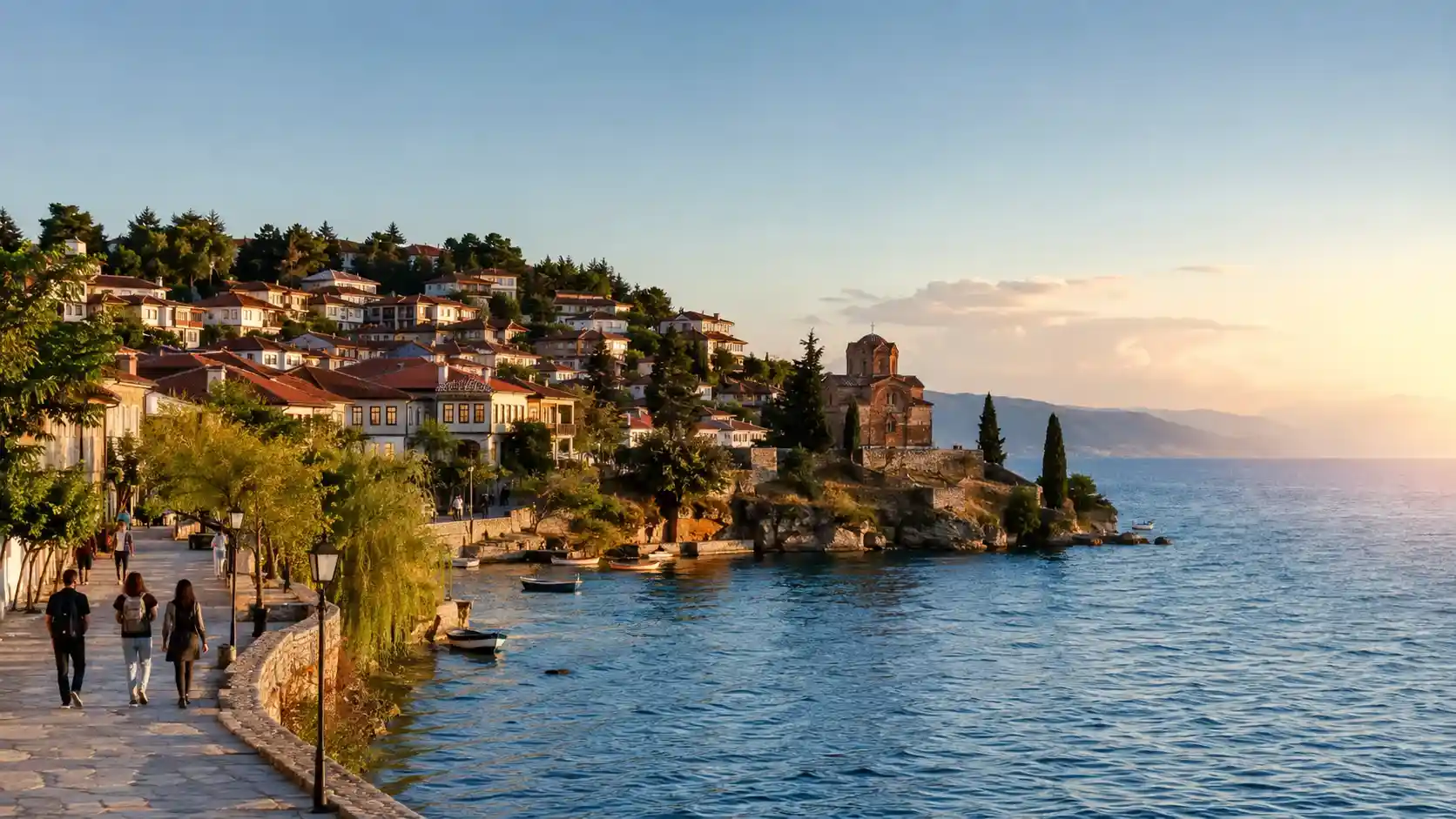
2 Days in Ohrid: Old Town, Lake & St Naum (2026)

Planning 2 days in Ohrid is one of the best ways to experience North Macedonia’s famous lakeside town without turning a short stay into a race. Spend your first day walking through the historic Old Town, from the waterfront and St Sophia to the ancient theatre, Samuel’s Fortress, Plaošnik and the cliffside Church of St John at Kaneo. Keep the second day for Lake Ohrid: choose a short local boat trip with an optional visit to the Bay of Bones Museum, or commit most of the day to a longer cruise to St Naum.
The distinction matters. Ohrid’s historic peninsula is compact but hilly, and the lake’s south shore takes time to reach. A cruise advertised as a St Naum excursion can take seven hours, not the hour or two that a sightseeing loop around the Old Town might require. This independently researched 2026 itinerary distinguishes those choices, gives realistic travel and walking guidance, and points to the museum and operator pages you should check before leaving.
The historic town and Lake Ohrid belong to the UNESCO-listed Natural and Cultural Heritage of the Ohrid Region, recognized for both exceptionally old freshwater ecosystems and remarkable religious and urban heritage. Responsible sightseeing here means more than photographs: use existing paths, respect active churches and avoid disturbing the lakeshore.
Table of Contents
2 Days in Ohrid: Quick Answer
| Decision | Best practical answer |
|---|---|
| Is two days enough? | Yes, for the essential Old Town sights and one satisfying lake-focused day. |
| Day 1 | Old Town → St Sophia → ancient theatre → Samuel’s Fortress → Plaošnik → St John at Kaneo → waterfront. |
| Day 2, relaxed | Short boat sightseeing or swimming, followed by the optional Bay of Bones Museum near Peštani. |
| Day 2, full-day alternative | St Naum monastery and springs by a prearranged longer boat cruise or road transfer; drop other afternoon plans. |
| Best accommodation base | Central waterfront, Old Town edge or near the port; inspect hills and steps before booking. |
| Do you need a car? | No for Day 1; potentially useful for independent trips south along the lake on Day 2. |
| Best season for boating | Generally late spring through early autumn; confirm each operator’s sailing dates. |
| Planning currency | Macedonian denar (MKD). Carry some local cash; verify card acceptance at each attraction. |
| Biggest mistake | Treating a St Naum day cruise and a short city boat ride as interchangeable activities. |
The most useful rule: protect the first day for the historic hill and protect the second day from overloading. If you arrive after lunch, move one uphill sight into your second morning or spend less time on the optional excursion; do not walk the Old Town in a hurry just to keep a printed timetable.
Before You Go: Geography, Hills and the UNESCO Setting
Ohrid sits on the northeastern shore of Lake Ohrid. The historic core rises from the promenade through lanes of old houses and religious buildings toward the fortress, then descends across the peninsula toward Kaneo. The city center and the historic peninsula are walkable; that does not make every route accessible to travelers who cannot manage stairs, cobbles or steep gradients.
The shoreline destinations south of town are a different logistical zone. The Bay of Bones archaeological museum is near Peštani and Gradište, outside central Ohrid. St Naum lies farther south near the Albanian border. Both are enjoyable, but they are not extra Old Town stops that can be inserted into a free half hour.
The lake is also an ecologically sensitive system. UNESCO describes it as one of the world’s oldest lakes and a refuge for many endemic plants and animals. Avoid litter, stay out of restricted conservation areas and do not assume that every attractive patch of shoreline is a managed swimming beach. Check local advice on water quality, currents, access and beach facilities.
How much walking should you expect?
Day 1 involves several hours on foot including steep sections. The distance may not look impressive on a map, but repeated climbs, steps, stops and summer heat make the effort noticeable. A traveler happy to walk around a flat city for 90 minutes may still find the fortress ascent tiring. Take pauses and consider skipping the fortress ramparts or an additional viewpoint if you are not comfortable with heights or uneven stone.
Day 2 can be almost completely low-effort if you choose a boat experience and promenade time. The Bay of Bones, however, needs transportation and some walking on museum platforms. St Naum takes more of your day whether reached by road or boat.
Exactly what counts as two days?
For the schedules below, assume two usable daylight periods, ideally with two nights in Ohrid. If your first day begins after a long bus transfer from Skopje, you have closer to one-and-a-half sightseeing days. Likewise, a bus leaving mid-afternoon on Day 2 rules out a full-day St Naum cruise. Arrange your outgoing connection before purchasing a non-refundable activity.
Day 1: Walk Ohrid Old Town, the Fortress and Kaneo
The practical order is to start low, climb through the historic core, then descend toward the western lake viewpoint. Rather than treating every church as an independent appointment, choose a short list and allow time to understand why the architecture and setting matter.
| Part of day | Stops in a sensible order | Allow | Important condition |
|---|---|---|---|
| Morning | Old Town streets and Church of St Sophia | 1–1.5 hr | Worship and visitor access may affect interior entry. |
| Late morning | Ancient Theatre and ascent to Samuel’s Fortress | 1.5–2 hr | Hilly walking; confirm fortress opening and ticket price. |
| Early afternoon | Lunch and Plaošnik / St Clement’s area | 1.5–2 hr | Combine archaeology with a proper rest break. |
| Later afternoon | St John at Kaneo and lakeside paths | 1–1.5 hr | The church and paths can involve steps; avoid exposed edges. |
| Evening | Waterfront, port and dinner | Flexible | Sunset time varies with season; no need for another paid attraction. |
These are time allowances, not confirmed museum entry slots. Reverse the uphill portion if the fortress closes earlier than expected or if midday heat makes an earlier climb preferable.
1. Get oriented on the port and Old Bazaar side
Start at the waterfront or central square and follow the older streets uphill. This gives you a useful mental map before the route becomes steeper. Small streets reveal traditional urban houses, balconies, stonework and glimpses of the lake. You do not need an expensive guided activity merely to find the first buildings, although a local history guide can add meaningful context if architecture is a priority.
Pause at the market and pedestrian streets rather than racing directly uphill. Some streets serve everyday residents, so keep doorways clear and be considerate when photographing homes. If you are arriving by bus, leave your luggage with the accommodation first. Carrying a rolling suitcase into steep Old Town lanes is an unnecessary challenge.
The waterfront is also a sensible place to identify tomorrow’s boat meeting point. Do not assume that every operator departs from the same pier; ask which pier, vessel and boarding time are printed on your confirmation.
2. Visit the Church of St Sophia
St Sophia is a major stop for understanding Ohrid’s medieval religious heritage. UNESCO specifically highlights St Sophia among the churches demonstrating the region’s distinguished Byzantine art and architecture. The visit is more valuable when you appreciate the setting and interior decoration rather than treating it as a quick landmark photograph.
For a short itinerary, allow 20–40 minutes around the church, adding time if interior admission is possible. It remains a religious and heritage site; access to interiors, ticket rules, worship arrangements and photography policies can change. Respect staff instructions and ask before photographing any frescoes.
If St Sophia is closed at the time you arrive, continue with the walking route rather than waiting for hours. The fortress and Kaneo are still central to the day, and you can return if the site opens later.
3. Pass the Ancient Theatre on the climb
The ancient theatre is on the slope below the fortress, making it a logical stop while walking upward instead of a separate cross-town excursion. The Ohrid Institute and Museum lists the ancient theatre among its protected monuments. It is a useful reminder that Ohrid’s cultural layers extend far beyond its medieval churches.
Take a short look at the setting and surviving seating. Depending on events, preservation work or access restrictions, you may see the site from the surroundings rather than entering every part. Allow roughly 15–30 minutes, then continue uphill. A seat on an ancient stone step is not worth taking risks where barriers restrict movement.
4. Climb to Samuel’s Fortress for the wide lake view
Samuel’s Fortress crowns the hill above the Old Town. Its walls and towers provide an elevated perspective over rooftops, the historic peninsula, Lake Ohrid and the opposing landscape. The official heritage institute describes the fortress as a major medieval fortification and defining element of Ohrid’s urban skyline. See the official fortress description.
The approach is uphill and can feel strenuous in bright summer sunlight. The best estimate is to budget an hour or more including the final approach, entry, viewpoints and pauses, rather than assuming the attraction itself demands a two-hour standing visit. Railings and historic ramparts should not be confused with a modern observation deck; watch your footing and keep children close.
Opening and price caution: do not copy an old fortress ticket price or promised opening hour from a travel article into your fixed plan. Ask the accommodation or check the official heritage institute for the day’s status; hours can be seasonal and monuments may close for events, conservation or weather reasons. If entry is unavailable, the hilltop setting is still worth appreciating from permitted public paths, but avoid entering closed areas.
5. Continue through Plaošnik and the St Clement heritage area
Descending from the fortress toward Kaneo, include Plaošnik, associated with St Clement and the St Panteleimon church. The institute’s archaeological research describes the site’s early Christian remains and later monastic importance. This is a natural extension of the hilltop route, not an extra trip by car. Its religious history is part of the same cultural landscape that gives Ohrid its World Heritage significance.
Allow approximately 30–45 minutes if you intend to enter permitted areas and read about the monuments. This can change with archaeological work, religious activity and access arrangements. Do not step over fences or climb on remains to take photographs. If you are behind schedule, keep Plaošnik short and continue toward Kaneo.
The walk between fortress, Plaošnik and Kaneo makes more sense than walking back to the waterfront for lunch and then climbing the hill again. If you need a substantial sit-down meal, eat before the uphill section or after you descend, or bring a modest snack rather than forcing a restaurant detour.
6. See the Church of St John at Kaneo
Few Ohrid views are as recognizable as St John at Kaneo, a church set high above the blue lake on the western edge of the historic peninsula. UNESCO names Kaneo as one of the region’s notable religious monuments. The view is striking, but the best experience is giving yourself enough time to arrive, rest and take in the landscape responsibly.
A common mistake is to describe Kaneo as a quick roadside attraction. You reach it along walking paths that can involve steps, slopes and exposed lakeside terrain. Check the route on the day because temporary path closures, wet surfaces or repair work can affect access. Do not lean beyond walls or barriers for a photograph, especially with children.
The exterior panorama does not guarantee access to the church interior. Be respectful of services, modest dress requirements and any ticketing or photography instructions. For most travelers, 30–60 minutes around Kaneo is sufficient after accounting for a longer walk to the site.
7. Finish by Lake Ohrid and keep sunset flexible
The easiest finish is the waterfront near the historic center. If the lakeside pedestrian boardwalk is accessible, it can provide a scenic descent or alternative view, but check its condition and do not rely on a particular section being open year-round. The Old Town has more than one route back to the lake.
The first day’s reward is unstructured time by the water. Have dinner, sit at the promenade or take a short local boat loop if one happens to be running and you have the energy. There is no reason to schedule a distant excursion after the fortress and Kaneo. Late summer sunsets and winter sunsets happen at very different times, so use the local daylight forecast rather than a fixed 19:30 appointment.
Day 1 fallback: if weather is poor, shorten the fortress climb and spend more time at an accessible church, sheltered café or museum that is actually open. If you arrive too late for the fortress, prioritize St Sophia, the Old Town and Kaneo, moving the hilltop visit to a free morning only if transport permits.
Day 2: Choose the Lake Day That Fits Your Travel Style
There are two worthwhile but different versions of Day 2. Option A allows you to explore the lake without giving up all your free time. Option B is a full excursion toward St Naum. Pick the one that matches your interests and departure schedule, not the one that sounds like it includes the most stops.
| Choice | Best for | Typical commitment | What not to assume |
|---|---|---|---|
| A. Short cruise + Bay of Bones | Couples, families and visitors who want both town time and one museum | Morning on the lake and an optional separate afternoon excursion | The short cruise automatically stops at Bay of Bones. |
| B. St Naum boat cruise | Travelers who prioritize the southern shore and monastery | Much of the day; one published example runs about 10:15–17:00 | You can still do a long independent afternoon in Ohrid. |
| C. Stay around Ohrid | Budget travelers, poor-weather visits, early departures | Flexible | A paid boat ticket is necessary to enjoy Lake Ohrid. |
Option A: Morning short boat cruise and a flexible afternoon
Start with breakfast near the waterfront. Walk to the pier named by your chosen operator and ask for the exact duration and route. A local scenic sightseeing cruise around Ohrid’s historic peninsula is a different product from a St Naum excursion. Do not book simply because both listings say “Lake Ohrid boat tour.”
A short loop may offer the most memorable water-level perspective of Kaneo and the waterfront. Confirm whether the boat returns to the same dock, how long the journey lasts, whether children need special seats, and what the operator does if weather makes navigation uncomfortable or unsafe.
If wind or rain makes boating unsuitable, replace the experience with the lakefront walk, a café or beach time in a permitted area. If swimming, choose a designated and appropriate entry point, follow local water-quality or safety advice, avoid boat lanes, and supervise children closely. Lake Ohrid should not be treated as a swimming pool merely because the water looks clear.
Keep lunch in Ohrid if you plan to go independently to Bay of Bones afterward. There is little advantage to combining a short boat tour, a long leisurely lunch and an out-of-town museum that closes mid-afternoon.
Bay of Bones Museum: the best optional heritage excursion
The Museum on Water, generally called the Bay of Bones Museum, reconstructs a prehistoric pile-dwelling settlement on wooden platforms above the lake near Gradište and Peštani. The official Ohrid heritage institute describes archaeological work at the site and the reconstructed settlement. It is a genuinely different type of experience from the churches in the Old Town.
According to the official Museum on Water page, the museum is closed on Mondays. Its published winter schedule is 09:00–15:30 from October through April, with a warmer-season schedule of 09:00–16:30. The English site contains a typographical error in the summer end date (“September 31”); use the posted hours as guidance but verify the exact current calendar before traveling.
If you are driving or taking a prearranged taxi, aim to reach the museum comfortably before closing rather than at its last possible admission time. For the museum itself, about 45–75 minutes is a reasonable visitor allowance; road travel, delays and a possible meal require their own space in the schedule. A public bus or shared ride might work on some dates, but do not invent a daily departure frequency or assume a guaranteed return connection. Ask your host or a local operator for the current route.
Sample Option A sequence: lakefront breakfast → short scenic boat trip → lunch in Ohrid → private or verified public transfer to Bay of Bones → museum visit → return to Ohrid for an easy evening. If the museum is closed or transport is inconvenient, stay in town or use a nearby lake beach instead.
Option B: Full-day St Naum cruise
St Naum is a worthwhile destination but usually takes most of Day 2 when reached on an organized lake cruise. The monastery area lies at the southern end of Lake Ohrid. Besides the religious buildings, travelers visit the spring-fed landscape and may take a separate rowboat experience where locally permitted and operating.
For example, the operator Armada Boat’s St Naum cruise currently advertises departure from Ohrid’s main port at 10:15, around 1 hour 20 minutes cruising one way, departure from St Naum at 15:15 and return to Ohrid at about 17:00. The listed base adult price is 1,200 MKD (approximately €20) for the return cruise. These are that operator’s published terms, not a universal schedule or a live seat guarantee. It says online booking is seasonal, generally May–September, and the precise schedule is confirmed closer to travel.
The same listing describes a stop at Bay of Bones, but do not interpret that as guaranteed admission or assume that every cruise includes the same museum stop. Its page lists museum admission and additional activities as separate expenses. Confirm the duration of the stop, which fees are included, whether you need cash and the effect of museum closures on your sailing date.
If you choose this version, enjoy the southern shore and remove the independent Bay of Bones afternoon transfer. Do not schedule a 17:30 bus from Ohrid after a cruise due back at 17:00. Weather cancellations, docking delays and road transfers are real possibilities. This plan works best if you are sleeping a second night in Ohrid.
Can you reach St Naum by road instead?
Yes. A taxi, private driver or rental car can be more flexible than a long return cruise, particularly outside the normal sailing season. A local bus may also run on some dates, but timetables change and it is unwise to rely on a years-old timetable for your return. Confirm both directions before leaving Ohrid. Travel along the southern shore can also involve protected land connected with Galičica National Park; follow any official access or fire-prevention restrictions.
The Galičica National Park website is a useful official source for notices. It issued a temporary forest movement restriction linked to fire risk in July 2026, which is a reminder that a park visit and a road trip are not the same as unrestricted access to any mountain trail.
If you drive, do not cram St Naum, a major Galičica hike, every beach and the Bay of Bones Museum into the same afternoon. Choose one or two meaningful stops and leave room for the lakeside setting.
Ohrid Boat Trips: What to Verify Before Paying
Boat advertisements can describe very different products in similar language. Ask the operator for the boarding pier, departure and return times, total cruising versus time ashore, stops, admission fees and refund/cancellation policy. A scenic loop around Ohrid’s peninsula might fit into a relaxed morning; a St Naum itinerary might occupy approximately seven hours.
| Question to ask | Why it matters |
|---|---|
| Is this the short town sightseeing loop or a St Naum cruise? | A completely different time commitment. |
| Which pier and what boarding time? | Multiple boats may share the same waterfront. |
| Does the boat actually stop at Bay of Bones? | Passing a museum from the water is not visiting it. |
| Are museum, monastery or spring-rowboat tickets included? | Operators may list them separately. |
| Is there a weather cancellation and refund policy? | Wind, storms and low demand can change departures. |
| Is the return trip fixed or flexible? | Important for onward buses and children. |
| How is payment handled? | A small amount of MKD cash is a useful backup. |
The Armada operator page is a specific published example to compare, not an endorsement or a substitute for asking your chosen operator directly.
Where to Stay for Two Days in Ohrid
Location affects the experience more than star ratings alone. A room inside a picturesque hilltop house may provide lovely views but require steep steps every time you return. A hotel along the promenade may be more convenient for boat departures but less atmospheric than traditional Old Town accommodation. Make your choice around the walking and transport demands of your two days.
Old Town edge: best for history and atmosphere
Choose this area if you want to step straight into narrow streets and spend Day 1 mostly on foot. Check whether taxis can reach the property, whether there are steps between the drop-off and reception, and how luggage will be handled. Historic houses may have narrow staircases, and parking inside the old core can be restricted.
If you are sensitive to noise, read reviews for your exact street rather than assuming an Old Town apartment is always quiet. Nighttime sound varies by location and season.
Waterfront and port: best for boat departures
Accommodation near the central waterfront works well if your Day 2 includes a cruise or if you like evening promenades and easy restaurant access. It is also a practical area for travelers who prefer flatter initial walking routes. You will still need to climb into the Old Town for the fortress and some churches.
Check the walking distance to the actual pier used by your cruise, not merely to the lakeshore. An apartment described as “lake view” can be some distance or several steep streets from the town port.
Near the bus station or modern town: best for onward travel
If you arrive late by bus or leave early, a location convenient for the bus station may save an awkward luggage transfer. The trade-off is a longer walk or short taxi ride to the most atmospheric areas. For a full two-day sightseeing stay, this trade-off can be reasonable, but account for the extra local transport.
Peštani or the southern lakeshore: best for a longer lake stay
Staying farther south can be lovely for swimming and a quiet holiday, yet it is less convenient for a two-day itinerary dominated by the Old Town. Choose it primarily if you are driving, have a prearranged transfer or plan to spend more days outside central Ohrid. Do not infer that all lakefront villages have late-evening buses back to the historic center.
How to Get to Ohrid and Travel Around
From Skopje by bus
If your journey begins in the capital, see our detailed Skopje to Ohrid bus guide for the route, operators, station details and the difference between published timetables and tickets available for your date. A direct service can take around 3–4 hours, but registered routes and traffic conditions vary. Avoid turning the arrival day into a full Day 1 if your departure from Skopje is late.
Reserve an appropriate departure for the return leg too. If you plan to take a full St Naum cruise on Day 2, leave Ohrid the next morning instead of combining an uncertain boat return with the last available bus.
From Ohrid Airport
Ohrid’s airport is outside the central Old Town. Arranging pickup through your property, a licensed taxi or a confirmed transfer is often simplest when carrying luggage. Check your flight’s actual arrival time, payment method and the fare in advance. Avoid quoting a single fixed transfer price for the entire year.
Walking, taxis and buses inside the region
For the central attractions, walking beats driving: cobbled streets, narrow approaches and pedestrian restrictions make a car more hassle than help. A taxi is a reasonable backup if the hill becomes tiring, if you have luggage or if you need a direct ride to a specific point outside town. Establish the price and pickup point before you depart.
For Bay of Bones or St Naum, local transport requires more advance checking. Ask where the service actually stops, whether it will stop by the museum, and what return options exist. Rural routes may operate differently in winter and on weekends, and ticket apps do not always reflect every local transport service. Do not assume a taxi will be waiting at the museum at closing time.
Parking and rental cars
A rental car is useful mainly if Ohrid forms part of a North Macedonia 10-day itinerary or you want independent access to southern-shore attractions. Confirm accommodation parking before arrival, especially in the historic core. For your first day, leaving the car parked and exploring on foot is usually the simplest plan.
What Does Two Days in Ohrid Cost in 2026?
A useful budget separates verifiable published prices from rough personal spending categories. Hotel rates and meals change by date and establishment; precise 2026 averages without a live booking date can mislead more than help.
| Item | Useful 2026 reference | Status / caution |
|---|---|---|
| Old Town wandering and lakefront | No sightseeing package required | Individual museums and churches may charge admission. |
| Bay of Bones Museum | A cruise operator currently quotes around 150 MKD admission | Confirm directly with the museum, especially children/reduced categories. |
| St Naum round-trip cruise | From 1,200 MKD per adult on Armada’s published itinerary | Operator-specific, seasonal; other costs can be excluded. |
| Springs rowboat at St Naum | Armada lists about €5 per person | Approximate third-party activity; verify on arrival. |
| Samuel’s Fortress and churches | Ticket may be required | Check current posted entrance fees; do not rely on unverified figures. |
| Local taxi or southern-shore transfer | Request a fare before travel | Depends on exact route, luggage and waiting time. |
| Accommodation and food | Compare actual booking dates and menus | High summer can cost substantially more than quiet months. |
If the budget is tight, do not feel obliged to purchase a long cruise. A well-planned Old Town day and a second day of lakefront walks, a modest meal and a short local ride are still an excellent introduction to the destination. If paying for only one substantial activity, decide whether you value the fortress/history or a long lake excursion more, then allocate your spending accordingly.
Currency note: prices on some international booking sites are in euros, while local tickets are often in Macedonian denars. Do not assume the exchange rate or currency shown in an old online post is current. Carry an accessible payment method plus local cash as a backup, particularly when using small local operators.
When Is the Best Time to Follow This Ohrid Itinerary?
May, June and September: the most balanced months for many visitors
Late spring and early autumn are often attractive for walking. The fortress climb is typically more comfortable than on the hottest summer afternoons, and boat outings can be available depending on each operator’s actual season and weather. The lake can still be cool for swimming, so do not plan a holiday entirely around water time without checking conditions.
September may offer pleasant weather, but a late-season booking should not assume the same number of boats, services or evening departures as midsummer. Museum hours also change; Bay of Bones publishes shorter winter hours from October.
July and August: best for a lake holiday, busiest for the Old Town
Warmer weather makes swimming and lakefront time appealing, with the trade-off of more people, higher accommodation demand and a hotter uphill climb. Consider tackling Samuel’s Fortress earlier in the day, bring drinking water and avoid crowded narrow paths at peak times. Advance confirmation of cruises is useful when the available seats and hotel capacity are limited.
October to April: focus on the Old Town and flexible outdoor views
The historic scenery remains rewarding, but Day 2 may be better as a museum-and-lakefront day instead of a cruise itinerary. Winter days are shorter, temperatures can be cold by the water and the fortress paths may become slippery after rain or snow. Bay of Bones is not an option on its listed Monday closure day, so use the official calendar rather than a generic “open daily” entry.
What to Eat During Your Two-Day Ohrid Visit
Food is part of the experience, but it should not take up the kind of space reserved for a guide to restaurants. Around the Old Town and promenade, look for regional Macedonian dishes such as tavče gravče (beans), shopska salad, ajvar, grilled vegetables, local cheeses and traditional breads. Menus vary, so read the individual dish description rather than assuming one restaurant’s version represents the entire region.
Fish is often associated with lakeside dining, but Lake Ohrid’s native species are a conservation issue. UNESCO emphasizes the lake’s endemic wildlife. Rather than specifically seeking endangered or illegally sourced fish, ask restaurants about legal sourcing and consider other local dishes. Avoid buying products presented as coming from protected wildlife.
Meal planning for this itinerary is simple: have lunch on Day 1 before or after the high historic peninsula loop, and on Day 2 eat around the port if using a short cruise, or at the southern shore if doing St Naum. Do not promise that every lake beach or museum has a restaurant open in every season.
Tipping in cafés and restaurants is optional, not compulsory. If you choose to leave extra for attentive service, do so voluntarily and check whether your bill already includes a service charge.
Adjusting the Two Days for Families, Couples and Slower Travelers
Families with children
On Day 1, reduce stops before tackling the fortress and Kaneo; stairs, heights and afternoon heat matter more than theoretical walking distance. Choose the safer viewpoints and supervise children near water and ramparts. A stroller may be inconvenient on cobbles and stairs, so plan an alternative route for young children and confirm step-free access to individual attractions rather than assuming it exists.
On Day 2, choose between swimming at a suitable beach and a shorter boat ride. Do not place a long St Naum cruise immediately before a late bus connection with tired children. The Bay of Bones can work as an engaging archaeological outing if its walkways and operating hours suit your family.
For a longer two-country holiday, see our family-friendly Albania and North Macedonia route instead of squeezing extra border crossings into this short Ohrid itinerary.
Couples and photographers
Allow extra time at Kaneo and on the waterfront for the changing light, but be flexible about sunrise and sunset positions across seasons. A quiet evening by the lake can be more enjoyable than another paid activity. Stay somewhere you can return to on foot so you do not need to arrange a late taxi after dinner.
Travelers with reduced mobility
Ohrid is not a flat city. The fortress and Kaneo routes can have uneven surfaces, climbs and steps. Choose a waterfront base, an accessible lakefront day and individual sites whose current access you have confirmed. A taxi can reduce some climbs, but it may not take you to the door of every historic monument. Ask staff about the actual approach rather than treating “car accessible” as equivalent to step-free.
Travelers departing on Day 2
Use Option C or a short morning cruise, not a seven-hour St Naum schedule. Collect luggage early and allow a sensible transfer buffer to the bus station or airport. A 2–3 hour buffer before critical onward transport may be useful for an independent out-of-town excursion, but it is not a universal guarantee; your connection and operator terms determine the actual margin required.
Other Nearby Places: Better With a Third Day
An extra day allows a genuinely different experience without distorting the two-day itinerary. Travelers who want a wider historical and nature route can add St Naum and Galičica more comfortably with a rental car or tour. Those interested in a longer trip through North Macedonia should consider Prespa and Bitola within a dedicated road trip, not as a casual extension to Day 2.
If you’re curious about the Albanian shore, the cross-border day trips from Ohrid to Albania guide explains why a crossing toward Lin and Pogradec needs its own transport and document planning. Do not assume an ordinary Ohrid boat ticket permits a border crossing or that a rental car can enter Albania without written permission and appropriate insurance.
For a broader trip, the Skopje 2-day itinerary is a natural city complement, while our Lake Prespa hiking guide covers more ambitious outdoor possibilities. These are linked as separate guides intentionally; none should be shoehorned into your second day in Ohrid.
Common Mistakes to Avoid
- Booking a seven-hour St Naum cruise as if it were a one-hour harbor loop. Read the end time before you pay.
- Assuming Bay of Bones is open on Mondays. The official museum page explicitly says it is closed on that day.
- Trying to do every southern lake attraction after a morning cruise. A relaxed two-day itinerary is stronger when you choose one afternoon excursion.
- Using a fixed sunset time from another season. Plan around the date, weather and actual daylight.
- Underestimating the hills. The Old Town is compact on a map but not flat underfoot.
- Relying on old ticket prices. Confirm 2026 tickets and conditions before non-refundable travel.
- Assuming a boat cruise includes museum admission. Ask for a written list of included and excluded costs.
- Using a museum listing as proof that every gallery is fully open. The Ohrid Institute currently states that the main archaeological exhibition at Robev House is undergoing work, with limited displays visible.
- Forgetting that Lake Ohrid is protected. Dispose of rubbish appropriately, respect sensitive habitats and use lawful swimming or boating access.
- Leaving onward transport unbooked. A late ferry or rural taxi is not a reliable connection to your bus without a buffer.
Frequently Asked Questions
Is 2 days enough in Ohrid?
Yes. Two full days let most first-time visitors see the essential historic sights and enjoy one meaningful lake activity. If you want both a full St Naum cruise and a separate Bay of Bones visit plus additional museums, consider a third day.
Can you explore Ohrid without a car?
Yes, central Ohrid and the historic peninsula are best explored mainly on foot. You need more planning for Bay of Bones and St Naum, using a confirmed boat, local transport, taxi or driver.
Is Kaneo free to visit?
You can often appreciate the exterior setting and panorama from permitted public paths. Do not assume interior church entry is free or available: religious-site access and ticket arrangements should be verified locally.
Can I visit St Naum and Bay of Bones in one day?
Potentially, if you book a specific organized cruise that explicitly includes both stops, or plan a careful road-based day with the museum’s opening hours in mind. The sample Armada cruise advertises a Bay of Bones stop while listing museum admission separately. An independent museum visit plus an unrelated long cruise should not be assumed feasible.
Do Ohrid boat trips run all year?
Some operators may run selected cruises outside summer, but the published longer excursions can be seasonal. The cited Armada booking page lists May–September online availability and a final schedule published closer to travel. Contact an operator for your exact dates.
Where should I stay for only two nights?
Near the historic center or waterfront if you want minimal transfer time. If you have mobility constraints or heavy luggage, check the property’s steps, hills and taxi access rather than relying on the neighborhood name alone.
Can I swim in Lake Ohrid?
Swimming is possible at suitable locations in warmer conditions, but choose safe permitted places, heed local water-quality and weather advice, keep away from boats and protect the lake’s sensitive environment.
Official Information and Last-Minute Checks
Use primary sources for time-sensitive facts:
- UNESCO: Natural and Cultural Heritage of the Ohrid Region — significance of the lake and Old Town, ecological and heritage context.
- NI Institute and Museum Ohrid — official monument and museum operator.
- Bay of Bones / Museum on Water: current posted hours — seasonal schedule and Monday closure; verify any updated calendar.
- Samuel’s Fortress: official monument information — location and historical context.
- Robev House archaeological exhibition status — limited display currently noted, rather than assuming the full collection is open.
- Armada St Naum cruise — one operator’s published duration, inclusions, seasonal booking and prices.
- Galičica National Park — outdoor access and conservation notices.
Editorial verification note (21 October 2026): prices, schedules and opening times here are examples checked against official venue and operator pages, not live ticket availability or an assertion of a personal visit. Check again shortly before traveling.
Final Thoughts: The Best Way to Spend 2 Days in Ohrid
The most satisfying 2 days in Ohrid combine the hilltop history of the Old Town with time to appreciate the lake rather than trying to cover every stop along its shore. On Day 1, walk from the historic center toward St Sophia, the ancient theatre and Samuel’s Fortress, then continue via Plaošnik to Kaneo and finish with a relaxed waterfront evening.
On Day 2, make one deliberate choice. A short lake cruise with an optional Bay of Bones Museum excursion leaves room for a slow afternoon. A full St Naum cruise provides a broader southern-lake experience, but deserves almost the whole day. Both are worthwhile when planned for their actual timing. That clear separation, plus flexible museum hours and enough time for the hills, turns a crowded checklist into an enjoyable first visit to Lake Ohrid.