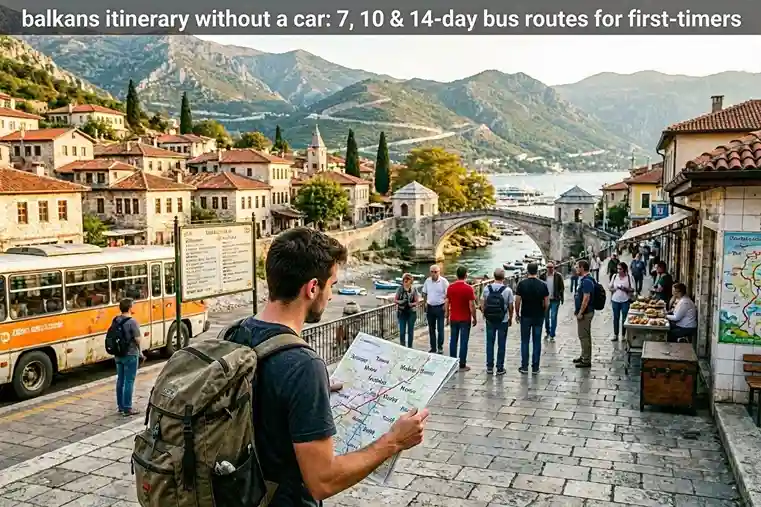
Balkans Itinerary Without a Car: 7, 10 & 14 Days (2026)

A practical Balkans itinerary without a car starts with the connections, not a list of beautiful places. You can see Serbia, Bosnia and Herzegovina, Montenegro and Albania by bus, add an occasional train, and—if you have two weeks—continue into North Macedonia. The trick is allowing enough time for mountain roads, border checks and the journey from a bus station to your accommodation.
This 2026 guide compares realistic 7-, 10- and 14-day routes, gives concrete examples of fares and journey times, identifies the terminals that commonly catch travelers out, and shows where to simplify your plan. It is based on published timetables and transport-provider information, not a claim that every service will operate on every future date.
The short answer: For one week, follow Belgrade → Sarajevo → Mostar → Kotor. With ten days, continue via Budva → Tirana. With fourteen days, consider Kotor → Shkoder → Tirana → Ohrid → Skopje, but make the Albanian Alps a separate route variation rather than an extra overnight stop squeezed into a transfer day.
Table of Contents
Choose Your Car-Free Balkans Route
| Time available | Recommended itinerary | Countries | Reality check |
|---|---|---|---|
| 7 days | Belgrade → Sarajevo → Mostar → Kotor | Serbia, Bosnia & Herzegovina, Montenegro | Three major travel legs; arrive before Day 1 and ideally fly home after Day 7 |
| 10 days | Belgrade → Sarajevo → Mostar → Kotor → Budva → Tirana | Add Albania | Budva is an overnight stop; the next morning is a cross-border departure |
| 14 days | Belgrade → Sarajevo → Mostar → Kotor → Shkoder → Tirana → Ohrid → Skopje | Add Albania and North Macedonia | Five countries, but deliberately no rushed Valbona–Theth crossing |
These are one-way itineraries. Book an open-jaw flight into Belgrade and out of Tivat, Podgorica, Tirana or Skopje as appropriate; check the final airport transfer separately. Returning to your starting city by bus can consume another full day or more.
A seven-day plan ending in Kotor assumes the last day is spent there. If your flight leaves on Day 7 rather than the following morning, shorten sightseeing or reduce a stop. Likewise, the 14-day version is best with departure from Skopje on Day 15; if Day 14 includes an early flight, finish your itinerary in Ohrid or reach Skopje on Day 13.
2026 Bus and Train Connections: Times, Prices and Station Traps
This table is the most useful planning tool in the guide. Fares and travel times are examples shown on published services in October 2026, not quotes or confirmations for future travel. Currency is as shown by the source; station charges, luggage and booking fees may be extra.
| Travel leg | Published example | Approx. fare | What to check |
|---|---|---|---|
| Belgrade → Sarajevo | Around 7–9 hours on many published daytime services | RSD 3,000–3,864 | Many services terminate at East Sarajevo, not the main city station |
| Sarajevo → Mostar | Train or bus; plan roughly 2–3.5 hours by the selected service | Compare live fares | Train frequency is limited; confirm with ŽFBH and check railway disruptions |
| Mostar → Kotor | Jadran Ekspres example: 12:30–19:50, 7h 20m | €45.50 | One date-specific direct example, not a promise of daily year-round service |
| Kotor → Budva | Frequent regional buses; often around 30–60 minutes | Check day-specific fare | Summer traffic may lengthen a short hop |
| Budva → Tirana | Old Town Travel example: 08:30–13:50, 5h 20m | €29 | Departure from Budva station; arrival at Tirana East Terminal |
| Kotor → Shkoder | Old Town Travel example: 08:00–11:50, 3h 50m | €22 | Useful 14-day route; a different cross-border leg than Budva → Tirana |
| Shkoder → Tirana | Common listings around 2 hours | About €6 average | Multiple pickup/drop-off locations depending on carrier |
| Tirana → Ohrid | Direct listings, commonly ~3 hours advertised; allow 4–5 with border buffer | About €15–17 | Many depart East Terminal; some use other stops |
| Ohrid → Skopje | Most published services approximately 3–3.5 hours | About €11–16 | Verify the exact Ohrid pickup point and Skopje station |
For an example of the station issue, Polazak’s October 2026 Belgrade–Sarajevo results explicitly identify East Sarajevo as the arrival station for several buses. Belgrade city authorities also confirm that the main BAS terminal moved to Block 42 in New Belgrade in 2024; use the current ticket address, not an older downtown station map.
You can cross-check Mostar–Kotor, Kotor–Shkoder, Budva–Tirana, Tirana–Ohrid and Ohrid–Skopje examples with Gjirafa Travel’s route listings. Their results can display a route-wide average that differs from the date-specific tickets; always prioritize the exact service, stop, fare and date shown during checkout.
7-Day Balkans Itinerary Without a Car: Three Countries
Route: Belgrade (2 nights) → Sarajevo (2 nights) → Mostar (1 night) → Kotor (2 nights). This is a brisk but defensible route if you enjoy cities and accept two long bus days. Avoid adding Dubrovnik, Theth or Ohrid this week.
| Day | Sleep in | Plan | Transport task |
|---|---|---|---|
| 1 | Belgrade | Arrival, Knez Mihailova, Kalemegdan and an easy dinner | Airport transfer; do not book a cross-border bus immediately after landing |
| 2 | Belgrade | Explore Dorćol, Skadarlija and museums | Walk or use city transport; check tomorrow’s bus station |
| 3 | Sarajevo | Belgrade → Sarajevo; light evening around Baščaršija if time permits | Choose a bus with a known arrival station; allow roughly 7–9 hours |
| 4 | Sarajevo | Latin Bridge, historic center and one museum or viewpoint | Walking/tram; avoid trying to fit every attraction |
| 5 | Mostar | Sarajevo → Mostar; Old Bridge area in afternoon or evening | Check the ŽFBH train first; use a suitable bus otherwise |
| 6 | Kotor | Mostar → Kotor; dinner and rest only | Reserve this as a full transit day; cross-border example ~7h20 |
| 7 | Kotor | Old Town, town walls or a short bay outing | Do not schedule an onward bus or flight immediately after a boat tour |
The Two Connections That Matter Most
Belgrade → Sarajevo: You may arrive at East Sarajevo bus station in Lukavica, a different location from the main Sarajevo station at Put života. East Sarajevo is not within the historic center, so budget time and money for a taxi or onward local journey. If your ticket says the central bus station, plan for that location instead. The distinction matters more than an advertised journey time differing by twenty minutes.
Sarajevo → Mostar: The scenic railway is an excellent choice when it is running at a suitable hour. Train schedules and online ticket availability have changed; review the official Federation of Bosnia and Herzegovina Railways website and current station notices. Their summer 2026 announcements described service adjustments, which is why an old screenshot is not a dependable ticketing plan.
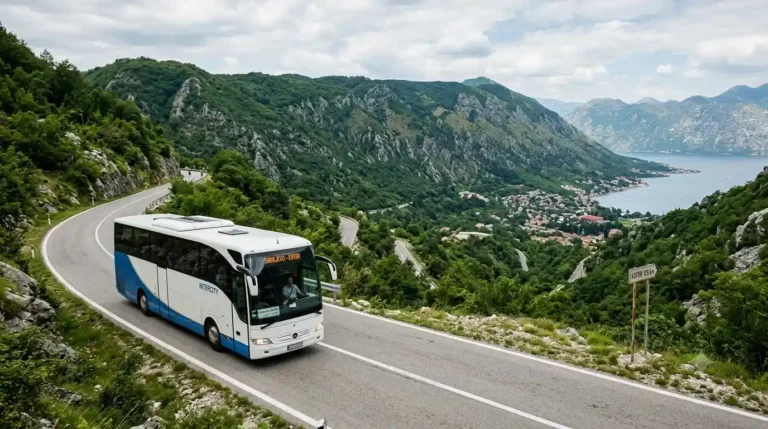
Mostar → Kotor: A published Jadran Ekspres example departs Mostar at 12:30 and reaches Kotor at 19:50 for €45.50. That leaves only morning hours in Mostar and virtually no sightseeing time in Kotor after arrival. If the service is unavailable for your date, a route via another city may require an extra night. Our Sarajevo to Kotor bus guide explains another cross-border connection, but do not assume both legs fit on the same day.
If your seven days include flights: A full sightseeing day in Kotor on Day 7 means an overnight stay after it. If Day 7 is your departure day, plan a shorter Kotor visit and confirm transfers to Tivat or Podgorica airport well in advance.
Without a car, a day in Kotor works well because the Old Town is compact. For boat trips or guided bay activities, check pickup points and weather restrictions, rather than committing to an activity that requires an uncertain bus connection.
Plan a Kotor Activity
Choose an excursion only after your long bus day is over. You can compare Kotor tours and activities on GetYourGuide.
10-Day Balkans Itinerary Without a Car: Add Albania
Route: Belgrade → Sarajevo → Mostar → Kotor → Budva → Tirana. This is the seven-day route with three additional nights, giving you a coastal stop and a practical arrival in Albania. The Budva overnight is intentional: it avoids assuming you can leave Kotor early enough to catch an international morning coach after a complicated local transfer.
| Day | Base | What to do | Travel detail |
|---|---|---|---|
| 1–2 | Belgrade | City sights and two nights | Keep one full day without intercity travel |
| 3–4 | Sarajevo | Bus from Belgrade; next day sightseeing | Verify East Sarajevo versus central arrival |
| 5 | Mostar | Train/bus; Old Bridge and old town | Check train operating status |
| 6–7 | Kotor | Cross-border bus on Day 6, full bay day on Day 7 | Reserve Day 6 for the long drive |
| 8 | Budva | Kotor → Budva; beach and Old Town afternoon | Short coastal hop; sleep near Budva bus station if practical |
| 9 | Tirana | Budva → Tirana international coach | Published example 08:30–13:50; border delay possible |
| 10 | Tirana | Skanderbeg Square, Blloku and museums | Depart the next day or leave a substantial airport buffer |
The Budva–Tirana listing showed one direct 08:30 departure at €29 for a selected October 2026 date. If that date’s direct service is unavailable, investigate a route through Shkoder or a different overnight schedule. Do not book a separately ticketed connection with a tiny gap at the international border.
Optional Door-to-Door Transfer
For a family or group with several bags, compare a private ride as an alternative to the cross-border bus: check Budva to Tirana private transfers with Kiwitaxi.
Where to Stay Without a Car
| City | Practical base | Trade-off to know |
|---|---|---|
| Belgrade | Central area with tram/bus access | BAS intercity departures are from New Belgrade, not Old Town |
| Sarajevo | Baščaršija or a transit-connected central district | East Sarajevo arrivals require a separate transfer |
| Mostar | Walking distance of the Old Bridge or a convenient route to the station | Cobbles and luggage may slow the last walk |
| Kotor | Old Town edge or near the intercity bus station | Old Town rooms can involve stairs and no vehicle access |
| Budva | Near the bus station/Old Town corridor | Some beach apartments are uphill or far from departures |
| Tirana | Central neighborhood with good access to your specific terminal | International buses may use East, South/North or another stop |
Compare Accommodation by Location
For this itinerary, a central location close to a bus connection may save more than a cheaper room farther away. You can compare accommodation on Agoda.
14-Day Balkans Itinerary Without a Car: Five Countries, No Rushed Mountain Loop
The original temptation is to add Theth, Valbona and Lake Koman on top of Ohrid and Skopje. That is not a practical default for fourteen days with the rest of this route. Instead, this version uses Kotor → Shkoder → Tirana → Ohrid → Skopje and leaves the high mountain circuit for an optional alternative outlined below.
| Day | Overnight | Day plan | Connection or constraint |
|---|---|---|---|
| 1 | Belgrade | Arrive, settle in | No intercity journey after flight |
| 2 | Belgrade | Complete city sightseeing day | Check Belgrade bus terminal address |
| 3 | Sarajevo | Belgrade → Sarajevo | About 7–9 hours, check destination bus station |
| 4 | Sarajevo | City sightseeing | Stay a second night |
| 5 | Mostar | Sarajevo → Mostar; Old Bridge | Train/bus; verify schedule |
| 6 | Kotor | Mostar → Kotor | Treat as cross-border transport day |
| 7 | Kotor | Old Town or Bay of Kotor outing | No long bus today |
| 8 | Shkoder | Kotor → Shkoder | Direct listing around 3h50 / €22, date-dependent |
| 9 | Shkoder | Rozafa Castle, pedestrian streets or lakeside outing | Flexible local day; no forced Theth/Valbona overnight |
| 10 | Tirana | Shkoder → Tirana; afternoon exploring | Often around 2 hours; check stop address |
| 11 | Tirana | Museums, Blloku, Grand Park | No cross-border journey |
| 12 | Ohrid | Tirana → Ohrid; lake walk after arrival | Direct advertised services; allow border buffer |
| 13 | Ohrid | Lakeside and historic Old Town | Full day in Ohrid |
| 14 | Skopje | Ohrid → Skopje; short city walk | Bus roughly 3 hours; ideally fly home Day 15 |
The direct Kotor–Shkoder example for October 2026 was listed at 08:00–11:50 for €22. That is materially easier than going all the way to Tirana and backtracking north. Shkoder–Tirana listings average around two hours, while Tirana–Ohrid listings contain several direct services with differing stops and travel estimates. The final Ohrid–Skopje journey commonly takes roughly three hours. Check departure and arrival locations on every e-ticket, not just city names.
A more relaxed two-week alternative: End in Tirana rather than Skopje. Use the saved four days for an Albanian Alps stay, additional time in Montenegro, or more nights in Bosnia. Fewer border crossings can make a better vacation than an ambitious five-country checklist.
Want the Albanian Alps? Swap Days, Do Not Stack Destinations
Theth and Valbona are different mountain bases. Reaching Theth from Shkoder involves a seasonal minibus or a coordinated private ride; reaching Valbona via Lake Koman involves Shkoder → Koman road transfer → Koman–Fierza ferry → Fierza–Valbona transfer. You cannot simply add a half-day “Theth or Valbona” after arriving from Montenegro and still keep the original five-country plan intact.
For example, VisitShkoder transport information publishes Shkoder–Theth minibus options and the separate ferry route. a Koman ferry operator’s itinerary shows a 06:30 Shkoder transfer, 09:00 ferry and midday Valbona arrival, subject to operating conditions. These are different logistics from a simple coastal coach.
A Feasible Four-Day Mountain Swap
- Day A: Arrive in Shkoder from Montenegro and sleep there.
- Day B: Take a prearranged morning Shkoder → Theth transfer, settle into a guesthouse and enjoy a modest local walk.
- Day C: Use a full day in Theth for an appropriate hike or village exploration, based on weather and fitness. Do not assume every trail is open.
- Day D: Return from Theth to Shkoder; continue to Tirana only if departure times genuinely align. Otherwise sleep in Shkoder.
This substitution means removing or shortening the North Macedonia extension in a 14-day journey. For the Valbona–Theth mountain pass, reserve at least a further hiking day, allow for weather disruptions, and discuss luggage and transport with your guesthouse. See our Valbona Valley hiking guide and Komani Lake ferry guide for separate planning details.
Theth: Transport and Guided Options
If you would rather organize this segment in advance, you can browse Theth tours, transfers and Albanian Alps experiences on GetYourGuide.
How to Book Buses Across the Balkans
No one booking platform reliably lists every bus in every country. A good planning method is to start with the official operator or bus station, compare booking platforms, then confirm the exact pickup stop, luggage rules, ticket format and refund terms. Some listings are direct services; others combine two operators into an unprotected transfer.
- Check the exact date first: schedules may be seasonal, and a route summary is not seat availability.
- Read both station names: East Sarajevo versus Sarajevo Main and Tirana East versus Tirana South/North are particularly important.
- Save tickets offline: confirm whether your operator accepts mobile QR tickets or asks for a printed voucher.
- Budget for bags and station charges: suitcase storage fees can be collected at boarding on some routes.
- Choose protected or generous connections: a cross-border delay can make separately booked onward tickets unusable.
- Verify bus availability before non-refundable hotels: especially for Mostar–Kotor and mountain sections.
Cross-Border Bus Search
Use it as a comparison tool, and confirm every specific journey before checkout: compare available Balkan bus routes and tickets on Busbud.
How Much Should You Budget?
There is no honest single “Balkans daily cost” covering peak-season Kotor, Sarajevo hostels, cross-border tickets and guided mountain trips. Instead, separate your accommodation/food budget from intercity transport and optional tours. The example below is an illustrative planning calculation, not an average sampled across every city.
| Budget element | Illustrative assumption | For a 10-day trip |
|---|---|---|
| Accommodation + food + local sightseeing | €40–65 a day for a solo budget traveler with hostel-style stays | €400–650 |
| Intercity buses / one train | Set aside €100–180 for the main six-city route | €100–180 |
| Local taxis, luggage, station fees | Reserve €30–70 | €30–70 |
| Optional guided tours / transfers | Not included in baseline | Add only after reviewing live prices |
| Illustrative total | Before flights and optional tours | €530–900 |
Your own trip can cost more—particularly for private rooms in coastal Montenegro in July/August—or less if you find inexpensive lodging. This is a transparent budgeting scenario, not a promise of nightly prices. The sample Belgrade–Sarajevo ticket is often quoted in Serbian dinars, and exchange rates will affect its euro-equivalent cost.
Border Rules, Cash and Practical Details
These itineraries cross national borders outside the Schengen area. Do not assume a visa for one country automatically grants entry to another, and do not apply a single nationality’s visa-free rules to all readers. Check your passport’s rules individually using the destination government or consulate. Montenegro’s official entry and exit guidance and Montenegro’s visa information provide a starting point for that part of the route.
Travelers also need to plan currency. Montenegro uses the euro, Albania uses the lek, Bosnia and Herzegovina uses the convertible mark, Serbia the dinar and North Macedonia the denar. Card payment is widespread in many cities, but carry small cash for local buses, station fees, mountain transfers and small cafés. International roaming coverage varies; download offline city maps and ticket screenshots before border crossings.
Special case: Serbia and Kosovo: If you decide to insert Kosovo into the route, check the current Serbia–Kosovo entry/exit situation for your nationality and travel direction. This guide’s main 7-, 10- and 14-day routes deliberately avoid using Kosovo as an assumed shortcut.
Common Mistakes That Make Car-Free Travel Harder
- Confusing destination names with station names. East Sarajevo can add a separate city transfer.
- Assuming a scenic train runs every day. Verify the Sarajevo–Mostar timetable with ŽFBH.
- Calling every route “direct.” Read the ticket for operator changes, intermediate transfers and stations.
- Using a late arrival as a sightseeing day. Mostar–Kotor is an entire travel afternoon and evening on the published example.
- Adding Theth or Valbona as a one-night afterthought. Mountain transfers and hiking conditions require their own days.
- Changing hotels for a short day trip. Budva can be visited from Kotor; only switch hotels when it serves the onward route.
- Booking the flight for immediately after a long international bus. Stay near the departure airport the night before when possible.
- Forgetting exact baggage and cancellation rules. A cheaper ticket can be less flexible or require an extra suitcase payment.
Which Route Is Right for You?
| Traveler | Choose | Why |
|---|---|---|
| First-time visitor with one week | 7-day Serbia–Bosnia–Montenegro | Best-known stops, three countries, minimal detours |
| 10-day city + coast traveler | 10-day route ending in Tirana | Adds a manageable coast-to-Albania link |
| Two-week traveler wanting variety | 14-day route via Shkoder, Ohrid and Skopje | Five countries if you accept several transport days |
| Hiker / nature-first traveler | 14-day route ending in Albania | Swap North Macedonia for a proper Theth or Valbona stay |
| Traveler who dislikes buses | Smaller regional loop or a train-focused route | Avoid pretending international railway connectivity is seamless |
For a different approach, compare our Balkans itinerary by train. Rail-focused travel requires a different route design; simply changing every bus in this itinerary to a train will not work.
Frequently Asked Questions
Can I really visit the Balkans without renting a car?
Yes. Intercity buses connect the cities used in these itineraries, and selected trains, local buses and minibuses fill some gaps. You will have to plan more carefully than on an all-high-speed-rail trip, especially at borders and in mountain areas.
Can I visit five Balkan countries in 14 days?
It is possible with this west-to-southeast route, but several days are primarily for travel. If you want proper mountain hiking, a more relaxing option is fewer countries and more nights in one area.
Should I choose Kotor or Budva as my base?
Kotor makes more sense for the historic bay, short boat outings and walking. Budva is useful for beach time and—as shown in the 10-day route—can be a convenient overnight before an early coach to Tirana. You can also visit Budva from Kotor without changing hotels if the schedule allows.
Is it possible to see Theth and Valbona in two days?
It is not a sensible default for a public-transport first-timer. Reaching Valbona via Komani involves several coordinated legs; the hike between Valbona and Theth is a separate mountain day and depends on weather and trail conditions. Allocate more time or choose one valley.
Do I have to book all buses before I leave home?
Not necessarily. Secure the infrequent or essential cross-border legs first, particularly Mostar–Kotor, and arrange mountain transport ahead. Regional hops sometimes allow local purchase, but verify availability if your dates are inflexible.
What is the single biggest station mistake?
Treating “Sarajevo” or “Tirana” as one stop. Check whether Sarajevo means the main station or East Sarajevo, and whether Tirana means East Terminal, South/North Terminal or a named street pickup. They are not interchangeable.
Final Recommendation: Plan Around Connections, Not Country Counts
For most travelers, the best Balkans itinerary without a car is the one that spends the least time fixing missed connections. Choose the 7-day Serbia–Bosnia–Montenegro route for a short first trip. Add Budva and Tirana for ten days. With fourteen days, either continue to Ohrid and Skopje or devote several proper days to the Albanian Alps—not both at full depth.
Before paying for hotels, verify the day-specific international services, departure stations, border documentation and airport transfer. Once the difficult links are secured, keep sightseeing flexible and enjoy the towns rather than racing between them.
Source check: Transport examples and station information above were reviewed against Polazak, Gjirafa Travel, ŽFBH, Belgrade city information, VisitShkoder, Komani ferry operator details and Montenegro government guidance in October 2026. Individual ticket availability, weather and entry rules must be rechecked for the exact trip date.